Accolades for the Memo: A deep dive into the two-tier education system pushed by Dunleavy
My long-running streak of haplessly submitting my work to annual awards has come to an end.


Hello Alaska!
I wanted to share a belated announcement that my long-running streak of haplessly submitting my work to annual awards has come to an end.
At last month's annual conference of the Alaska Press Club, I took home the first-place Leslie Ann Murray Award for Best Editorial or Commentary and second-place Suzan Nightingale Award for Best Columnist. The piece at the heart of both awards was March 2025's deep dive into the education policies that Republican Gov. Mike Dunleavy, a longtime proponent of funneling public school funding into selective and lightly regulated programs, was proposing and how they stood to worsen existing disparities in education policy.
The fight over education policy – namely, who gets what – is far from over, and even though this deep dive is more than a year old, it's still relevant, so I've republished it in full below, without a paywall.
The push to selectively invest in programs for kids who come from families with the means and desire to take advantage of them hits close to home. I grew up painfully aware that not everything was for everyone, but I saw firsthand just how much public schools can cut across whatever situation a kid comes from. I believe public schools should focus on providing opportunities to everyone because, for some, it might be the only opportunity they're guaranteed in life. Schools will never be a perfect leveler of the playing field – the best advantage in life will always be being born into wealth and opportunity – but Alaska's public education policy shouldn't make it worse. And, just to be clear, it's not that those with opportunity shouldn't have more, but that all should have some.
Thanks to your support – especially to those who helped me through many drafts – I was able to spend extra time drilling down into an issue I care deeply about and build a case that the judge said was written "clearly and with relentless logic." And that my "moral indignation at the inequities... is all the more powerful for (his) restraint in expressing the same."
Thanks, sincerely,
Matt Acuña Buxton
Current mood: 🙂
Let's be honest. Dunleavy's proposing a two-tier education system.

Originally published May 3, 2025.
The first month and a half of Alaska’s legislative session has painted a grim and frustrating picture surrounding public education. A newly elected set of bipartisan majorities is looking to break through nearly a decade of status-quo indecision that's starved Alaska’s public schools to deliver a massive boost to education funding. Still, that effort faces two significant challenges: Alaska’s ongoing financial woes and Gov. Mike Dunleavy’s stubborn efforts to leverage much-needed funding for a slate of less-than-popular policy changes.
Dunleavy and his allies have screeched against any effort to increase the state’s per-student funding formula, arguing that they need to see accountability and reforms before they throw schools a much-needed lifeline. We heard many Dunleavy Republicans make that case two weeks ago when the education bill, HB69, cleared two committee assignments, and will likely hear more of it on the House floor before the vote.
As legislators have unpacked Dunleavy's way, it’s become apparent that it continues the state's path toward a two-tier education system. As a renewed lawsuit challenging the seemingly unconstitutional exploitation of the state's homeschool allotments shows, the public education system under six years of Dunleavy delivers vastly inequitable student opportunities.
I think it's critical that we understand where the governor's policies are leading us before we get mired in hollow talk about test scores and flawed studies.
Behind all the rhetoric that neighborhood schools must do more with less, what Dunleavy proposes is a system that funnels what little funding he will support to the few — while leaving everyone else to fight over the scraps.
Let’s take a deep dive.
We didn't get here by mistake
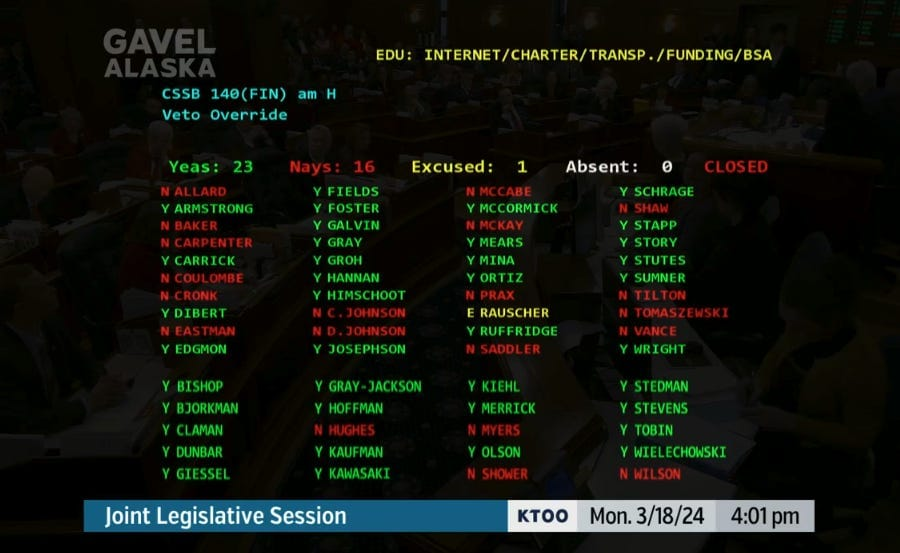
Last March, the legislature overwhelmingly passed Senate Bill 140, a historic education measure, with just three no votes. Even though it was the most significant single increase in funding in state history, it still fell well short of what many districts needed. Cuts and shuttered schools were still expected, but fewer than the alternative. Many remained cautiously optimistic that the bill would at least help stop the bleeding — the bleak drumbeat of shuttered schools — and give teachers room to breathe.
But not Gov. Mike Dunleavy, who vetoed the bill.
Even before his veto, the governor began twisting arms among legislative allies to prevent a veto override (which needed 40 votes out of the initial 56 yes votes) with rumors of improper political pressure and promises. The override failed by a single vote. Some who had previously voted for the legislation switched their vote, insisting it was the plan all along.
Dunleavy was never subtle about his intention to spike the bill. In fact, the real drama centered not on whether he’d veto the measure, but whether he could stop the override. It was one of the most high-tension votes in recent political history, and helped mobilize a shift that elected bipartisan coalitions to both houses in a year when Trump won nearly 55% of the vote.
With the veto sustained, lawmakers scrambled to put together last-minute temporary legislation so schools around the state could limp along for another year.
It’s a situation that has left districts throughout the state in a fog of uncertainty and ever-rising costs while flat funding and inflation — that pesky thief in the night — are eating a generation's future for lunch.
The situation — a starvation diet for most
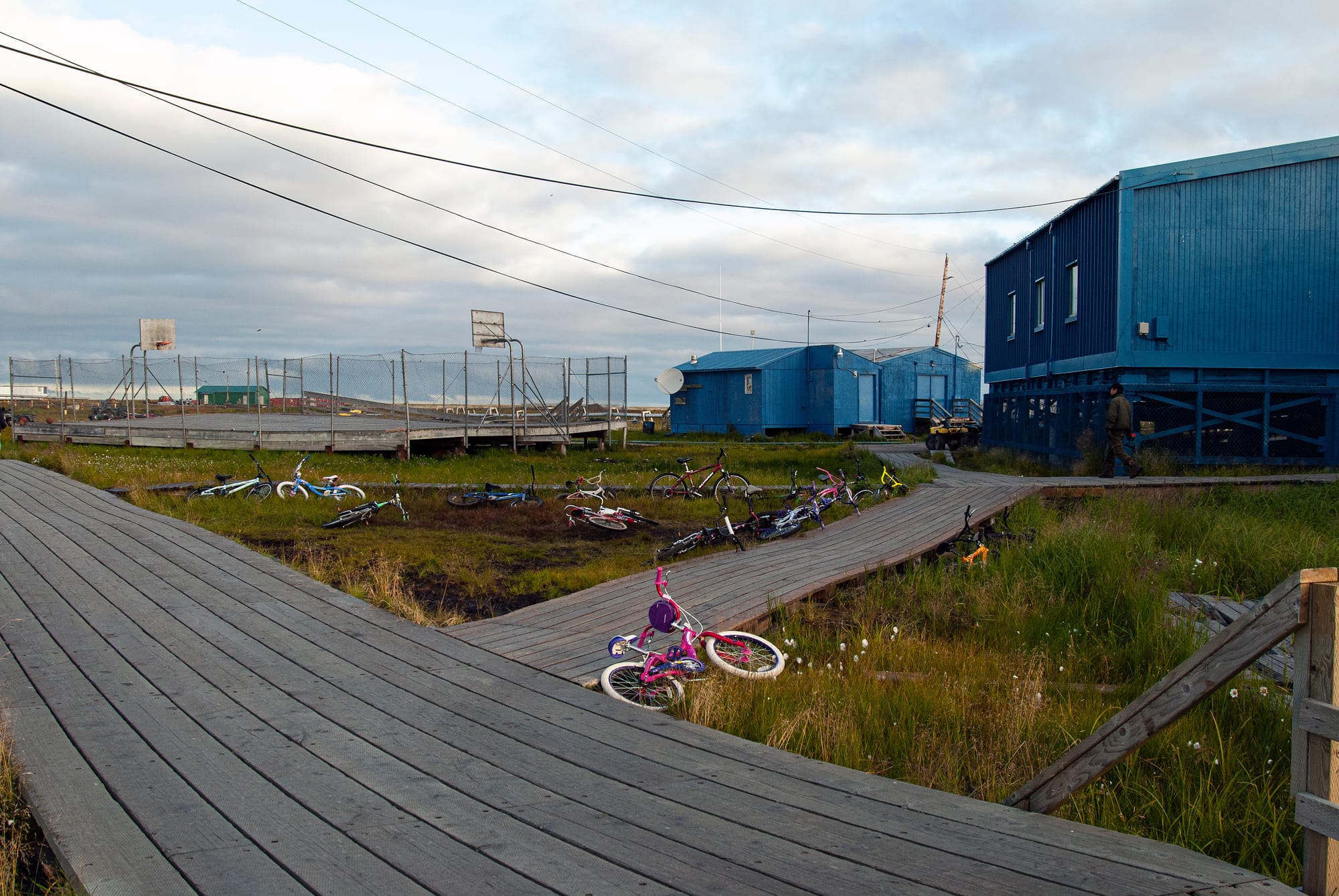
This year, the expiration of last year’s one-time stop-gap education funding looms large alongside Dunleavy’s radical demands that are doggedly rolling back into the mix. Meanwhile, financially hamstrung school districts face even more school closures, escalating teacher shortages, ballooning class sizes, and the wholesale slashing of entire school programs statewide.
“We have trimmed the fat. We have cut into the flesh, and we are beginning to cut the very bones of the district," Fairbanks school board member Bobby Burgess told a joint education committee hearing during the Association of Alaska School Boards' fly-in in February.
The pain has far-reaching implications to the state’s desirability and workforce readiness, all factors that undercut the economy. Study after study has also shown that increased educational investments lead to lower crime rates later in life.
The Legislature’s education committees have been inundated with heartbreaking stories from students in stretched-thin neighborhood schools.
But even in the dark spots, Alaska’s neighborhood schools are still delivering for students as best as they can, given everything. Among much of the doom-and-gloom testimony, there are many bright spots and stories of students whose lives are better because of the care and attention they find at their neighborhood schools.
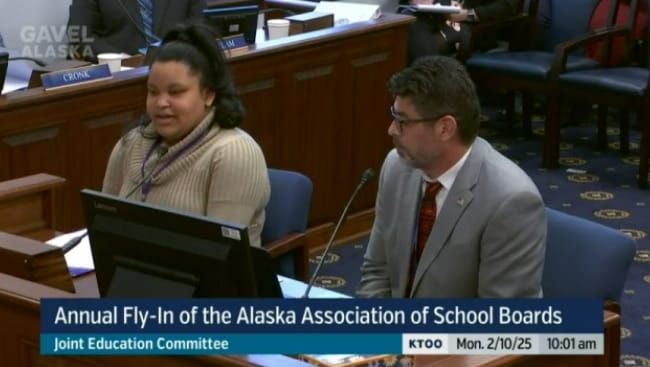
“People will forget what you said and people will forget what you do, but people will never forget how you made them feel,” said Reese Taylor, a student in the Annette Island School District, at the school board fly-in. “Personally, I like to say how my school district made me feel from the first day as a student in a new school. I feel accepted, loved and welcome to be myself. I believe that’s a direct result of teachers who were made to feel safe, important, supported and empowered to give the best of themselves in order to create that same environment for their students.”
At the news conference rolling out his education bill, Dunleavy insisted that the alarm over closing schools was overblown.
“You just don’t need as many schools,” he said, pointing to declining population numbers.
But his insistence that the crisis just can't be helped flies in the face of head-turning increases to other parts of the budget under the Dunleavy administration. Budget hearings earlier this year showed that $280 million of the $317 million in growth over the past 10 years has gone to prisons and troopers.
Meanwhile, school funding fell by $62 million over that period, or about 5%. When factoring in inflation, it’s a loss of nearly $420 million in buying power.
Rep. Rebecca Himschoot, I-Sitka, emphasized similar points with her HB69, which would immediately boost K-12 funding by more than $360 million annually. The bill would also increase funding for the following two years, and thereafter link the BSA to inflation.
And don’t let Dunleavy Republicans fool you. While Alaska spends a lot of dollars per student compared to the rest of the country, that comparison neglects crucial context, as was explained by Dayna Jean DeFeo, director of ISER's Center for Alaska Education Research, at a hearing last week.
According to her breakdown, Alaska’s raw dollars may paint a good picture of the state funding schools at 29% above the national average. However, when you factor in the cost of living in Alaska and communities beyond Anchorage, it drops to 15% below the national average. The same goes for teacher compensation, where nominal dollars put Alaska ahead of the nation, but when adjusted for costs, drops to about 25% below the average.
Not-so-‘honest’ conversations
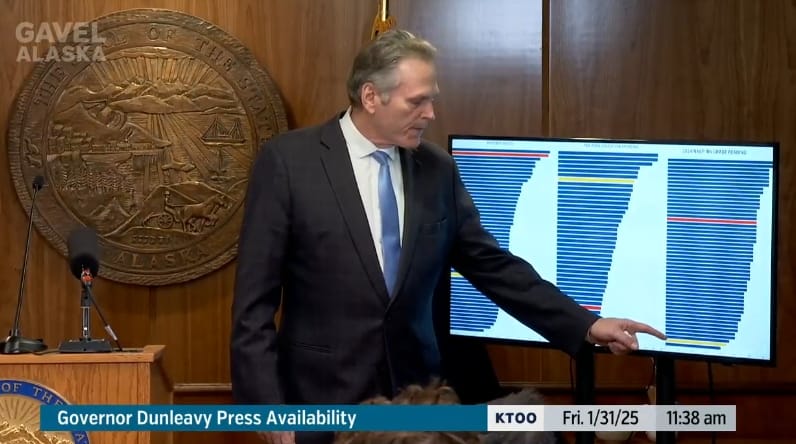
Meanwhile, Dunleavy continues to pretend public education’s problem isn’t about money-starved schools but about poor student performance and nefarious “special interests” (code word for teachers), which he insists cannot be fixed with more funding. Instead, Dunleavy remains stubbornly committed to far-right catchphrases like “accountability” and “school choice,” policies that he’s used to justify outsized attention on a fraction of students participating in homeschool programs and charters. There, he insists, is where improved outcomes will come from.
“If these scores don’t motivate the discussion about policy, I don’t know what will, to be honest with you,” Dunleavy said at a recent news conference while pointing at a chart of National Assessment of Educational Progress (NAEP) scores.
But Dunleavy’s proposed policies, by design, will not help all students.
Far from it.
The governor has proposed only about a third of the education funding as the leading proposal in the state House, and none of it would flow through the base student allocation. His proposals — which the Democratic, independent and moderate Republican legislators who make up the Legislature’s two coalition majorities have already soundly rejected — would direct money toward boosting funding for homeschool students and throw the doors wide open on public charters, granting a state board appointed entirely by him the power to foist new charter programs on unsuspecting school districts.
For example, a whopping 40% of the governor's proposed increase to education funding — $75 million — would flow directly to state homeschool programs that serve just 17% of all Alaska students.
As the lawsuit challenging homeschool allocation spending lays out, Dunleavy's relaxed oversight on allocation funding has meant that a not insignificant number of homeschool students are receiving public funds to attend private or religious schools. Some homeschool programs allow families to use public funds to pay private-school tuition, while others have permitted private-school students to enroll in homeschool programs using public money to pay for extracurriculars.
So, while neighborhood school students face increasingly cramped classrooms, the state has allowed some Alaskans to bankroll their children’s extracurricular activities, including horseback riding and dance lessons, with public education dollars.
To be clear, the Alaska Constitution clearly states that this type of activity, funnelling public funds into private and religious schools, is prohibited. The general public is also not on his side, either. Alaska voters resoundingly defeated Dunleavy’s constitutional convention push in 2022, while voters in several other states have rejected or reversed similar practices because they favor the well-off over the many with little accountability or results.
And one of the most glaring holes in the governor’s demands is that for all the accountability Dunleavy demands from neighborhood schools, homeschool and charter school students opt out of testing at a far higher rate. Only about 14% of homeschool students participate in testing, leaving us with little certainty on how they are actually doing, and invites other “school choice” advocates to cherrypick datapoints to support their positions. Graduation rates are similarly poor compared to traditional schools.
Taken in total, all the governor's talk about investing in "proven" results essentially translates into investing into programs that serve just a segment of students — students, who, as I'll lay out in the next installment of this deep dive, also are typically more wealthy and less diverse than those in neighborhood schools — while everyone else is condemned to operate on a starvation diet. This is a movement reflected in right-wing talks about "parental involvement," "school choice" and culture war hysteria that allow and encourage wealthier, whiter families to abandon neighborhood schools.
The flaws in Dunleavy's two-tier education system are obvious and many

Originally published May 4, 2025.
In a bit of fortuitous timing, the Senate Education Committee held a hearing on the governor's education bill, Senate Bill 82, on Monday that went a long way toward illustrating just how unserious and poorly justified the policies are.
Legislators zeroed in on the $75 million the governor wants to add toward homeschool funding, with many thoughtful concerns about accountability given the fact that more than 80% of homeschool students opt out of testing. Committee Chair Sen. Löki Tobin brought up a good point about how the Alaska Constitution requires the state to provide a quality education to all students, and we can't really say we're meeting that constitutional duty when just a fraction of students are testing.
Education Commissioner Deena "AI Did My Homework" Bishop gave characteristically vague and specific-free answers. She said she heard from some programs that they knew the testing results would be higher if everyone just tested. Low graduation rates, she claimed, are because some districts are pushing kids with chronic absenteeism and other learning challenges into homeschool programs. She couldn't even justify the need for funding — the testimony of two homeschool programs said they already break even, or better. They're not facing the same funding crisis as everyone else.
"We just want to ensure that our children are valued in our public education system," she finally said about why Dunleavy wants to put 40% of his proposed additional funding into homeschool programs that serve about 17% of Alaska's students.
So, vibes.
While all the talk of anecdotal success stories and parental involvement may be good for those who can take advantage of it, it was hard to overlook the kind of educational system everyone without engaged parents and the means to take advantage of these programs is left with. Bishop continued to defend the lack of funding for an increase to per-student funding through the base student allocation, arguing that targeted investments are more appropriate — even if they are already doubling down on a system that, by most accounts, isn't facing a funding crisis.
Sen. Tobin was blunt in her assessment of Bishop and Dunleavy's positions.
"$75M to correspondence programs but none to our schools like Sleetmute, which is currently condemned and students are learning in a condemned environment," Tobin said. "Good to hear."
As the hearing laid out, the governor's legislation would leave most students out in the cold in educational environments that are both figuratively — and literally — condemned. Let's continue to break down the flaws in his claims, particularly around charter schools, and how legislators are holding the line for equity in education.
More nuanced understanding of why charters do 'well'
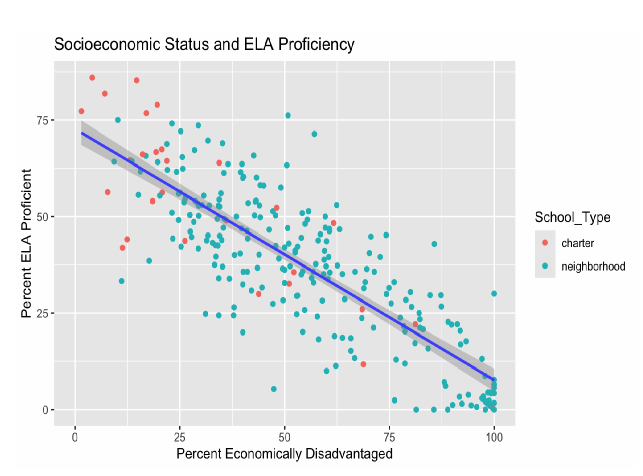
A fascinating study by Fairbanks educator Beth Zirbes and Mike Bronson, a Ph.D. who volunteers for the Anchorage NAACP, adds much-needed context to the governor’s repeated refusal to abandon his specious Harvard study that he and supporters insist proves Alaska's charter schools are the best in the country (mainly ignoring the fact that it's the current system that played into those results and many states that are lagging well below Alaska are essentially the wild west of unregulated charters).
Zirbes and Bronson also note that the Harvard study's author, Paul Peterson, is a long-time proponent of school vouchers and wasn’t particularly forthcoming about the study's inner workings, such as which charters he pulled for comparison. Zirbes and Bronson also point out that the Peterson study compares Alaska’s charter system to other states, not to peer neighborhood schools.
And it certainly doesn’t consider students’ socioeconomic status.
Doing their own work, Zirbes and Bronson's study reveals that charter schools are not nearly as rosy an indicator of educational success as Peterson’s study purportedly found, nor as exaggerated and misleading as Dunleavy’s claims.
Instead, students who perform better in charters do well academically largely because they come from wealthier, better educated, whiter families than the general population. They found that socioeconomic status — measured by the number of students on free and reduced lunch — is a far more accurate predictor of student outcomes.
“In short, the answer is no, charter school students likely do not perform better than neighborhood schools, after accounting for characteristics of students,” write the co-authors, noting a fairly linear connection between academic performance and the overall family wealth of the student body.
According to Zirbes and Bronson, factors like chronic absenteeism, language barriers, and special-education needs also play a role. Charters can typically filter out those issues, while neighborhood schools cannot.
“While these latter variables are statistically significant, school type never is,” the co-authors assert.
“We discovered that charter schools, on average, have very different student bodies than neighborhood schools. For example, charter schools have far fewer economically disadvantaged students and English language learners,” explain Zirbes and Bronson. “Furthermore, not only do charter school students in Alaska differ from neighborhood school students in Alaska, Alaska charter students are also whiter and richer than other charter students in the Lower 48 states . . . Alaska charter school student bodies look like private schools in the Lower 48 states more than they resemble charter school students in the Lower 48.”
The path ahead — a rising tide lifts all boats

Luckily, not everyone sees the world of public education like Dunleavy and Bishop do.
As Anchorage Rep. Alyse Galvin pointed out in a budget subcommittee hearing, targeted funding may provide opportunities to roughly 23% of charter and homeschool students, but what about the other 76% of Alaska's students in neighborhood schools?
"There has been so much talk about all of the things that we get to offer in our specialty schools, whether it's charter, whether it's homeschool, whether it's wherever else ... but in our neighborhood schools, which is serving more than 70% of our students, it seems to me that we need more opportunities like what's offered (to the 23%)," she said. "I like to think that we provide our opportunities to all students."
She said everything from job-readiness programs and coding classes to extracurricular activities is essential for today's young people, but not everyone has the same ability to homeschool students or attend public charter programs. While public charters cannot charge students tuition, they aren't required to provide basic services like transportation or meals and also can require a not-insignificant amount of parent volunteer time.
Volunteer time requirements "are not possible in these neighborhood schools that are serving 70% of our families. Those families are very, very busy," Galvin said. "In my mind, we'll have to shrink up the classes, we'll have to have teachers with more capacity to engage with families. ... I just want to be sure we're thinking about how can we invest in a way that will bring those opportunities to these families that I believe have a wish for (them), too."
Senate Majority Leader Cathy Giessel, R-Anchorage, recently relayed sentiments from a second-grade student's letter to her office during a Senate floor speech. The little girl described trying to learn in ever-larger class sizes, with her growing class not having enough room on the rug for storytime.
Giessel said it’s unthinkable for Alaskans anywhere to be OK with that.
“It brought tears to my eyes to read that Holly wrote that there’s not enough room for some of the kids on the rug,” Giessel said. “Holly and I are thinking about those kids for whom there is no room. What does it feel like to be a kid in a classroom, trying your best to learn, and there’s no room for you? No one should be left out because there’s no room for them on the rug or at the teacher’s desk.”
As Alaska lawmakers negotiate with the governor on education funding, Giessel recalled an old saying she believes should guide the legislature’s work.
“Our children are the living messages that we send to a future that we will never see,” she said. “What is the message that we are sending to the future through the children today who are in our classrooms?”

The Alaska Memo Newsletter
Join the newsletter to receive the latest updates in your inbox.