Even at its second-most volatile point, Alaska can't quit oil
Ultimately, forecasts are just forecasts, and as House Majority Leader Chuck Kopp joked on the House floor on Monday, "the sole purpose of oil price forecasting is to make astrology look respectable."

Hello, Alaska!
In this edition: The train has left the station, and Alaska is going for another ride on the oil price roller coaster. With oil about as volatile as it's ever been, the latest spike in oil prices has legislators reworking their plans for covering this year's unexpected costs. But with attitudes ranging from cautious optimism to near-giddy abandon, that money's not exactly bringing much clarity to the situation. Also, the reading list.
Current mood: 🤔
Programming note: Sorry for the spottiness lately, I've been working on a big project that we should be able to announce shortly.
Even at its second-most volatile point, Alaska can't quit oil
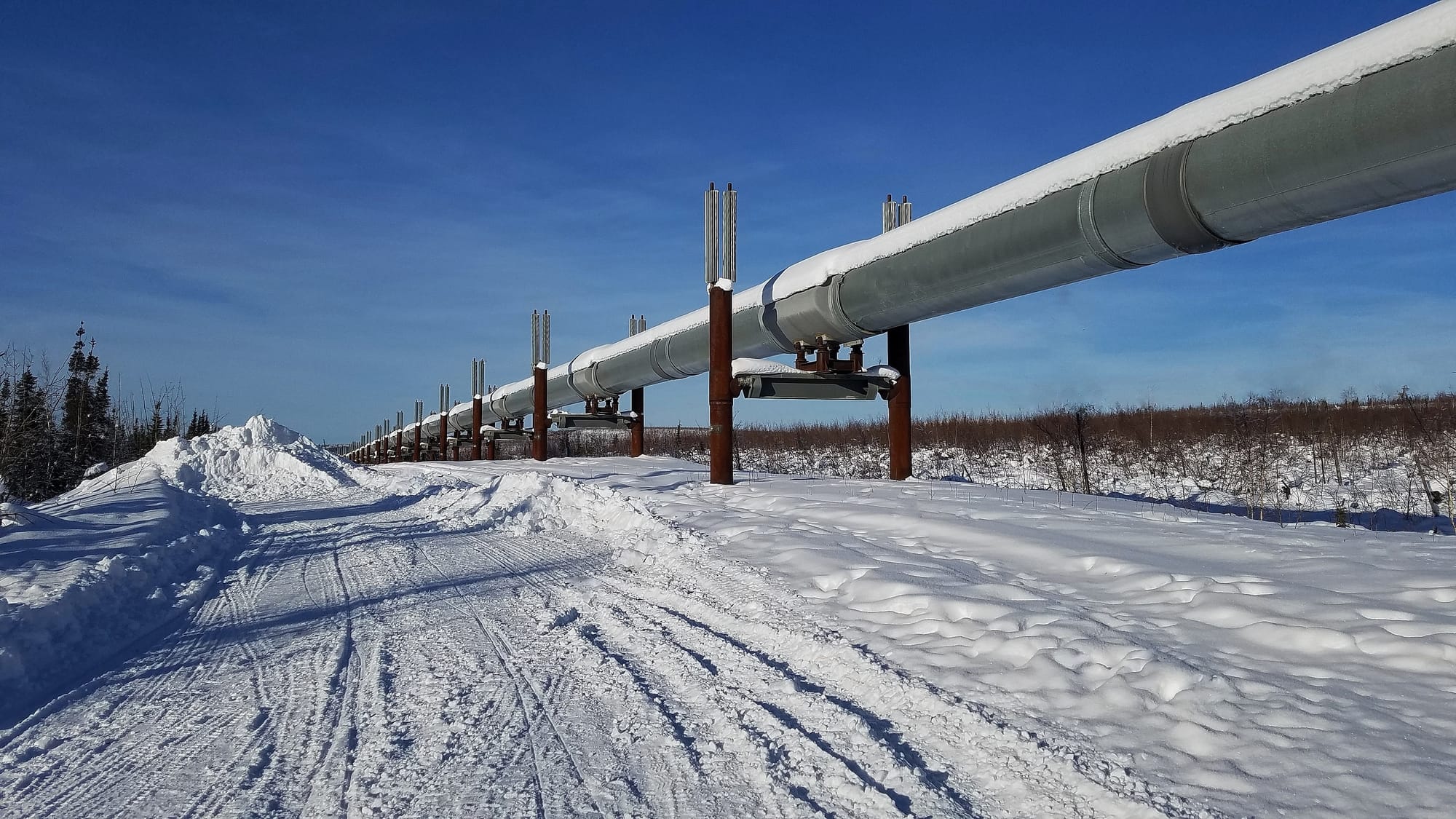
Trump’s war with Iran will probably drive up Alaska’s oil prices by just enough that it will probably take care of the state’s most pressing budget issues, probably.
That seems to be the take from the Alaska Tax Division, which last week released its spring revenue forecast as the war enters its third week of disrupting the global oil market and economy. The forecast predicts prices will average about $91 per barrel of oil for the current budget year that runs through the end of June, which is far shy of the $105 barrel that the Legislative Finance Division had suggested would be needed to balance the budget, but oil isn’t the forecast’s only driver.
Chief Economist Dan Stickel told legislators during overview hearings on Monday that the state also benefited from higher-than-expected corporate and property taxes – largely driven by activity in the mining industry. On paper, the new revenue is enough to erase the deficit for the current budget year and cover the roughly $500 million in additional expenses incurred since last year. That includes funding to cover the state's disaster response and fire suppression, meet the federal highway match for this summer's construction season, refill the state's scholarship fund, and cover overruns in the prison system and other areas.
But the key phrase is "on paper."
“Looking forward, there is a tremendous amount of uncertainty … Uncertainty has really been the story,” Stickel told the Senate Finance Committee on Monday, pointing to an oil price volatility index that put the current situation second only to the COVID-19 pandemic, which is when oil dipped to negative. “The level of uncertainty around future prices in the oil markets now is higher than during the peaks of the Great Recession, and it's higher than when Russia invaded Ukraine.”
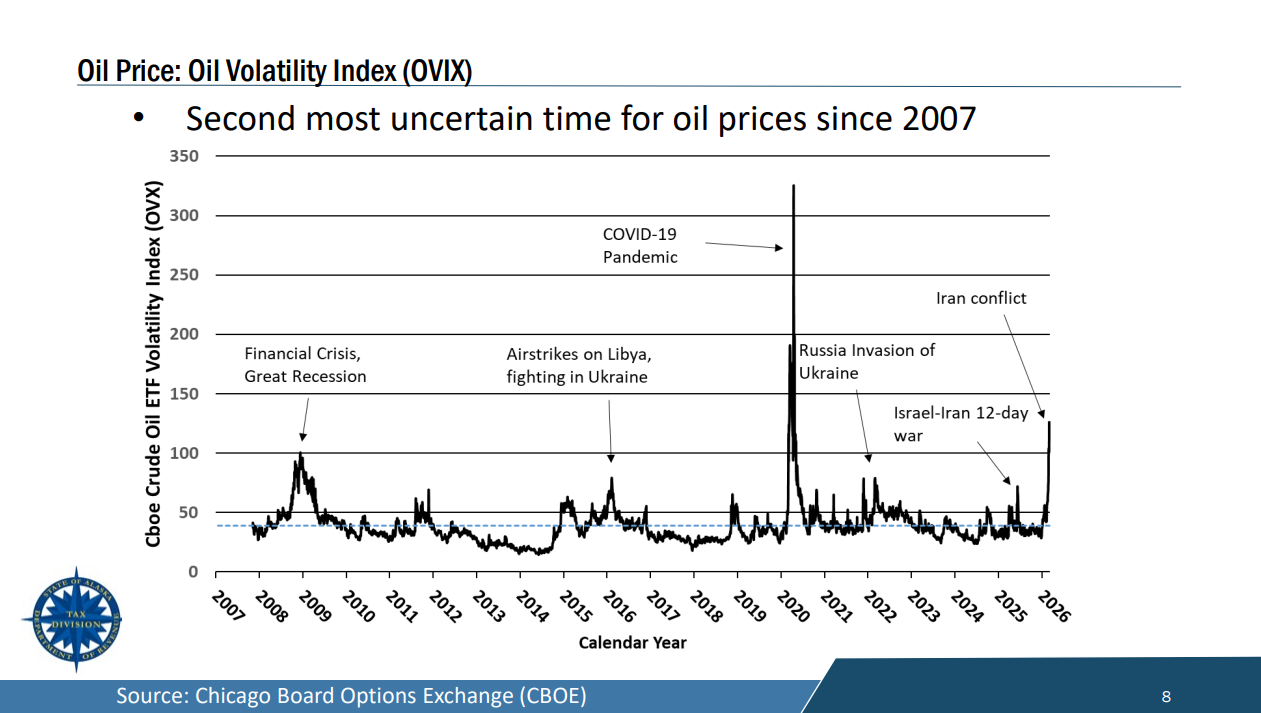
Ultimately, forecasts are just forecasts, and as House Majority Leader Chuck Kopp joked on the House floor on Monday, "the sole purpose of oil price forecasting is to make astrology look respectable."
And Stickel's presentations illustrated just that, giving legislators a range of possible outcomes on oil prices that would swing the state's revenue picture by massive margins. The difference between a bottom 10% outcome (oil averaging below $40 a barrel) and a top 10% outcome (oil averaging above $140) for the remaining four months of the state's fiscal year, for example, equates to a roughly $1.5 billion swing in revenue.
The volatility ahead for next year's budget is even greater, with the revenue difference from those high- and low-price swings totaling $3.5 billion.
A $1 shift in the per-barrel average for the remainder of the fiscal year equates to a roughly $15 million difference, Stickel told legislators. And prices are fluctuating by $5 or $10 a day as markets grapple with the latest twists and turns of the war.
It’s with that uncertainty in mind that House and Senate Majorities have pushed to balance the current year’s budget with a draw from the Constitutional Budget Reserve, which requires a supermajority in each chamber. They argue that while the forecast is good news, they'd rather have the certainty that these critical bills are paid without having to obsessively watch the oil price ticker.
While the Senate secured that vote last week in a deal with the GOP Minority (it's worth noting Sen. Lyman Hoffman said on Monday that, in light of the news, they could have done a smaller draw), it’s been a different story in the House.
There, Republicans have been nearly giddy over the war with Iran, arguing that the surging oil prices mean there’s no need to tap into savings.
"The thing that we're not talking about here today is the fact that we have been blessed in this state,” Soldotna Republican Rep. Justin Ruffridge said during last Thursday’s debate on the supplemental budget, when Republicans first blocked the CBR vote. “We have been blessed right now with the ability to look a little bit into the future, that's going to happen tomorrow (when the revenue forecast is set to be released), potentially, and notice that we have an additional amount of revenue that we have to spend. How incredible is that?”
Others have suggested that it’s a reason to pump up the dividend.
Either way, the Republican reluctance to secure funding for the supplemental budget has forced lawmakers to recalibrate their plans. Rather than send the budget to a conference committee over the failure to fund it, they sent the bill to the House Rules Committee, where it is currently parked.
Ruffridge and his fellow members of the Republican Minority Caucus stood by their position on Monday, arguing that everyone has already seen enough to know that they're in the clear and that there's nothing left to debate. They tried, and failed, to discharge the bill from the committee.
"I don't know why it would be no (to advancing the bill without the CBR funding)," he said. "It's something that we all agree on. It's something that we have money to do. It's something that the executive has asked for. What is the hesitation? I genuinely don't know. ... I understand that maybe there is a volatility question, but that question, I think, our revenue forecast answers very directly."
To be clear, the revenue forecast's executive summary says the state is in a period of "historically high uncertainty" and that "at this point, it is looking like the state may receive a temporary windfall from higher prices" but that "oil prices over the next year could be materially higher or lower than the official forecast."
Ruffridge also claimed that the Dunleavy administration had informed him that the state's general fund account has ample funds to cover the supplemental budget (what this would mean for the state's other expenses, which still need to be covered, is unclear). But that information, like pretty much any communication out of the executive branch, seems to have been conveniently only shared with Republican legislators, leaving the majority having to take their word for it.
To the majority, it's just another layer of uncertainty on a situation that's already too uncertain for their liking. Majority Leader Kopp said that legislators are still struggling to get firm answers about the supplemental budget. For example, while the construction industry has raised alarm over the $70 million highway match, the Department of Transportation has approached it with far less urgency, suggesting that the funding could be secured as late as July 1.
"I would also note that this body has suffered from a dissonance in messages heard by different members about the reliability of the money that we have in our account today, versus the necessity of taking a savings draw. Also, the position of the administration has changed from the very beginning of the session (on the urgency of the highway funds),” he said, arguing that delaying the bill would hopefully provide answers. “Is the money presently available, or is it not? Do we need a secure funding source, as it came to us from the Senate, or do we not?”
Ultimately, the Republican resistance to securing funding for the supplemental budget is effectively a win-win for them. Either they're right and, as Ruffridge suggested, "we all ride off into the sunset and pat each other on the back and say, good job," or they're not, and they still have their CBR vote as leverage over the rest of the legislative session.
Stay tuned.
Reading list
 Liz Ruskin
 Shelby Herbert
 KTOO | By Alix Soliman
 Anchorage Daily News
 Iris Samuels

The Alaska Memo Newsletter
Join the newsletter to receive the latest updates in your inbox.