'Delicate balance' election bill clears the House, on track to pass the Legislature
Oil price certainty is in the eye of the beholder. Bipartisan election bill passes with technically bipartisan support. Legislators get some big, bad numbers for rising health care costs.


Hello Alaska! It's Day 64 of the session. Let's finish this strong (well, stronger).
In this edition: Oil prices tipped down on Monday as Trump backed down from his threat to harshly escalate his war with Iran, just as legislators were reworking the supplemental budget to account for the windfall of revenue. Meanwhile, a carefully crafted election bill – delivering ballot curing, tracking and a handful of other updates ahead of the 2026 election – passed out of the House with less bipartisan support than one might expect from such a painfully compromised bill. Also, a peek into some pretty troubling health care numbers and the reading list.
Current mood: 🌞
🎙️News! As Pat Race and I dawdle our way to the 100th episode of our hobby podcast, Hello Alaska!, we're super excited to announce that it's probably not going to be a hobby all that much longer. Hear more about it in Episode 95 – Ride the Roller Coaster – and stay tuned for some quick-hit one-offs as we ride to Episode 100 and onto something a little (a lot (like a lot a lot)) more professional.
Supplemental budget advances, but oil price high has some legislators thinking differently
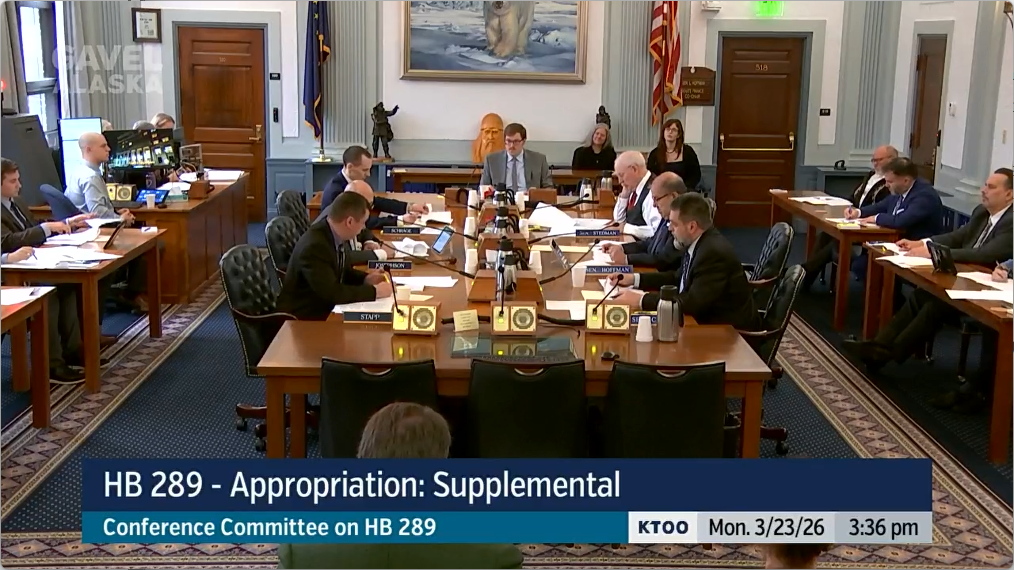
Legislators on Monday took another crack at crafting a supplemental budget – covering some $500 million in expenses that went unaccounted for in last year's budget, like $75 million for Typhoon Halong and other disasters, or are the result of cost overruns, like $24 million of mostly overtime costs in the prison system – but it's still not clear there's enough support as House Republicans hold fast to their position that Trump's war with Iran has been a cureall for the state's budget woes. With oil taking a haircut on Monday's news that Trump isn't igniting the next world war, at least for now, legislators advanced a new compromise on the supplemental budget that would limit the much-debated three-quarter vote for the Constitutional Budget Reserve – the how-we-pay-for-it part of the bill. Rather than making the direct transfer out of the fund to cover the disaster relief, fire suppression and the $70 million in federal highway match as well as refilling the Higher Education Investment Fund (the scholarship-funding endowment that unfortunately seems to be the easiest savings account to draw on as happened last year), the funding plan is more of a "Break in case if needed."
As approved by the conference committee on HB 289, the bill still calls for a three-quarters vote to tap the Constitutional Budget Reserve, but only as a contingency if general fund revenue – oil taxes, namely – doesn't cover expenses.
"We've adopted language that tightens up the language," Sen. Lyman Hoffman said in response to Fairbanks Republican Rep. Will Stapp's objection to having a draw at all. "We have had substantial increases in the forecast of oil prices, and we are hoping that we will be able to accomplish all of the funding without using the CBR, but if and only if the prices do not cover those expenditures, then the CBR will be utilized. I believe that this is the most prudent way forward."
On paper, the plan solves many of the complaints House Republicans made last week about drawing from the savings account. But as Stapp outlined in his objection, there's still a fundamentally different outlook on the uncertainty surrounding Trump's war in Iran and its long-term impact on oil prices. While budgeters, legislators and state officials haven't denied there's been financial upside for the state because of the war – which, for the record, is bad – they've warned against banking on oil prices, especially when they're at the whim of a president, who can be most charitably described as mercurial.
Stapp and others see otherwise.
"I do not believe it's necessary to fund the bill," he said.
And hey, that thinking also happens to maintain their leverage over the CBR vote... which they insist the state doesn't need.
More: Alaska Beacon, Alaska Public
'Delicate balance' election bill clears the House, on track to pass the Legislature

The Alaska House on Monday passed a long-awaited elections reform bill described as a "delicate balance" of progressive and conservative priorities.
Senate Bill 64 will tighten the state's maintenance of the voter rolls for inactive and ineligible voters while clearing the way for ballot curing and ballot tracking to be implemented for the 2026 general election. More partisan policies, such as eliminating the pointless witness-signature requirement for absentee ballots, allowing the use of drop boxes, and symbolic anti-immigrant measures, were all left on the cutting-room floor.
"This bill is about the people that we represent from the smaller village who want the polls open to the military members who want their ballot counted," said Homer Republican Rep. Sarah Vance, who has long been involved in trying to pass election reform and was one of the few conservatives to back the bill. "Besides homing pigeon, we have covered just about every area we can to make sure that people's votes can get back in a timely manner to be corrected and counted."
She said ballot curing and tracking should be common-sense, nonpartisan issues aimed at ensuring eligible voters aren't ignored due to paperwork errors, noting that several conservative states have implemented these processes.
But for conservatives like Vance, the voter roll maintenance is a major selling point. The bill addresses the long-standing complaints that the state's voter rolls are larger than the voting-age population — largely a product of the state's transient population, but have fueled baseless claims of voter fraud — by hastening the process of moving voters to the inactive status from eight years to 28 months (under federal law, you'll still be on the master list for those eight years, but would have to vote a questioned ballot and reestablish your registration). It would also make it easier for the state to move people to the inactive list if they establish residency in another state.
"If people are concerned that they're going to be mistakenly removed from the voting roll, they can contact the Division or simply go vote," she said. "They will be asked to vote a question ballot, and they'll be put back on the rolls."
The bill includes the following changes:
- Adds tribal identification cards as a valid ID, while removing hunting and fishing licenses.
- Updates the voter roll maintenance process by introducing mail forwarding and other methods for the Division of Elections to contact inactive voters. It would tighten the period to be inactivated to someone who has not had any contact with the Division of Elections for two years and hasn't voted in the 28 months preceding the voter roll check. It would also allow the faster deactivation of voters who register or establish residency in another state. (In any case, federal law requires people to be maintained on the master list for eight years, which means voters can reestablish their residency while voting a questioned ballot.)
- Requires the state to notify the public of data breaches.
- Creates a rural community liaison position in the Division of Elections
- Repeals the by-law standards for voting booths, leaving it up to regulations
- Allows the Division of Elections to more easily raise poll worker pay, rather than leaving it to regulations
- Mandates clearer reporting of unofficial results
- Requires that all absentee ballots include a postage-paid return envelope
- Creates a ballot-curing process for people to correct minor errors on their absentee mail-in ballots, such as missing signatures or insufficient identifiers. It'd give voters the option of curing those errors by providing a signature and a copy of their identification. And if it's deemed they did not, in fact, cast the vote, it'd need to be referred for investigation.
- Requires the state to implement an online ballot-tracking system similar to Anchorage's current system.
While Vance was joined by Republican Reps. Jeremy Bynum and Kevin McCabe in supporting the measure, the vast majority was roundly opposed to anything in the bill that could be construed as making it easier to vote. Even the suggestion to include pre-paid postage on the return envelopes for absentee ballots ran into opposition, with Republicans attempting to remove it via floor amendment.
"You know, citizenship has a few basic costs," said Eagle River Republican Rep. Dan Saddler, "And, certainly, a 55-cent, first-class stamp is not an excessive cost for the citizen to bear for the privilege of voting."
Others took it a step further, complaining about the voter roll maintenance provisions or voter ID requirements that they have long been pushing for, with many claiming that it would harm military voters.
"I believe anybody that votes yes on this is absolutely against our military," said Rep. Jamie Allard, R-Eagle River. "I'm disheartened, disgusted that anybody could vote for something that would not allow us military persons to vote."
That, unsurprisingly, isn't actually in the bill, a point that Anchorage Democratic Rep. Andrew Gray, a veteran, made during the debate. What's more clear, he said, is that districts with a high number of military voters are often the ones with the largest number of ballots that would otherwise be eligible to be cured and counted.
"This is also very, very important when we look at the 40 House districts in Alaska, where the most rejected ballots, the ones that absolutely needed the most curing, were at JBER," he said. "If you want to allow those voters, those military people, who fight for our country, to have their votes counted, you should vote yes for this bill, because we can correct those votes, because there's a curing pattern that will be allowed for the place where it's needed most, which is JBER."
Not included
Perhaps the most glaring omission from the election bill is anything addressing the state's witness signature requirement.
While JBER might be home to the largest number of curable ballot issues — missing voter signatures or missing identifiers — rural communities have long experienced higher rates of rejection due to a lack of witness signatures. It's a particularly frustrating issue because the witness signatures are not verified and were only ever used to catch fraud when a Copper Center man signed his ballot using slurs.
Rep. Bynum, R-Ketchikan, attempted to split the difference in the House Finance Committee with an amendment that would have eliminated the witness signature but implemented a verification system for voter signatures. It was ultimately rejected because, on the one hand, signature verification raises fairness concerns, with rejections largely falling on non-white communities, and, on the other, because it would disrupt the "delicate balance" of priorities in the bill.
Sen. Bill Wielechowski, the Anchorage Democrat who's leading the charge on the bill as the chair of the Senate Rules Committee, told the committee last week that while he supported the concept, approving it would throw off the bill and risk sinking it.
"What we did again with this bill was to put aside things that we could not come to an agreement on and crafted a bill that we think moves us forward as a state," he said. "It doesn't go as far as I would like, it doesn't go as far as others would like, but it moves us forward. ... I can't support (eliminating the witness signature requirement) because I think it will result in the ultimate failure of the bill."
Still, he urged lawmakers to consider making that change, noting that he would have also liked to see the implementation of ballot drop boxes for absentee ballots, but that, too, was a bridge too far for conservatives. Similarly, an effort by conservatives to end automatic voter registration, as well as largely symbolic measures aimed at reinforcing anti-immigrant hysteria, were not included.
The bill now returns to the Senate, where it's expected to pass on concurrence, before heading to Gov. Mike Dunleavy for a signature. It's unclear — and frankly unlikely — that he will sign the bill.
The vote on SB 64
Yeas: Bynum, Dibert, Edgmon, Eischeid, Fields, Foster, Frier, Galvin, Gray, Hall, Hannan, Himschoot, Holland, Jimmie, Josephson, Kopp, McCabe, Mears, Mina, Schrage, Story, Stutes, Vance
Nays: Allard, Costello, Coulombe, Elam, Johnson, Moore, D.Nelson, G.Nelson, Prax, Ruffridge, Saddler, Schwanke, St. Clair, Stapp, Tomaszewski, Underwood
Excused: Carrick
This section of the post was edited with help from Victoria Petersen and The Alaska Current. Everything else, including the typos, is mine.
More from The Current
 Matt Acuña Buxton
 Marnie Jones
 Rachel Levy
Coming up next time

I'll catch up on last week's Senate Health and Social Services Committee, which got some pretty sobering numbers about the impact of H.R. 1 (The Big, Beautiful Bill or, according to U.S. Sen. Dan Sullivan, some 15 times during his annual address to the Legislature, the "Working Family Tax Cuts Act") on Alaskans.
But for now... the topline number to know is that the GOP's refusal to renew ACA subsidies – the source of the monthslong government shutdown, where they successfully leveraged food stamps to force Democrats to ultimately cave on the demand that they be restored – will cost Alaskans about $43 million, according to Alaska Hospital & Healthcare Association's Jared Kosin. That'll lead to more people going without insurance (we're already seeing about a 10% drop in people buying insurance through the ACA marketplace, and those numbers will go up in May once we get a look at who actually followed through with paying their premiums, which in some cases doubled or tripled).
Stay tuned.
Follow the thread: Senate Health and Social Services Committee on rising health care costs
Reading list
 Mark Sabbatini
 Mari Kanagy
 Liz Ruskin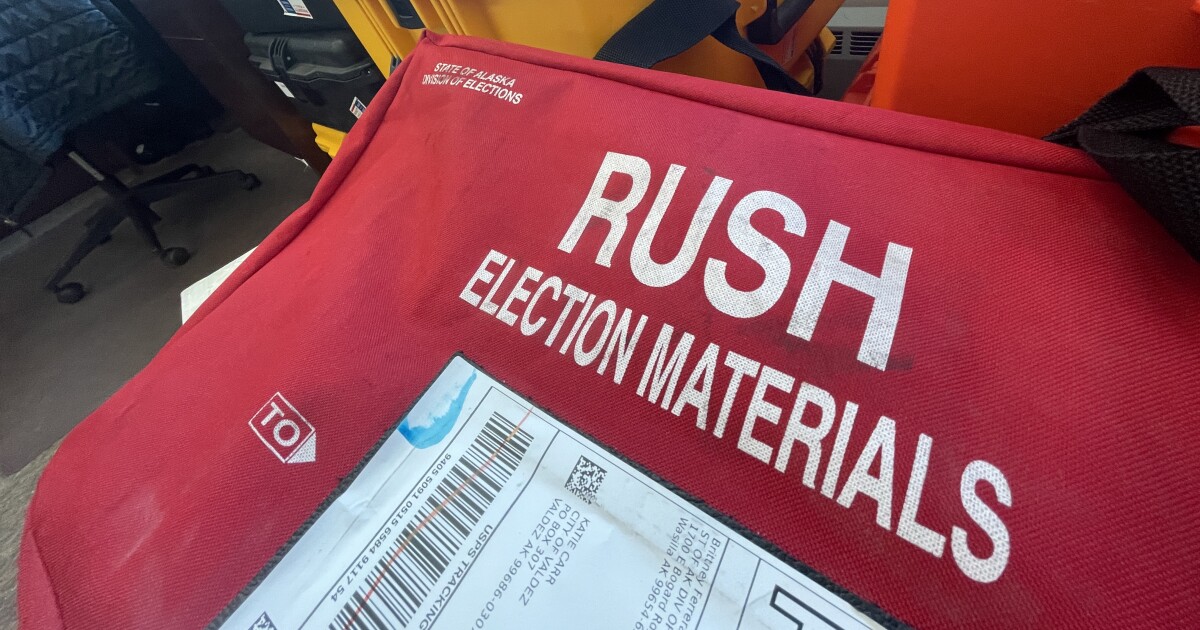
 Eric Stone
 Mat-Su Sentinel Staff
Alaska Beacon links that I can't get to load:
Alaska youth and advocates urge support for suicide prevention, state funding for 988 crisis line
Alaska prepares to get rid of historic ferry Matanuska, one of state’s oldest
Judge sets second trial date for former Alaska legislator Gabrielle LeDoux
Oregon tourist couple files lawsuit over dogsled crash in Fairbanks

The Alaska Memo Newsletter
Join the newsletter to receive the latest updates in your inbox.