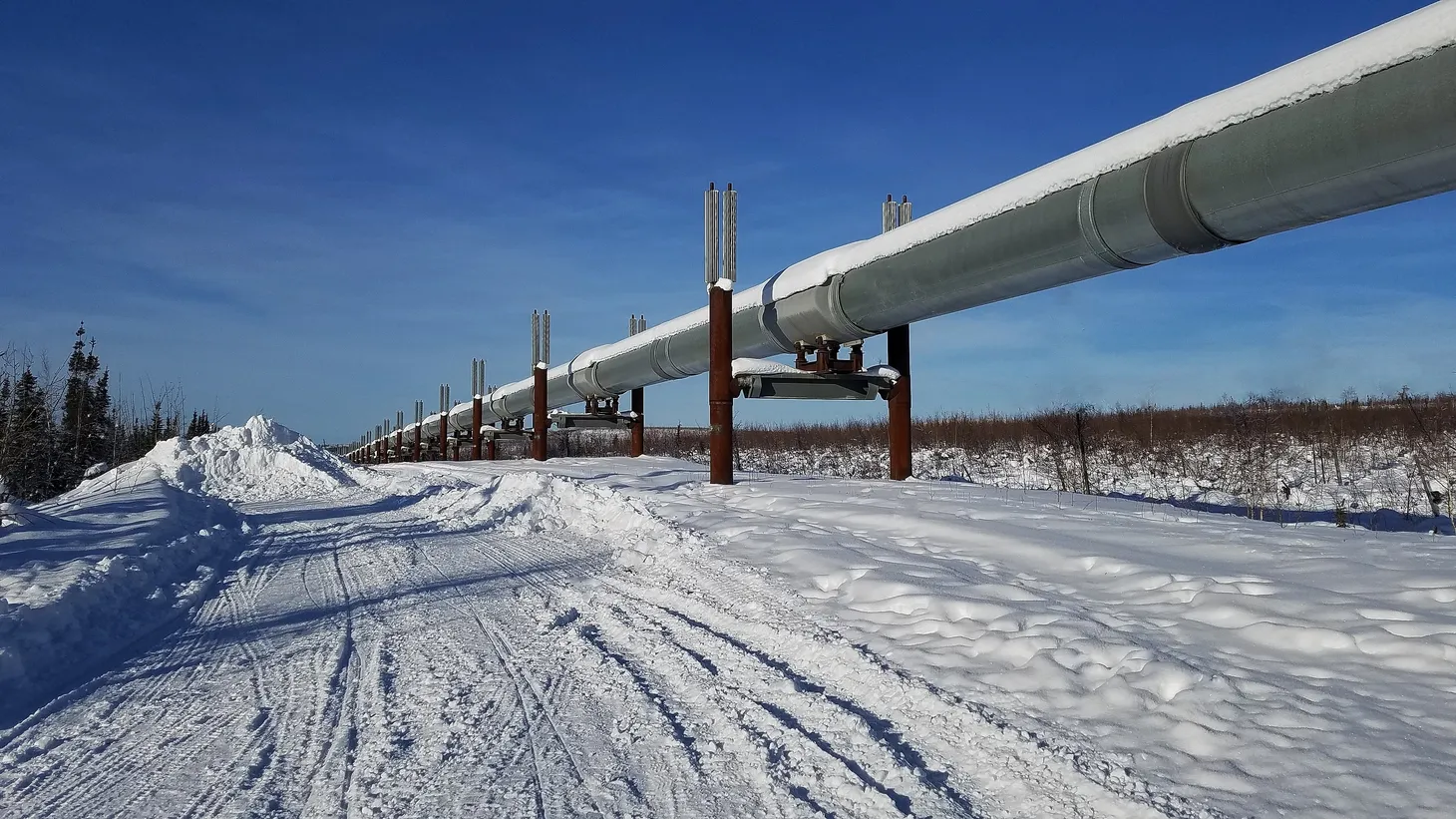
Hello Again, Murkowski's address and a constitutional amendment for public education
A reboot, Murkowski's annual speech sounded a tad more Republican-y than usual and a dedicated fund for K12 advances.

Hello Alaska!
In this edition: I'm pleased to announce that my long-running hobby podcast with Pat Race is getting a reboot! Also, Murkowski gave her annual address to the Alaska Legislature that, frankly, sounded a little more Republican-y than usual as she tried to pitch the silver linings of the Trump administration, especially when it comes to resource development. Meanwhile, the Senate advanced two proposed constitutional amendments this week, including one that would establish a dedicated fund for public schools.
Current mood: 🎙️
Hello Again!
We're happy to formally announce "Hello Alaska with Matt and Pat!" a reboot of the hobby podcast I've done with Pat Race for more than a decade. More episodes, more topics, more frequently and on a new feed! Our first episode is scheduled to be out this week, and you'll be able to find it wherever you find fine podcasts (like Spotify, PocketCasts, Apple Podcasts).

Murkowski's thrilled about drilling under Trump, everything else not so much
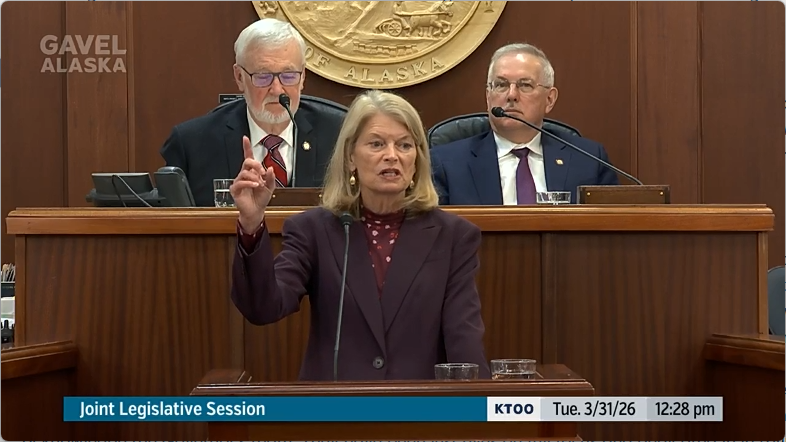
“Nothing is going better for Alaska than resource development.”
That was one of the few positive notes that Alaska U.S. Sen. Lisa Murkowski had for the Alaska Legislature during her annual address on Tuesday, where she praised Republican efforts under President Donald Trump to increase drilling, mining and logging in Alaska while registering tepid concern for Trump’s war in Iran, efforts to curtail voting rights, saber-rattling at Greenland and escalating health care costs.
Murkowski has been one of the few Republicans openly critical of Trump, but her speech on Tuesday made clear she sees the administration as a friend when it comes to resource development.
Her controversial decision to support Trump’s Big, Beautiful Bill last year, which instituted harsh cuts to health care spending among others, was in large part because it also included provisions that mandated opening up broad swaths of Alaska to development.
“We’ve restored access. We’ve mandated lease sales. We’ll soon keep a greater share of the revenues from our petroleum reserves,” she said. “This is real. This is meaningful. This is now. And of course, as we’re looking at all that is happening around the globe in light of the geopolitics and supply disruptions, this is a great opportunity.”
Watch: Joint Legislative Session – Address by U.S. Sen. Lisa Murkowski
She said the new urgency around resource development was a silver lining in Trump’s war with Iran, which she voted against reining in, arguing that it could drive support for Alaska-based projects even though it could cause broad economic destruction, including for Alaskans stuck paying high gas and energy prices.
“I’m worried. I’m worried about the impact of higher fuel prices, but I’m also worried about shortages, shortages of our ability to get refined product,” she said, noting that fertilizer is also expected to take a major hit, later adding, “The situation in Iran is not good. The situation, as it’s going to impact Alaskans in their homes, is not good, but could the state benefit because there is this increased focus on resource shortages and volatility?”
She suggested that the Trump administration could use the war in Iran to expedite permitting for resource extraction projects, such as a massive natural gas pipeline connecting the North Slope to export terminals in Southcentral, and praised the administration for working to develop domestic sources of energy and critical minerals – though she noted that Trump's not a fan of wind or solar.
“We have seen what it means to be vulnerable from a resource perspective, and we are learning what it means to be vulnerable when it comes to critical minerals,” she said, “And you have seen this president turn that around in a strong way.”
But one of Trump’s biggest targets for critical minerals, Greenland, isn’t thrilling Murkowski, who warned that the president’s threats to take the region by force don’t help anybody.
“I don’t think that Alaska is better off. I don’t think that the region is more secure when the US threatens allies like Greenland that pushes them away instead of reinforcing the partnerships that protect our mutual interest,” she said. “I think we’re going to be fine, but we need to remember that these relationships matter.”
She offered similarly glancing criticism of Republicans’ efforts to limit voting access with the controversial SAVE Act, which would subject voters across the country to strict identification requirements and require them to visit election offices in person to register and prove their citizenship. For many Alaskans who don’t have a local election office to drive to, it would create a massive and costly roadblock to voting.
She said she shared those concerns, but insisted that the thinking behind the bill was valid.
“I strongly agree with the premise that only citizens should vote, and voters, it’s reasonable you should have to show your ID. The problem here is with implementation under the Act,” she said. “This bill, again, is well-intended, and the premise is strong. It was not intended to disenfranchise Alaskans who can rightly vote, but I fear that that could be its effect.”
She seemed similarly split when it came to Trump's harsh treatment of immigrants and people who look like immigrants. The claimed purpose, she said, is good, but it's the implementation that's getting her.
"I think it is undeniably good that President Trump has closed the southern border to control it. It's important for our security," she said. "But when the extension of these policies results in a mother in Soldotna and her three children being taken into custody, with the mother deported and the oldest put in jail, I think it's time for serious reflection and reform of our legal immigration policies."
In legislators’ questions, several asked about the impact of Republican priorities on Alaska’s already expensive health care system. Under Trump’s Big, Beautiful Bill, critical social safety net programs like Medicaid and food stamps are expected to shed tens of thousands of Alaskans under new, tighter eligibility requirements and burdensome work requirements. They’ve also run into limits with how the Rural Health Transformation Fund — a pot of money pitched as a way to soften the blow of the cuts — works, even though it’s far less money and time-limited.
Murkowski conceded that some likely won't be insulated from the cuts.
“Health care is a worry for me, I know, a worry for you all. I mentioned the reconciliation bill earlier in my speech. I held my vote out from the reconciliation package. It was not a pleasant time, but I needed to make sure that Alaska would see the adjustments, the flexibilities built in, whether it was delays, exemptions and basically the funding needed to minimize the harm to Alaska,” she said. “And even with all that we gained with that, I worry about those Alaskans who may fall through the cracks as requirements change.”
But when asked what, if anything, could be done about it, Murkowski said it was up to state legislators to comply with the federal requirements so the money doesn’t get siphoned away elsewhere. When asked about the limitations on how the fund can be used, given prohibitions against spending it on issues that many say are root problems of health care access in Alaska, like infrastructure and broadband access, Murkowski said it’s about thinking innovatively.
“This administration is really leaning in on the technologies that are going to make us smarter, better,” she said, noting that Alaska’s lack of infrastructure may actually be a benefit because it’ll be easier to transition to emerging health industries. “It’s technologies that they really want us to lean in on, and it’s good to utilize technologies as long as we have that base layer.”
As far as the state's own situation, she said it's finally time for legislators to get serious about landing on a fiscal plan, noting that the federal government's $64 trillion in debt – much of it racked up under Republican presidents – will make securing federal aid in the future that much more difficult.
"Alaska will need a legitimate fiscal plan, as the federal budget inevitably tightens," she said. "Higher oil prices right now are no substitute. The windfall will only go so far and last so long."
This story was edited with help from Victoria Petersen and The Alaska Current. Everything else, including the typos, is mine.
Follow the thread: Murkowski's address to the Alaska Legislature
More coverage: Alaska Public, ADN, KTUU, Juneau Independent
Constitutional amendments on education, veto threshold advance
The Senate advanced a pair of proposed constitutional amendments this week: one seeking to lower the threshold for overriding a governor's budget veto, and another laying the groundwork for a fund specifically for the state's public education system. If approved by a supermajority in the House, the measures would appear on this year's ballot, needing a majority vote to become law.
SJR 2 by Sen. Matt Claman would lower the threshold for overriding a governor's budget veto from three-quarters to two-thirds of the Legislature, or from 45 votes to 40. Until last year's votes on education funding, the 45-vote threshold was effectively an impossible bar to clear. Lowering the threshold to the same level as non-budget veto overrides of 40 is still tricky, but more likely in the future. It passed the Senate 14-6, with minority Republicans voting against the measure.
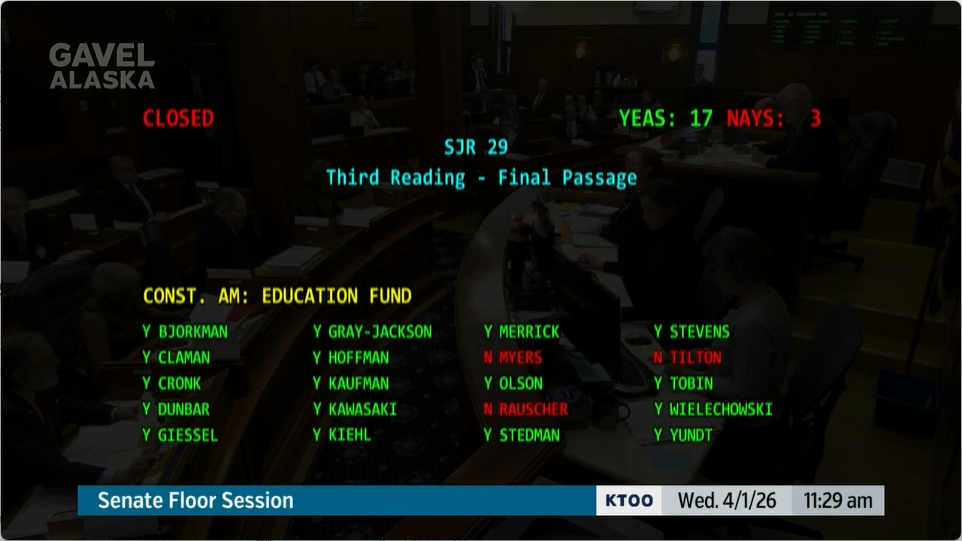
Things were a little bit more interesting for SJR 29, which would lay the groundwork for the state to create a dedicated fund for public education. Efforts to raise revenue for schools or to spare districts from the annual budget uncertainty have run into the Alaska Constitution's prohibition against dedicated funds. It means legislators can't, say, levy a tax dedicated to schools. While they can write the measure's intent, future legislators could simply change the spending by law.
Sen. Lyman Hoffman, D-Bethel, carried the measure on the Senate floor, arguing that it would simply lay the groundwork for creating a dedicated fund. It'd allow legislators to explore taxes, for example, that are permanently tied to schools (well, barring another amendment to the Alaska Constitution), possibly making raising revenue a little more palatable.
"Let the people decide whether the arguments we make are good for this constitutional amendment to put our kids at a better advantage with adequate funding," he said. "Or should the people decide, no, the status quo is wonderful. It's fair, it's equitable. There's no need to do anything to change our constitution. ... This is not saying it will be done. It's saying. let's ask the people. Everybody says the people know best."
The lone opposition was voiced by North Pole Republican Sen. Robert Myers, who argued that while education may be a priority, "but that priorities do change."
Myers was only joined by Republican Sens. Cathy Tilton and George Rauscher in voting against the measure (it's also worth noting that after Rauscher voted against a dedicated school fund, he introduced a gallery of public school students).
SJR 29 passed 17-3. Both measures now head to the House, where they'll need at least 27 votes to be sent to voters.
More from The Alaska Current
 Emily Sullivan
 Emily Mesner
 The Alaska Current
Reading list
 Katherine Rose
 Wesley Early
 Yereth Rosen
 Zachariah Hughes

The Alaska Memo Newsletter
Join the newsletter to receive the latest updates in your inbox.