Legislators, local governments and Alaskans pan Dunleavy's silly sales tax pitch
Dunleavy's flimsy fiscal plan ran into one of the most thorough demolitions of a bill to take place over the course of a single legislative day.

Happy Friday, Alaska.
In this edition: Gov. Mike Dunleavy's sweeping tax proposal didn't exactly leap out of the starting blocks when it was rolled out last week, but what little momentum it did have evaporated with its face-plant of an appearance in a trio of hearings in front of the House Finance Committee on Thursday. Revenue officials couldn't really justify it, local government officials poked it full of holes, and the public called it out as a lousy attempt to make those with the least pay the most. Also, the reading list and weekend watching.
Current mood: 🥇
Legislators, local governments and Alaskans all pan Gov. Mike Dunleavy's silly sales tax pitch
The series of hearings the House Finance Committee held on Republican Gov. Mike Dunleavy’s omnibus tax bill on Thursday was one of the most complete and thorough demolitions of a piece of legislation over the course of a single legislative day that I've ever seen in more than a decade of covering session. And that’s true even when you take into account the lukewarm well-it’s-nice-that-he’s-finally-trying-after-doing-nothing-for-two-terms reactions to the governor's rollout.
The committee held three hearings on House Bill 284: A morning hearing with the Department of Revenue that stuck to a painfully thin set of talking points, making it really look like they hadn’t done their homework; an afternoon hearing with the Alaska Municipal League that laid out a litany of basic-to-deeply-technical logistical, legal and moral issues with the governor’s plan; and an evening hearing for public testimony that not only lacked a single supporter but poked more holes in the governor’s superficial reasoning.
In his final year in office and after many years of opposing attempts to solve the state’s structural budget deficit through piecemeal solutions, Dunleavy introduced a sprawling all-or-nothing fiscal plan that's ostensibly pitched as a way to bridge the state's current financial situation to when several oil and gas projects – some of which haven't even made it to the drawing board – could come online in the mid-2030s. At the center of the plan is a 4% near-exemptionless sales tax that would ratchet down to 2% in the winter, along with some temporary tweaks to oil taxes and the eventual complete elimination of the state's corporate income taxes. It would also enshrine the dividend in the Alaska Constitution, dedicating half of the Alaska Permanent Fund's spendable earnings to the payout, far more than what legislators have approved for the better part of the last decade.
The measure has already faced significant skepticism, given that the policies don't actually lead to a balanced budget and would put an outsized burden on working-class families and those living in high-cost areas. Also, people really don't want to pay taxes, especially when the stated goal is to pay for a dividend.
Thursday's hearings didn't put the nail in the coffin of the bill because it was dead from the get-go. If anything, they tamped down the soil on its grave.
The administration sticks to the superficial talking points
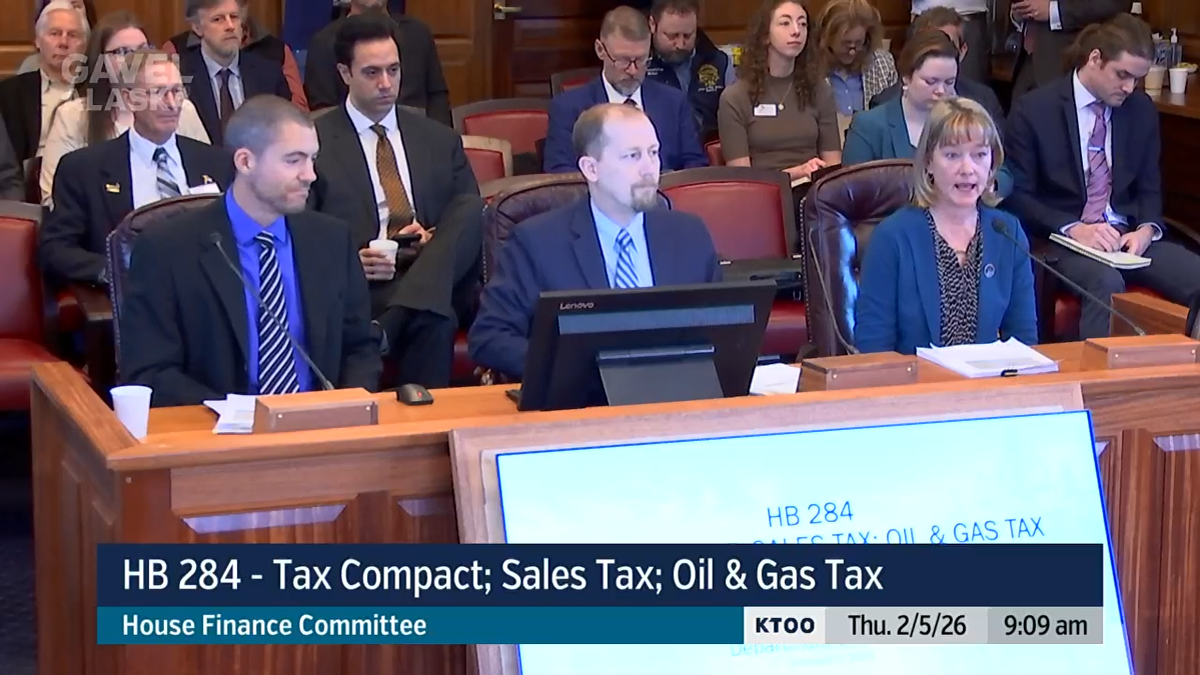
The presentation from the Department of Revenue, a cobbled-together crew of acting Commissioner Janelle Earls, acting Tax Division Director Brandon Spanos and Chief Economist Dan Stickel, was reminiscent of the hearings on the governor’s year-one budget, where he proposed drastic cuts to the state services in order to deliver on his campaign promise of a large dividend and no taxes. Where in 2019 his administration would answer legislators’ pleas to explain why he was proposing to cut public school funding by 20% with a “Our directions were large PFD, no taxes,” the administration took the same stick-to-the-talking-points approach this week, with this time’s phrase being “There’s no perfect tax.”
"There is no perfect tax regime," Earls said when asked to compare the sales tax to an income tax that could capture revenue from the non-resident workers who hold about a quarter of all state jobs. "By having the sales tax, we are able to collect from non-resident workers and tourists as well. So it's not fully the burden of the residents of Alaska."
That was their answer to the litany of technical and moral issues surrounding a measure that would land "equally" across the state, exacerbating the already high cost of living in rural communities or layering on top of communities' existing sales tax structures.
"Broadly speaking, I think, as was stated earlier, there is no perfect tax," Stickel said when asked if they had modeled any of the long-term impacts that a sales tax would have on Alaskans. "Any tax is going to have negative downsides. And that's definitely that's true of a sales tax, it's true of an income tax. The impact on population and decision to live in Alaska is one of the impacts of a tax that gets balanced against the positive impacts of having a sustainable fiscal plan."
Legislators' appeals to consider the outsized impact a sales tax would have on rural communities, where essentials can be three or four times as expensive as in urban communities, were also met with a similar non-answer.
"Certainly, there are places in Alaska that are more expensive. Rural Alaska is more expensive than the rest of Alaska. To reiterate what our acting commissioner said earlier, there is no perfect tax regime," Spanos said, noting that at least construction isn't taxed, so that wouldn't apply to rebuilding rural communities hit by natural disasters like Typhoon Halong. "It's difficult to build equity into a flat tax. ... The current structure is a very broad base to allow for a low rate for rural Alaska, not just for rural Alaska, for all Alaska, but it benefits rural Alaska to have that low rate. But again, no perfect tax regime."
Try as they might, legislators across the political spectrum failed to get answers to key questions about the tax plan, including its impact on consumer behavior and local governments, the viability of more equitable alternatives such as an income tax, and the costs and challenges of implementing and enforcing the measure in such a far-flung state. More high-level philosophical questions, like the fairness in levying a tax in a state where costs vary so wildly, the practice of levying a sales tax to pay a large dividend, the fiscal peril of enshrining a multibillion-dollar liability in the state constitution or the wisdom in going through all the trouble to create a sales tax that's set to last for only seven years.
Perhaps the closest they came to an honest analysis of the bill came from Spanos, when asked whether the governor had considered how disruptive this whole thing would be to communities that already levy sales taxes and would, if this becomes law, see a total sales tax rate well above 10%. Had he considered the fact that a decade of cuts and flat-funding under Dunleavy has already forced local governments to shoulder a greater share of the necessary services, like roads and fire?
"To be clear, it's the governor's plan," Spanos said. "And, as the commissioner stated, there is no perfect tax regime. This is the regime that the governor believes is the best for the state. ... The governor did consider all options and landed on a sales tax as the best option for the state at this time."
"I'm going to take that as a no," replied Rep. Jeremy Bynum, a Ketchikan Republican who's one of the more moderate members of the generally Dunleavy-aligned Republican House Minority. "You didn't consider or evaluate impacts to communities that are already charging or already collecting sales taxes to support the local communities."
"The governor considered all the options on the table and chose this one," Spanos said, effectively answering the question without answering the question.
The morning meeting ultimately ran long with legislators' questions and the administration's non-answers about the sales tax dominating the discussion to the point that other parts of the plan, like the elimination of the corporate income tax, were put off to a later hearing.
Follow the thread: The Department of Revenue testifies
AML puts on a wonky masterclass of a rebuttal
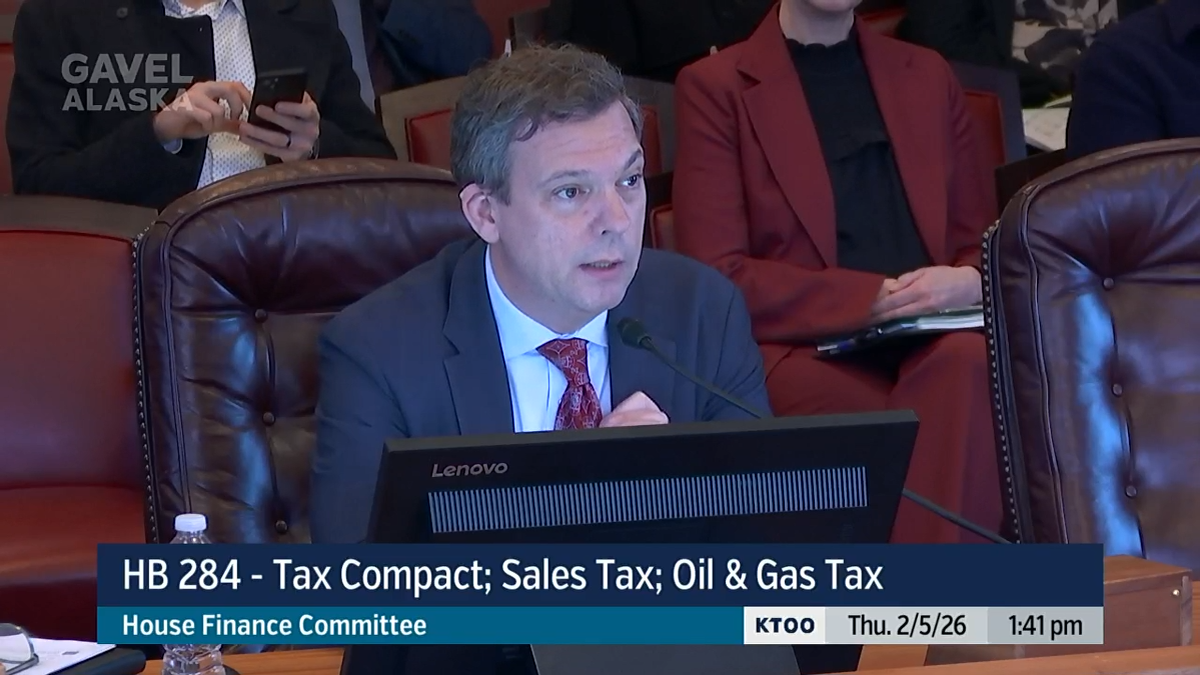
And for all the deflections of the administration, the afternoon hearing with the Alaska Municipal League Executive Director Nils Andreassen provided plenty of answers and more. He started by outlining local governments' opposition to the state getting into the sales tax game, supporting a progressive income tax, opposing the governor's strict spending limit, and supporting sustainable draws on the Alaska Permanent Fund, before diving into a scorching breakdown of the governor's proposal and all its shortcomings.
As for the governor's sales tax proposal, Andreassen said there were many technical issues with the plan that would disrupt the existing local sales tax system and ultimately harm local governments' ability to fund themselves. There are 55 communities in Alaska that currently charge a sales tax, he said, and 36 of them would see their sales tax exceed 9% under Dunleavy's bill. That, he warned, would be expected to start changing spending behavior and ultimately hurt local economies as people cut back on discretionary spending.
"You stop spending pretty much across the board, or slow your spending across the board, which reduces your overall economy," he said of rates above 9%. "And you get that political sensitivity. You get increasing calls at the local level, where taxpayers are demanding that the local tax level decrease, because that's the level of government they're going to look to first, knowing that they're not able to address it at the state level."
He also warned that the exemptions like those that some communities have passed for seniors would be eliminated under the bill. He was also skeptical of the administration's claims that a sales tax would collect more from non-resident visitors and workers than, say, an income tax or a progressive sales tax. According to a recent report, non-residents hold about a quarter of the state's jobs. And he also cast doubt that implementing a sales tax across the state would be as simple for businesses as pressing a button, as the administration claimed earlier in the day.
He even touched on the governor's claim that the sales tax is softened by a larger PFD, noting that the governor's sales taxes would end up costing more than the PFD for everyone but Alaskans making less than $12,500 a year. (Though, frankly, this argument really boils down to whether you believe PFD cuts are tax cuts.)
Andreassen ultimately stressed that legislators need to be thoughtful about the broad impacts of the tax legislation, noting that for all of the administration's deflections about the types of taxes being used that there are less disruptive and more equitable ways for the state to raise revenue.
"I know that earlier comment was there's no perfect tax. We should probably unpack "perfect." I think what we mean when we say there's no perfect tax is that, at some point, somebody pays the tax, right? There's no tax that doesn't impact somebody," Andreassen said, adding, "Are there ways to mitigate some of those impacts? Yes, I understand, again, all the trade-offs out there – this versus PFD cuts, distributional impacts and so on. There's lots of revenue options that get you to something like this without doing the same kind of damage that it might do to local governments."
The income tax, he noted, is a more reliable way to guarantee non-resident workers pay into state services, rather than Dunleavy's strategy of hoping they buy enough fishing rods, hoodies, and jerky to make up for the roughly $3.8 billion in wages they take out of the state.
Follow the thread: AML's testimony
The public gets to the point: "Tax the other guy"
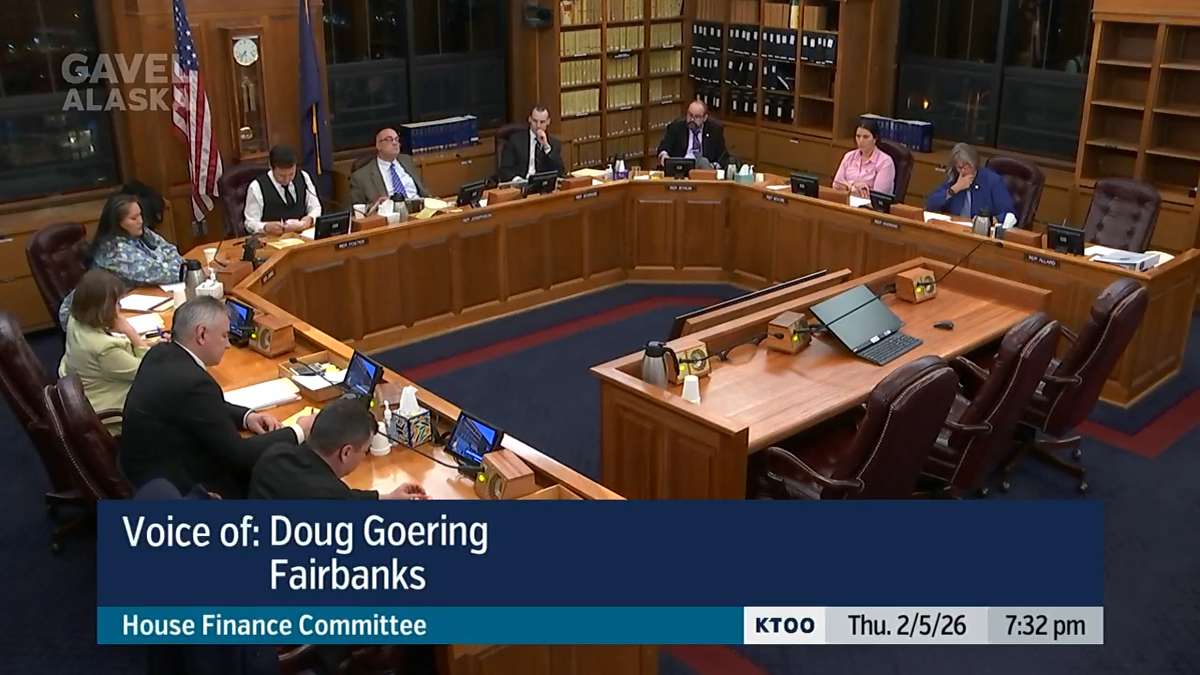
If the governor and his team was hoping for a lifeline in the evening's public testimony, he was left out to sea.
Testimony was roundly opposed to a sales tax, especially if the plan is to pay for a PFD. Several callers noted that the state can and should be more aggressive, not less, in taxing large companies and the oil industry.
"The number one rule of any tax, since before Fred Flintstone, is that you always tax the other guy, you always tax the other guy," said Mike Milligan from Kodiak. "We have a situation in Alaska where we allow foreign multinationals to lose money in a foreign country and bring those losses back to Alaska so they can deduct them from the obligation they have in Alaska oil taxes."
Others warned against making life harder for people already struggling.
"Sales taxes don't hit corporations first. They hit families. They raise the cost of groceries, diapers, gas and school supplies. They force working people to choose between food, rent, medicine and keeping the lights on, while large companies continue to receive tax breaks that is not fiscal responsibility that is shifting the burden downward," said Anchorage resident Roslyn Grady-Wyche. "If we're serious about fairness, Alaska needs a progressive income tax, one that protects low-income families, scales with ability to pay, and includes non-resident workers who benefit from our road schools and public services, not a flat tax, not a sales tax, a progressive income tax."
Or, as another caller put it, "It's time to tax the rich."
Stay tuned.
Reading list
 James Brooks
 ANNA LAFFREYSentinel Staff Writer
 Amy Bushatz
 Zachariah Hughes
 Alix Soliman
 Eric Stone
Weekend watching
Dang, it's been a while! In the spirit of the Olympics, here's a video delving into the neat and exacting work that goes into making curling stones, which all come from the same island in Scotland.
Have a nice weekend, y'all. And be kind.

The Alaska Memo Newsletter
Join the newsletter to receive the latest updates in your inbox.