
State sued for giving up voter list, Republicans flip their lid on Styrofoam ban, Reinbold pro se
Styrofoam could be on its way out of take-out while Lora Reinbold gets her (latest) day in court.

Hello Alaska! It's Day 93 of the legislative session (Monday was actually 91).
In this edition: The Division of Elections got served with a lawsuit over its decision to fully acquiesce to the Trump administration's demands, handing over voters' otherwise confidential information and inviting the feds to weigh in on who's allowed to vote. Meanwhile, as the Legislature barrels into its home stretch, House Republicans have not been having a great time, as evidenced by Tuesday's near freakout over a bill banning Styrofoam (as well as non-name-brand polystyrene) single-use food containers. Also, former state legislator Lora Reinbold had her self-represented day in court in her ongoing dispute with Alaska Airlines.
Current mood: 😮💨
Division of Elections violated Alaskans’ privacy by handing over voter list, lawsuit charges
Alaska may have avoided a lawsuit from the Trump Department of Justice's effort to access confidential voter information by simply handing it over and agreeing to give the federal government unprecedented say in who's allowed to vote, but it won't be avoiding court altogether.
Today, the ACLU of Alaska, the Electronic Privacy Information Center and the ACLU Voting Rights Project filed a lawsuit against the Division of Elections and Lt. Gov. Nancy Dahlstrom on behalf of the League of Women Voters of Alaska and the Alaska Black Caucus. It challenges the release of the confidential voter roll, which includes information that’s not publicly available, such as private residences, dates of birth, and partial or full Social Security numbers or driver’s license numbers, as a violation of the Alaska Constitution's particularly strong protection clause.
More: Filing in League of Women Voters of Alaska v. Alaska Division of Elections
The suit, which was filed in the Anchorage Superior Court and can be found here, seeks an order declaring the move unconstitutional and forcing the state "to make reasonable efforts to ensure the immediate destruction" of the voter list transferred to the federal government (something legislative attorenys says is likely already too late). It also seeks to nullify the agreement that directs the state to deactivate any voters the Department of Justice believes are ineligible within 45 days of being notified.
 Matt Acuña Buxton
"Protecting voters' confidential information is a non-partisan issue,” said Marianne Mills, the League of Women Voters of Alaska co-president, in a prepared statement. “Alaskan voters must be able to trust that the agency tasked with administering our statewide elections is doing everything in its power to protect Alaskans' privacy and lawful right to vote."
Under the Dunleavy administration, Alaska was one of the few states to fully comply with the Department of Justice’s sweeping request for confidential voter data by sending the full, unredacted list in December 2025. Several other states, including some ruby-red ones, have refused, been sued and already won.
At a hearing last month, a state attorney said ultimately they wanted to be good partners with the federal government.
More: KTUU, ACLU announcement
House votes to ban Styrofoam food containers, causing most Republicans to flip their lid

The Alaska House on Tuesday voted to ban single-use polystyrene plastic, often known under the brand name of Styrofoam, in the state’s food service industry, and along the way, a bunch of Republicans seemed to collectively lose their minds.
Backers of the measure say that while HB 25 isn’t a wholesale ban on polystyrene in packaging and other industries, removing it from the food service industry is a critical first step in a broader effort to phase out the toxic and polluting product. Polystyrene isn’t biodegradable and breaks down into microplastics that have made it to just about every corner of the world, including in most people’s brains.
While the food service industry accounts for an estimated 10% of polystyrene use in the state, backers argued it’s one of the few areas where legislators can actually make a change, rather than trying to force large companies to change their shipping practices.
“Microplastics are not just a potential problem; it is a problem,” said Anchorage Democratic Rep. Genevieve Mina in support of the bill, referencing a study that found microplastics in every body of water it tested in Southcentral Alaska. “This bill is small, but find me another policy where we can do something about microplastics that is more than the status quo.”
The bill was introduced by Anchorage Democratic Rep. Andy Josephson, who said that food service ware is one of the key targets because, unlike packaging, it comes into contact with food. He noted that polystyrene also has a nasty tendency to break down and leach into food when heated or used to store high-fat foods.

“Others said that the bill is imperfect because I’m not doing enough. While I’m not omniscient, I wish I could fix all of the world’s environmental problems, but I’m told that you eat an elephant one bite at a time, and that’s all I’m trying to do,” he said.
Unsurprisingly, a broad swath of minority House Republicans opposed the bill.
While most seemed to acknowledge that polystyrene contributes to a multitude of health problems, eye-sore pollution and environmental damage, several said they ultimately had to prioritize the profitability of private businesses. Food safety, they reasoned, should be left up to the market to decide.
“This bill would actually mandate that private industry must use more expensive alternatives to polystyrene, which is already known to be inexpensive and effective and has been the industry standard,” said Eagle River Republican Rep. Dan Saddler. “Forgive me for using the term nanny state, but it is this is the using the power of government to force people to do things that government believes are best for you. We’re the government. We’re here to help you. We know best. And I just don’t agree with that.”

Saddler, like some others, also suggested that while polystyrene has documented health impacts, they can’t be sure the paper-based replacement won’t actually be much worse. He also fretted that the state’s recycling system may lack the capacity to handle additional paper-based takeout containers (something that many restaurants have already started using), a concern recyclers did not actually share.
Some Republicans were so incensed by the bill that their speeches devolved into near-shouting — like Fairbanks Republican Rep. Will Stapp, who called the bill “putting lipstick on a Styrofoam polystyrene pig” — but most were deeply dismissive, and they made sure to let everyone know.
“Here we are spending a whole day on plastic containers,” said Rep. DeLena Johnson, the House Minority leader who on Monday complained that House Republicans weren’t being “allowed to breath” on the House floor. “And I would say that this is a feel-good bill, maybe even some would say it was virtue signaling.”
Between the shouting and the hurt feelings, others claimed that it was the Democrats who were the ones being “emotional” about the legislation.
“We’re talking about our health, our children’s health, the health of our planet. We’re talking about all these things, but we need to be honest. What does it do? What does it do to our businesses?” said Big Lake Republican Rep. Kevin McCabe in opposition to the bill.
And still others worried about what would happen to the trees if the food service industry switched to all-biodegradable products.

“We’re going to shift to paper. What about deforestation?” asked Wasilla Republican Rep. Steve St. Clair, who got the position because he was appointed by Dunleavy. “What about taking all of our trees that are sucking up the carbon monoxide and changing it into oxygen? Just saying.”
(For the record, trees intake carbon dioxide, not carbon monoxide. Would be nice if they did, but they don’t.)
Democrats defended the bill, arguing that there are things more important than businesses’ bottom lines and that it’s appropriate for the state to step in when it’s a matter of public health.
“I heard the (Republican) Minority Whip (Justin Ruffridge) state that the one group of people that we were sent here to advocate for were small businesses that use disposable food service ware,” said Anchorage Democratic Rep. Andrew Gray, who started off by vowing to not get "emotional" like Republicans had been complaining. “I would argue with the minority whip that we may have been sent here to argue and advocate on behalf of other groups as well. … Disposable food service ware made out of polystyrene is not healthy for you. It is not healthy for your customers, it is not healthy for our beaches, it is not healthy for our oceans.”
But, somewhat surprisingly, not all Republicans were quite so single-mindedly dedicated to the private sector’s bottom line and saw merit in government intervention on this forever plastic.
One of those was right-wing Glennallen Republican Rep. Rebecca Schwanke, who said she once would have agreed with her fellow Republicans about the costs it'd put on small businesses, but that times have changed.
“Polystyrene never breaks down. It does break up into small pieces, and it ends up in our waterways and on our lands. It ends up in fish, it ends up in wildlife, and it eventually ends up in us. It’ll end up in the bloodstream of our children and our grandchildren and their grandchildren,” she said. “10 years ago, I would not have supported this bill, because I don’t think that at that point we had viable, affordable alternatives, but we do now.”

Schwanke noted that a dozen other states have banned polystyrene, and three communities in Alaska have done so (Canada, much of the European Union and many island nations have also banned it). She noted that while local bans are an option for organized communities, they're not an option for Alaskans living in broad swaths of the state with no local government (this is the same reason the state smoking ban was ultimately necessary). She said in those cases, it’s up to legislators to look out for the people.
It's also worth noting that Schwanke is nowhere near a bleeding-heart liberal on any of this, but seems to be largely informed by her experience as a state wildlife biologist and a private hunting guide. During the amendment process, Schwanke successfully introduced an exemption for reusable polystyrene products, such as coolers frequently used for shipping fish.
She also met her fellow Republicans' complaints about business costs head-on.
“We have tin foil, it’s waterproof. We have wax paper, it’s waterproof,” she said. “I think there are a lot of straw man arguments about not passing this bill because it would impact small business owners. … These are packages that we dispose of, sometimes in a matter of minutes or hours. There are alternatives. There are affordable alternatives. They are available today, and they’ll be available tomorrow.”
Schwanke was joined by a handful of other conservative Republicans in supporting the bill, including Wasilla Reps. Jubilee Underwood and Elexie Moore, Ketchikan Rep. Jeremy Bynum and Fairbanks Rep. Frank Tomaszewski. House Majority Leader Rep. Chuck Kopp was the lone member of the Majority to dissent.
The bill passed 25-15 and now heads to the Senate for consideration. Like anything with a Democrat as a sponsor, it faces uncertain odds with Gov. Mike Dunleavy.
Follow the thread: The House debates HB 25, one-use polystyrene containers

This story was produced and edited with support from The Alaska Current. Everything else is mine, including the typoes.
Matt Acuña Buxton Matt Acuña Buxton
 Rachel Levy
Lora Reinbold gets her (latest) day in court
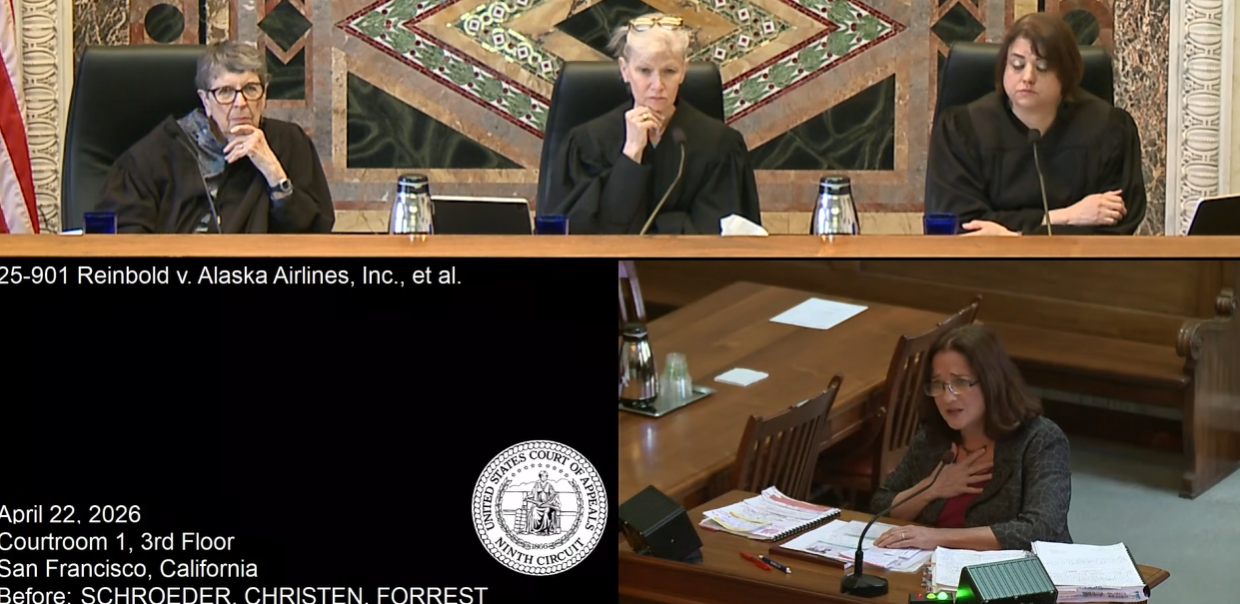
Ah, 2021. When most of us were still masking and social distancing, Eagle River Republican Sen. Lora Reinbold was busy being a total menace in her fight against tyranny – interrupting meetings, refusing to mask, grinding the Senate to a halt while holding some truly bonkers Senate Judiciary Committee hearings and taking part in a one-woman standoff with Senate leadership – all while wearing a chic clear-plastic face shield. The antics ultimately landed her in hot water with Alaska Airlines, and after a dust-up at the airport, she was removed from a flight and ultimately banned from flying on the airline for "continued refusal to comply with employee instruction regarding the current mask policy."
Even though she's left office – according to her, largely because of mounting legal costs from another lawsuit over her blocking constituents on social media – she's also continued her legal battle with Alaska Airlines. Apparently, the apology cake didn't smooth things over.
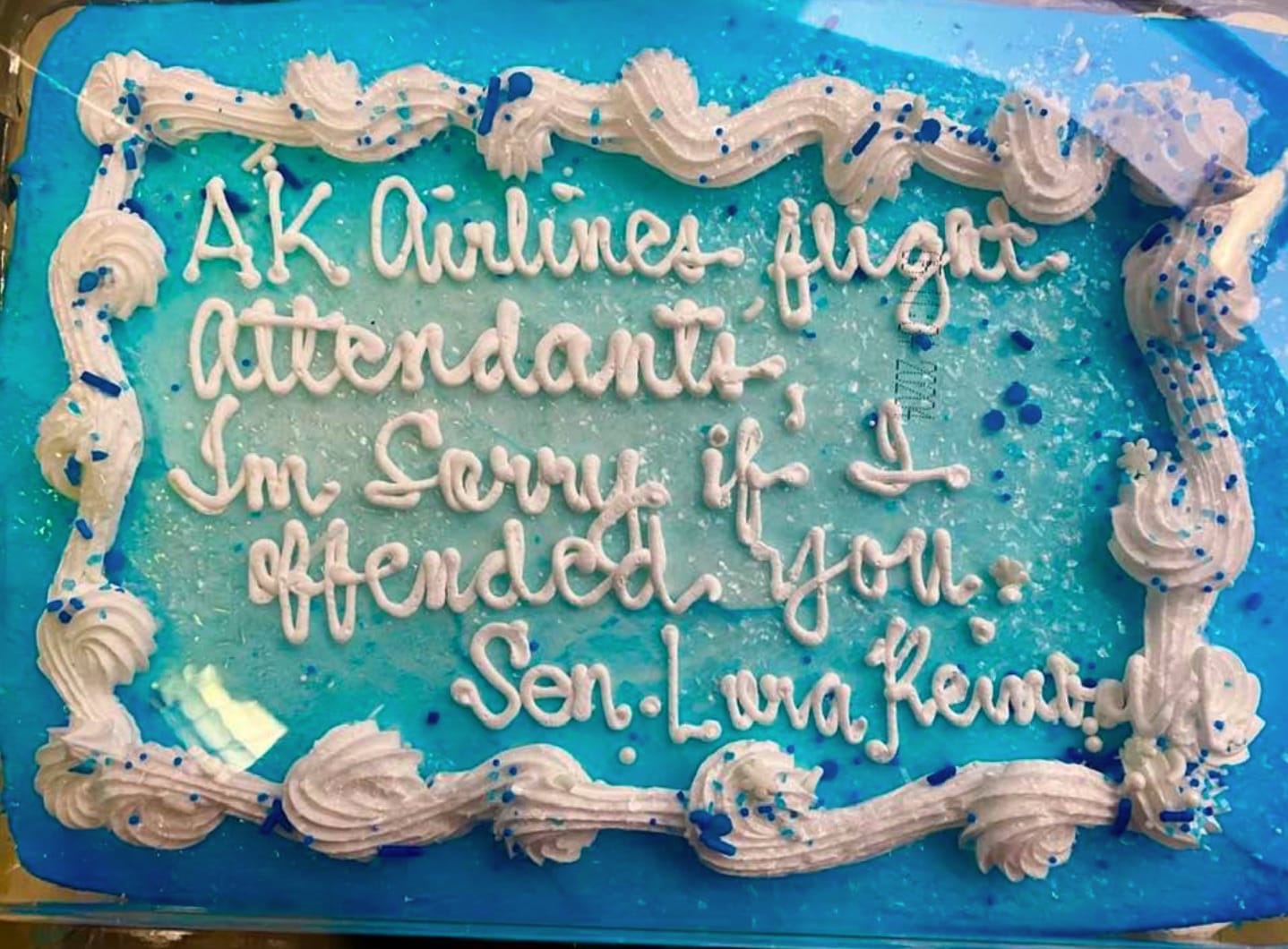
While a judge (now-disgraced ex-judge Joshua Kindred to be precise) dismissed her case in early 2024, the ex-legislator was down in San Francisco this morning to make her case to the Ninth Circuit Court of Appeals.
"I can tell you, the flight was 100% peaceful. I went ahead and boarded the plane, 100% peaceful. Got off. I honestly thought it was a joke when I got banned," she told a panel of justices who never really did get a satisfying answer about why Alaska Airlines should be treated as a joint actor that must abide by the U.S. Constitution (which, you know, is for how the government can treat you; it doesn't say anything about how private companies can treat you).
"They gave me absolutely no fair notice before this," she continued. "They discriminated. They targeted me, and they denied a senator – me as a senator – on the monopoly carrier. I was in furtherance of my constitutional duties, and they blocked any meaningful access to the Capitol to and from, and I think that's absolutely critical."
Oh, and did I mention she's representing herself?
This link should be cued up to the right time, but if it's not, Reinbold's hearing starts at 1:19.
Things, unsurprisingly, didn't seem to go particularly well for Reinbold, who faces a tough uphill battle of explaining why a private company like Alaska Airlines has to abide by the U.S. Constitution or how a plane counts as a "public accommodation" under the Americans with Disabilities Act. That's a point the judges frequently tried to tease out during the hearing, with little success.
"There's no constitutional right to fly," said Richard Grotch, the attorney representing Alaska Airlines. "There's certainly no constitutional right to fly Alaska."
The justices will issue an order at a later date.
Stay tuned.
Follow the thread: Lora Reinbold gets her (latest) day in court


The Alaska Memo Newsletter
Join the newsletter to receive the latest updates in your inbox.