
Supplemental budget passes, Alaskans lost millions in federal health care help because of GOP
As most lawmakers try to play it safe, one argued they should be busy praising the president for bailing the state out rather than worrying about what-ifs.

Hello, Alaska! It's Day 65 of the session. This ain't so bad!
In this edition: As we wait for the next turn in Trump's war, House Republicans continued to bet on high oil prices to solve the state's budget woes and voted against backstop language that would have ensured the current year's budget would be funded regardless of what happens in Iran. Meanwhile, a deeper look at the hearing from last week that highlighted massive losses the state is experiencing and will continue to experience under Trump's agenda – and why it'll cost everyone. Also, legislators note their concern about the federal health care funding that's been pitched as a cure-all for affordability and the reading list.
Current mood: 💉
Supplemental budget passes sans backstop as House GOP continues to bank on high oil prices
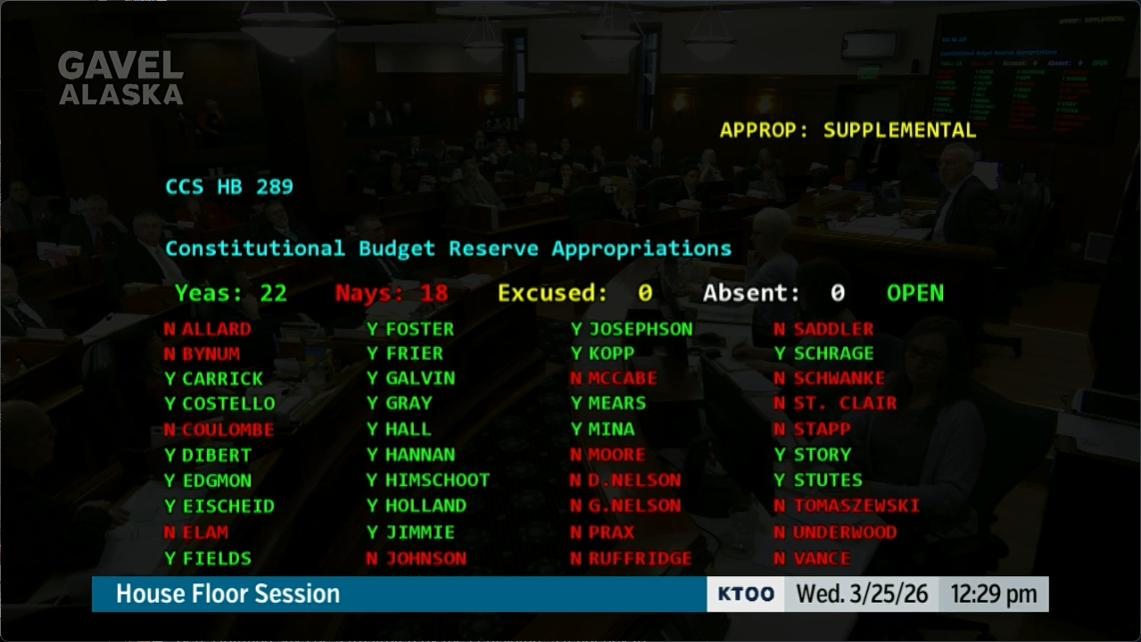
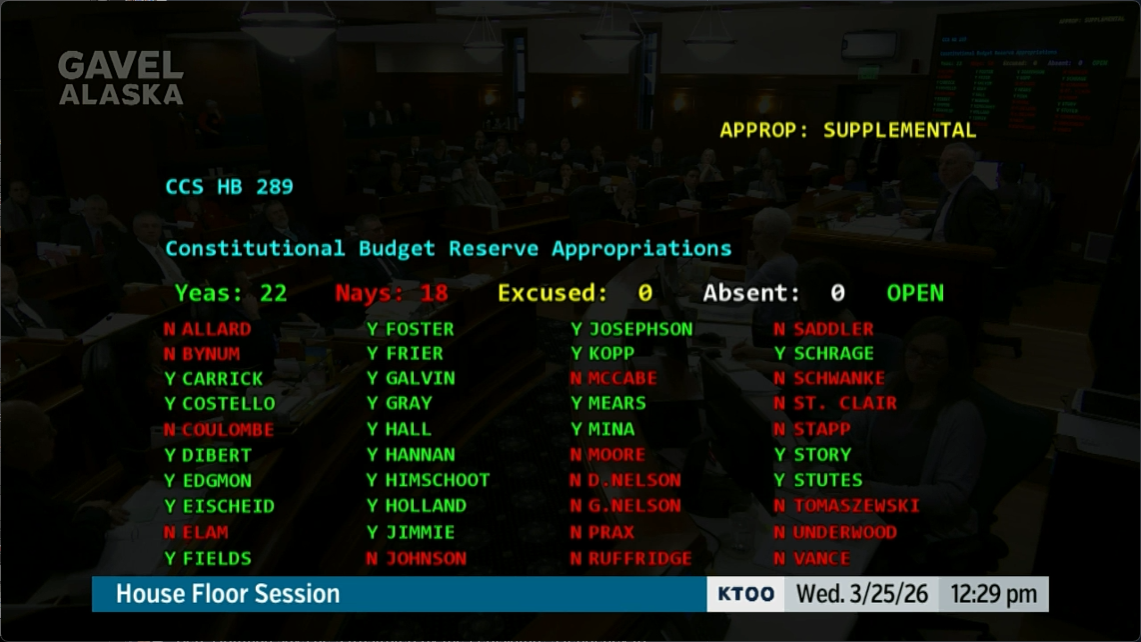
The reworked backstop language for the state's supplemental budget – a bill covering unexpected costs like disaster relief, expected-but-uncovered costs like $70 million in federal highway matching funds and cost overruns like $24 million of mostly overtime in the state's prison system – failed today to win the support of House Republicans who maintain Trump's war with Iran and the economic chaos it has caused have erased any need to have a back-up plan in place.
"It looks almost certain that there will be plenty of cash on hand," said North Pole Republican Rep. Mike Prax. "But even if there isn't ... we can address that in the course of the normal budget setting process."
Others insisted legislators should be busy praising the president for bailing the state out rather than worrying about what-ifs.
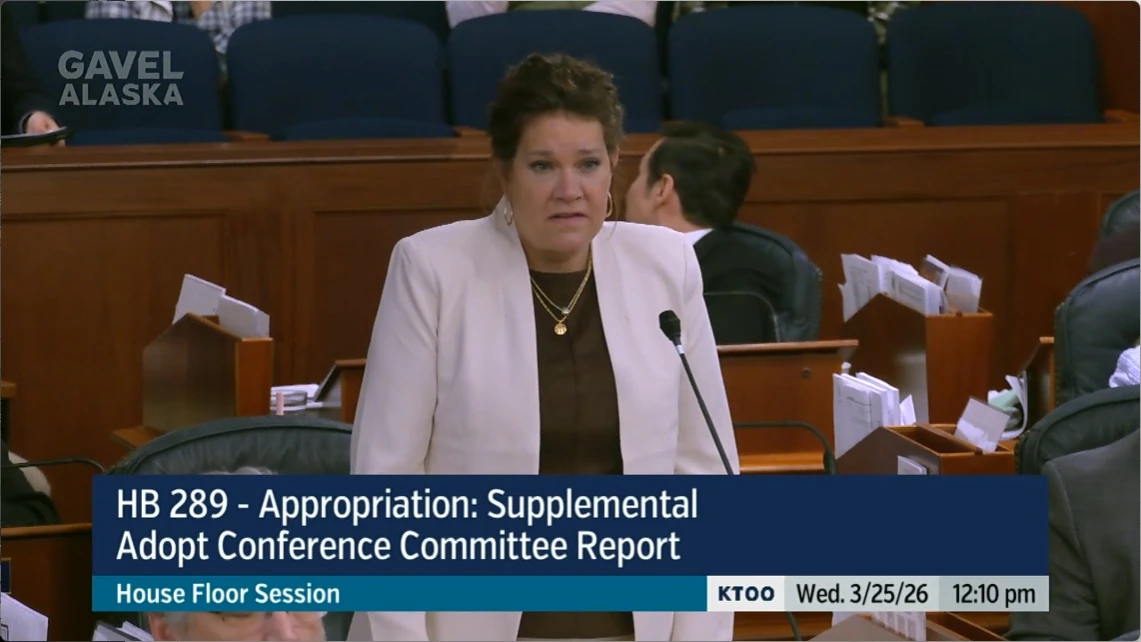
"I just wanted to say that everybody in this body should actually send the President of the United States a thank-you note," said Eagle River Republican Rep. Jamie Allard during today's debate on paying for the supplemental.
For their plan to work out, oil will have to average $87 per barrel of oil for the rest of the year. It's currently hovering around $100 per barrel, where it's sitting after a roughly $10 drop following Trump's postponement of strikes on Iran's power plants, but it looks like it's already creeping back up on talk of a ground invasion.
"I would just say that oil prices are fluctuating wildly," House Majority Leader Chuck Kopp, a moderate Anchorage Republican, said while emphasizing that the language is there only as a backstop so the spending, which everyone voted unanimously to support, will happen even if oil collapses. "History shows us again and again that high oil prices cannot be relied on."
The final vote in the House was 22-18, falling well short of the 30 needed to tap into the Constitutional Budget Reserve. The only crossover vote was from Anchorage Republican Rep. Mia Costello, who's also the only long-serving legislator to have experienced the heyday of Republican majority rule.
The Senate, meanwhile, reached its vote on a 16-4 margin, with Republican Sens. Mike Cronk and Robert Yundt crossing over.
Ultimately, the failure to secure the CBR provisions will ensure that traffic to oilprice.com will remain high as legislators assess whether the state can land this year's budget. While oil bailing the state out is the most likely scenario, a sudden collapse in prices could push the state toward a shutdown, a partial shutdown or the hairy world of gubernatorial impoundments if legislators don't agree on a new funding source.
Stay tuned!
Follow the thread: The House floor session
Alaskans lost $43 million because the GOP let popular health insurance subsidies expire
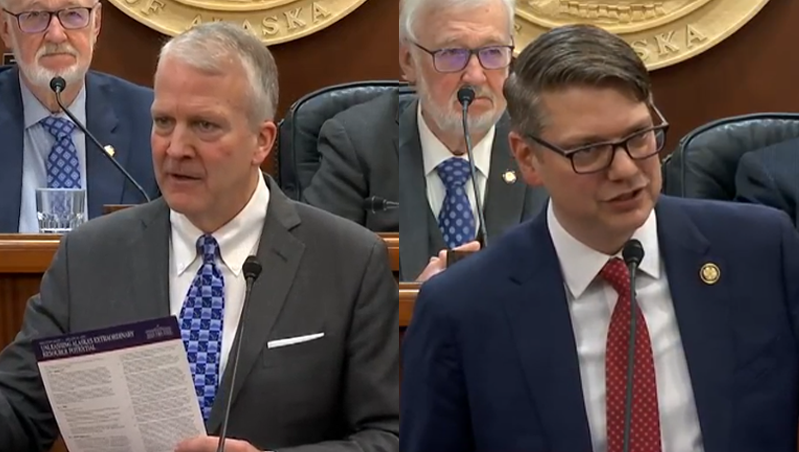
Alaskans who relied on federal subsidies to make health insurance nearly affordable lost out on more than $43 million after Congressional Republicans, including U.S. Sen. Dan Sullivan and U.S. Rep. Nick Begich, allowed the subsidies to expire at the end of last year.
Advocates for Alaska’s health care industry warn that rising costs will drive people to forgo insurance altogether, miss out on basic care and rely more on emergency room care.
And that’s only the beginning.
Alaskans and legislators are working to come to grips with what the cuts to federal spending will mean for Alaska and its health care system, which is already among the most expensive in the nation. What they’re finding is that thousands of Alaskans have lost or will lose coverage because it's become too expensive or because of new bureaucratic hurdles.
“We have a lot of people who are losing coverage,” Alaska Hospital and Health Care Association CEO Jared Kosin told the Senate Health and Social Services Committee last week. “The last thing we want to see when you're trying to address health care costs is people losing coverage … And what we're seeing with some of the policies that are coming down the pike, we're setting ourselves up for kind of the opposite of that trend.”

For the nearly 30,000 Alaskans who rely on the health insurance marketplace — usually small business owners and freelancers — the enhanced subsidies made health insurance purchased through the Affordable Care Act’s marketplace nearly affordable. But Republicans let those expire — successfully leveraging a suspension of food stamps to force Democrats to give up on their demands that they be renewed — without any meaningful plan to address the high cost of insurance.
While Republicans like Sullivan have suggested they’d be open to a temporary extension of the program, they’ve made vague gestures that the program is rife with fraud. The high number of people who buy health insurance and never use it is suspicious, they claim.
The real-world fallout has been stark.
Tens of thousands of Alaskans were hit with sticker shock over 2026 health insurance premiums, with about 10% of people declining to renew and exiting the market altogether (the first year that enrollments are set to drop since the subsidy was introduced) and that number is considered to grow in May, when the state gets a better look at who actually followed with activating the plans they signed up for.
More: Sullivan, Begich face reckoning over Trump policies sooner than expected
Shayla Teague, an insurance broker who works in Alaska’s market, told the committee that people have been hit hard, and this year’s open enrollment period was filled with many long, hard discussions about health insurance.
“Many Alaskan households are now experiencing what can be described as significant premium shock,” she said. “This most recent marketplace open enrollment was one of the most difficult of my career. Many clients were in shock, and some were even in tears.”
She relayed the example of a married couple in their late 50s with a combined household income of about $115,000, which put them just out of reach of any assistance after the enhanced subsidies expired.
“Their monthly premium was approximately $600. This year, the same plan costs approximately $3,300 per month,” Teague said, adding, “This is not for an exceedingly rich plan. It is actually the least expensive plan available to them, and it still carries a $10,000 annual out-of-pocket maximum for each of them. … This is not a one-off situation. It's what I'm seeing time and time again. Many, many middle-income Alaskans are reaching a point where coverage is simply no longer affordable, even for households that would traditionally be considered financially stable.”
And the loss of coverage is an alarm bell for Kosin, who told the committee he’s concerned about what it will mean for everyone, regardless of whether they have coverage. He noted that hospitals still have to provide care, even if people don’t have insurance.
“When there is a loss of health care coverage, inevitably, there's an increase in uncompensated care. That's just how it works,” he said, noting that hospitals and other care providers will likely be forced to shift costs elsewhere or cut back on care altogether. “Rising uncompensated care will inevitably drive up healthcare costs even more than they are today.”
And the insurance subsidies are just the first of many shoes to drop on Alaska.
Kosin also flagged concerns about what the newly enacted Medicaid work requirements and their massive bureaucratic burden will have on the state. One state estimate suggests that nearly 14,000 of the roughly 61,000 Alaskans in the expansion population will lose coverage. But he said that is likely optimistic and assumes the state bureaucracy is functioning perfectly — something the massive backlogs suggest is a stretch.
“It assumes the state has to be flawless, perfect in exempting 42,000 people,” that could be eligible for exemptions, he said. “It also assumes 5000 people have to be perfect in the way in which they comply. … Maybe it’ll be lower (than 13,000 people losing coverage). I think there’s a chance that it’s higher than that, and we’ll see more people than that lose coverage on top of that.”
Republicans, for their part, have been generally dismissive of the concerns raised by state legislators and other health groups. Sullivan has often resorted to calling criticism of Trump and the Republican agenda inauthentic. He and others have pointed to provisions in H.R. 1 — better known as Trump’s Big, Beautiful Bill or, as Sullivan said some 15 times during his address to the Alaska Legislature, “The Working Families Tax Cuts Act” — that would pump the state with a bunch of one-time money through the Rural Health Transformation Fund.
But, as legislators have been finding out, that fund comes with so many strings attached and other limitations that it can’t actually be used to address the underlying problems around the loss of coverage. Instead, it looks like the money was largely designed to go to gimmicky Outside health companies.
More: The health ‘transformation’ fund touted by Republicans isn’t all it’s cracked up to be
The effort by Republicans to sell the Trump agenda as a series of nonstop wins has been critically important heading into the 2026 elections, in which both Sullivan and Begich will be on the ballot. But issues like health care, said Anchorage Democratic Sen. Forrest Dunbar (who got under Sullivan’s skin at the address), are going to make that particularly tough for Republicans to maintain control.
“In the short term, there is this cliff that was created by the expiration of the enhanced premium tax credits,” he said, “and the only realistic time to change that was in the reconciliation process and in H.R. 1, and because Congress did not do so, I think Congress is going to look very different next year.”
Follow the thread: Senate Health and Social Services Committee's March 26 hearing on the rising cost of health care in Alaska
This story was edited with help from Victoria Petersen and The Alaska Current. Everything else, including the typos, is mine.
House asks feds for flexibility and time on federal health care transition spending
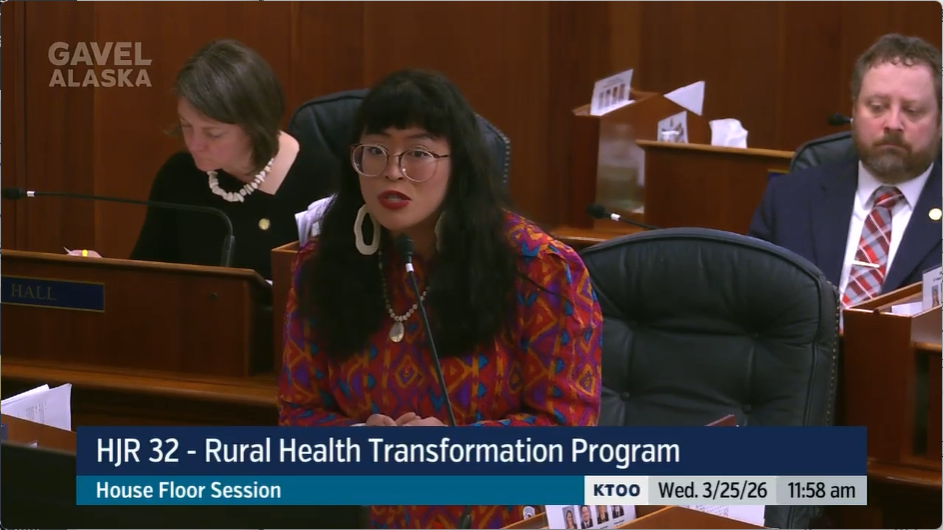
Speaking about the high cost of health care in Alaska, the House approved HJR 32 asking the federal government for greater flexibility and, critically, more time to comply with an expansive list of requirements to access hundreds of millions of dollars in funding from the Rural Health Transformation Program fund, a multibillion-dollar product of Republicans' efforts to woo Alaska Sen. Lisa Murkowski into supporting Trump's Big, Beautiful Bill.
As the hearings on the fund have laid out, the strings attached to the money are significant and require legislators to pass several bills by the end of 2027, or risk repaying some of it. That's a task that people who actually understand health care policy warn will be a big logistical lift to get done and implemented on time, especially because many of the rules and penalties haven't been written yet.
Anchorage Democratic Rep. Genevieve Mina, who chairs the House Health and Social Services Committee and helped craft the measure, told lawmakers that much of the program hasn't been finalized, so it's difficult to fully vet the various elements of the program to determine if they're actually in the best interest of Alaska's uniquely sparse and expensive health care system.
"We know that the RHTP is a finite fund, and within the broader context of H.R. 1, it's not going to completely fix the increasing rise of people who are uninsured, it's not going to fix impacts to federal cost shifts to the state or an increasing bureaucracy," she said. "But what we can do is work together to make sure that we take full advantage of these funds to help invest in capital, to help invest in infrastructure and to help invest in our workforce. That's what's going to matter to transform Alaska's health care system."
While some Republicans groused about asking for time and flexibility to implement President Trump's health care agenda, arguing that it didn't need to be vetted so thoroughly when they know what they have to, they all ultimately supported the measure, approving it 40-0.
It heads to the Senate next.
Reading list
 Eric Stone
 Alex DeMarban
 Colleen Mondor
 Dermot Cole


The Alaska Memo Newsletter
Join the newsletter to receive the latest updates in your inbox.