House approves key social spending boosts in operating budget as Republicans cry foul
For their part, the 19 House Republicans seemed to have about 19 different ideas for what the budget needed to look like to garner their support.


It's Tuesday, Alaska. Right? Day 85.
In this edition: The operating budget is out of the House after a marathon of amendments and debate, where the House Minority's 19 Republicans offered up about 19 different visions for what the state budget should look like and what the process would be if only they were in charge. For their part, the House Majority is in the less-than-enviable position of arguing that government is not, in fact, always an evil, ever-growing monster that provides nothing to no one. Also, some pictures from the field and the reading list.
🚀🌕 Something fun: From Space Camp to NASA Mission Control: Soldotna woman helps send astronauts to space
House approves key social spending boosts in operating budget as Republicans cry foul

The Alaska House approved its version of the state operating budget on Monday, a budget plan that includes some boosts for public schools and social services while paying a $1,500 dividend.
Members of the left-of-center multipartisan House Majority said the budget was an effort to preserve the state’s limited savings while using what’s expected to be a moderate boost in oil tax revenue from Trump’s war with Iran to support things like heating assistance, child care, early education and health care. Though, to be clear, the budget is leaving the House with an on-paper deficit of about $180 million that'll ultimately need to be sorted out before it's all finalized.
“We have a dividend this year that is 50% larger than last year’s, which will be real, tangible support for Alaskans,” said Anchorage independent Rep. Calvin Schrage, who is one of the co-chairs of the House Finance Committee. “Is it as much as everyone wants? No? Is it more than some people want? Yes, but it’s a budget that’s done the best it can to strike a balance, to provide support where it’s most needed and to provide support broadly and generally as well.”
The budget includes $147 million in additional funding for public schools, $11 million for student transportation, $17.5 million to restart the state’s heating assistance program, $15 million for rate increases for health care workers, $7.5 million for child care and $4 million for early education grants. The House’s total spending increase on state services is about $245 million.
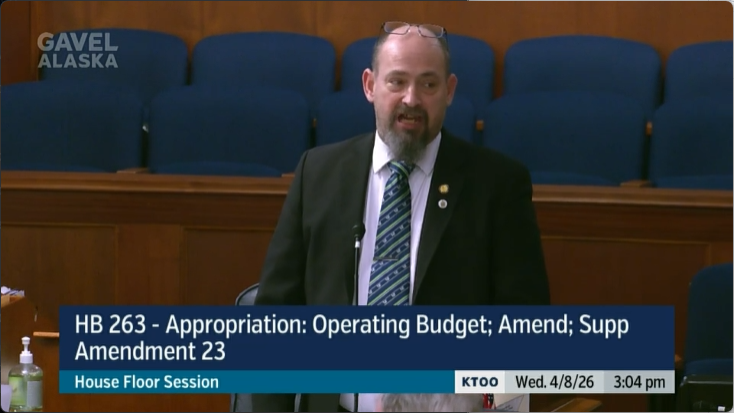
While the House Majority supported the measure, minority House Republicans were united in their opposition, leaving it to pass by the slimmest of margins on a 21-19 vote.
For their part, the 19 House Republicans seemed to have about 19 different ideas for what the budget needed to look like to garner their support.
There was too much spending in areas like public schools and too little in areas like resource extraction. The budget process wasn’t as thorough as it should have been, and it was a mistake to start with the budget submitted by Gov. Mike Dunleavy (a Republican) rather than starting from zero and justifying every single dollar in the $12.7 billion budget. The PFD was too small for some, while the budget was still too big for others. Some claimed the state was seeing “exponential growth” under the non-Republican rule, arguing that every rejected cut meant less for the PFD. Others questioned the need for inflation-proofing. There was too much social spending in areas they didn’t like, which was turning Alaska into a “welfare state,” and not enough in areas they did, like private-sector businesses.
“A government’s budget should address three priorities: Fiscal restraint, robust public safety, and the protection of Alaska’s resource development,” said House Minority Leader DeLena Johnson, R-Palmer. “Our group put together some really good amendments and tried to get those in.”
What the Alaska Constitution says about priorities:
This constitution is dedicated to the principles that all persons have a natural right to life, liberty, the pursuit of happiness, and the enjoyment of the rewards of their own industry; that all persons are equal and entitled to equal rights, opportunities, and protection under the law; and that all persons have corresponding obligations to the people and to the State.
Most of those amendments weren't accepted, which is nothing new, regardless of who's in the majority, and many Republicans seemed to take it personally.
In harsh, sometimes alarmist terms, they decried the House Majority as hyperpartisan and rude for not adopting more of their changes, including one that would have deleted the $158 million in one-time funding the House Majority had allocated to schools and another that would have increased funding for industrial road maintenance.
“I am saddened, especially given what I’ve experienced this year, the lack of respect for individuals that sit on Finance,” said Rep. Jamie Allard, the Eagle River Republican who has a reputation for screaming at people in her office and was mainly responsible for a three-week shutdown of House Education in 2023, before she was cut off for impugning the motives of other legislators.
Johnson even got in it, suggesting House Speaker Bryce Edgmon, I-Dillingham, failed to do his job because more minority-backed priorities weren't included.
“The job of speaker is to be the speaker to the whole body and to ensure that the minority’s voice is heard,” she told Edgmon during the debate (it’s not), explaining that the House Minority kept things tight and focused by only submitting about 50 amendments rather than the usual 100-plus changes. “I’m disappointed that they were voted down. We’re falling short of the responsibility of this body of the legislature to rise above divisiveness and realize that real fiscal achievement is for all Alaskans.”
While House Republicans had previously opposed spending from savings to backstop the current year’s supplemental budget, arguing that the state was awash in cash thanks to Trump’s war with Iran (which Allard literally said they should be thanking Trump for starting), they said that it was deeply irresponsible to bank on moderately higher oil prices in the coming budget year. That budget is based on the expectation that oil will average out to about $70 per barrel. Since the start of the war, it's sat north of $100 per barrel.
The latest on oil prices
After peaking at $12.80 per barrel on April 6 based on Trump's threats to commit a genocide of the Iranian people, ANS West Coast crude prices have "retreated" to about $108-$109, according to the latest numbers as of Friday, which means that the president's decision to institute his own blockade of the Strait of Hormuz hasn't been factored in, yet, nor whatever other wild card the president will pull on the global order.
“We can’t trust the revenue forecasts,” said Soldotna Republican Rep. Justin Ruffridge, who just a month ago argued the state was flush with cash because of the war. “I think that the members who sit in these seats a year from now are going to be saying, man, what were those guys thinking? They really made a budget on $75 a barrel of oil?”
And for much of the Republicans’ complaints about the budget process, majority members noted that many of the problems about budget transparency and accountability start and end with the governor’s office, which is held by Republican Gov. Mike Dunleavy, who's ostensibly on their side. They noted that areas such as travel spending, zero-based budgeting (starting from zero and justifying everything else as it's added to the budget), and alleged fraud and waste are all areas where Dunleavy has far more power to change than legislators.
“I hear on the floor that we hear from insiders within the administration that travel budgets are inflated, that vacancy rates are too high, and we can just cut those that there’s waste and abuse here and there and everywhere,” said Rep. Schrage. “Where are members getting this information, and if they are getting this, why are they not working with the Administration to make sure these cuts are brought forward?”
Schrage said it’s unrealistic to expect legislators to interview every state employee to uncover these claims of waste when the governor doesn't seem interested.
“No, we need a willing partner to be able to do so,” he said. “I’m not sure all those areas of waste and abuse actually exist, but to the extent they do, it’s very difficult to address when you don’t have a willing partner in the administration.”
He noted that the Legislature tried to cut some $20 million from the state’s prison budget, only for the Dunleavy administration to ignore the request and spend $24 million on overtime anyway.
But in the bigger picture, members of the House Majority argued that, fundamentally, they believe that it’s actually worthwhile to focus spending on helping needy and vulnerable Alaskans through targeted services. They argued Alaska needs to do a better job at investing in itself and making life easier.
“They’re proud to live in a state where we take care of one another,” said Rep. Genevieve Mina, D-Anchorage, of her constituents’ feelings on the budget.
Rep. Andy Josephson, the Anchorage Democrat who spearheaded the budget as the co-chair of the House Finance Committee, argued that he had tried his best to balance the pressing needs of Alaskans while trying to keep the state living within its means. He recalled one meeting with a family struggling to afford in-home care for their daughter because the state’s reimbursement for caretakers hadn’t been updated in nearly 30 years.
“This is an actual need. This budget reflects that need,” he said, getting a little choked up with emotion. “(We) walked out together and I said, ‘We’re doing this.’ So, you know, shame on me if there’s compassion in the budget.”
The budget now heads to the Senate, which will create its own version and has signaled plans to reduce the PFD to about $1,000 to create more room for school major maintenance funding. Then, the two versions will be expected to meet in a conference committee where legislators can work out the differences before sending it to Gov. Mike Dunleavy for consideration.
Dunleavy has not been shy about using the veto pen and has regularly vetoed measures such as public school funding, school construction, child care and early education.
This story was edited with help from Victoria Petersen and The Alaska Current. Everything else is mine, including the typoes.
More budget coverage: Alaska Public, Alaska Beacon, ADN, KTUU
Follow some particularly salty threads (yeesh, the snark was really flowing, even by my standards): Part 1, Part 2, Part 3, Part 4, Part 5
More from The Alaska Current
 Matt Acuña Buxton
 Matt Acuña Buxton
 Jenny Weis
In photos: Flight attendants protest Sullivan

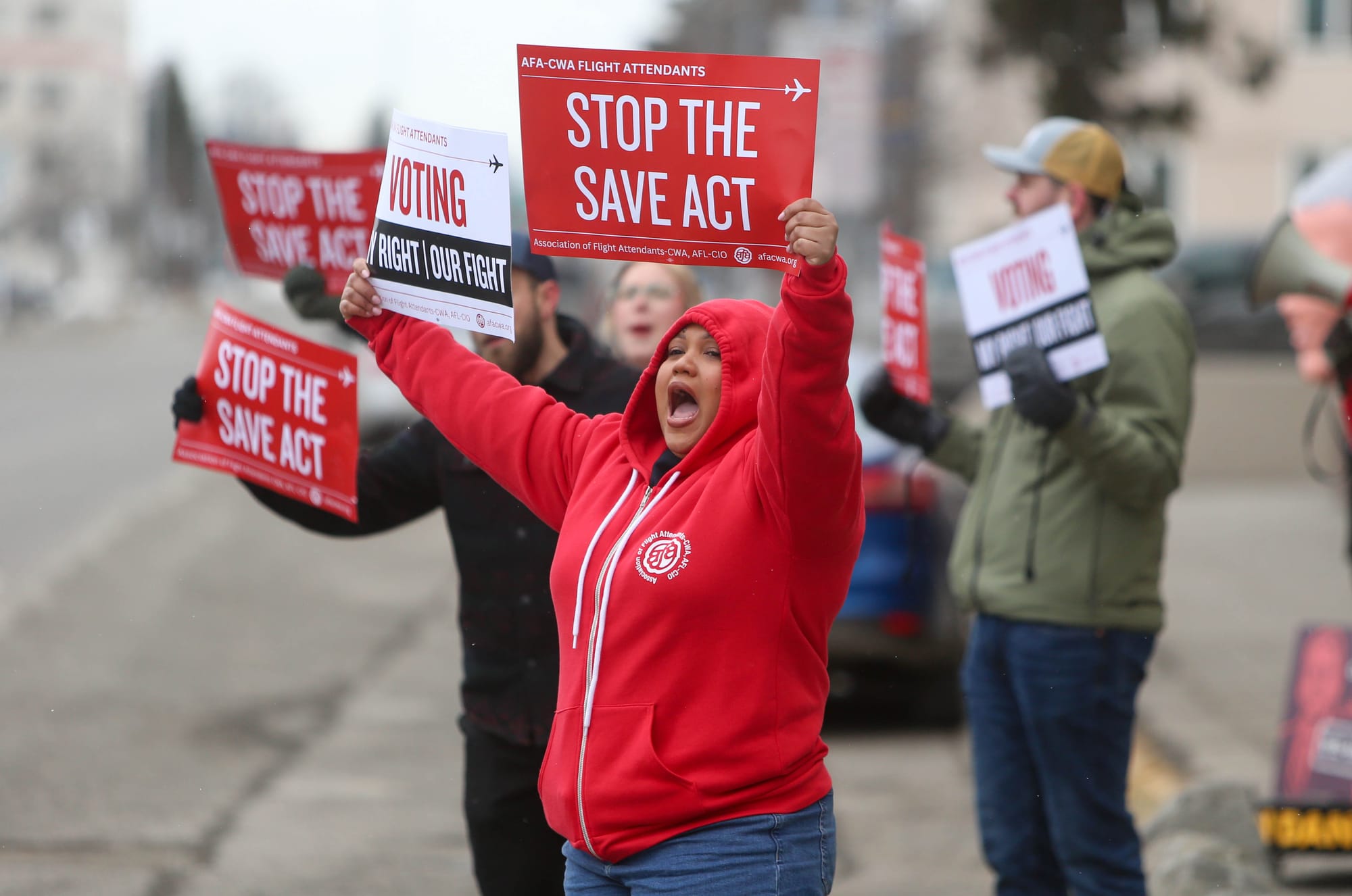
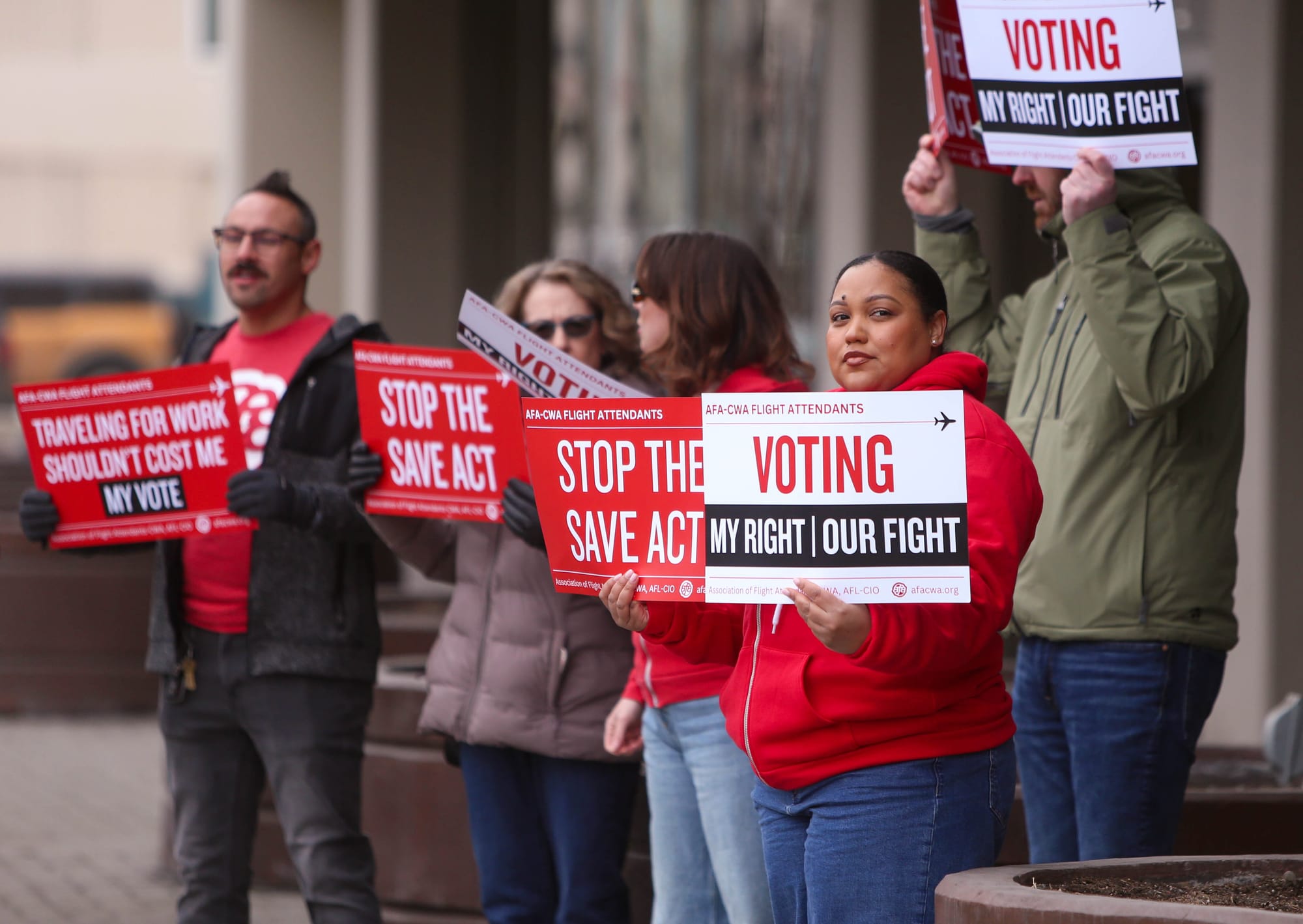
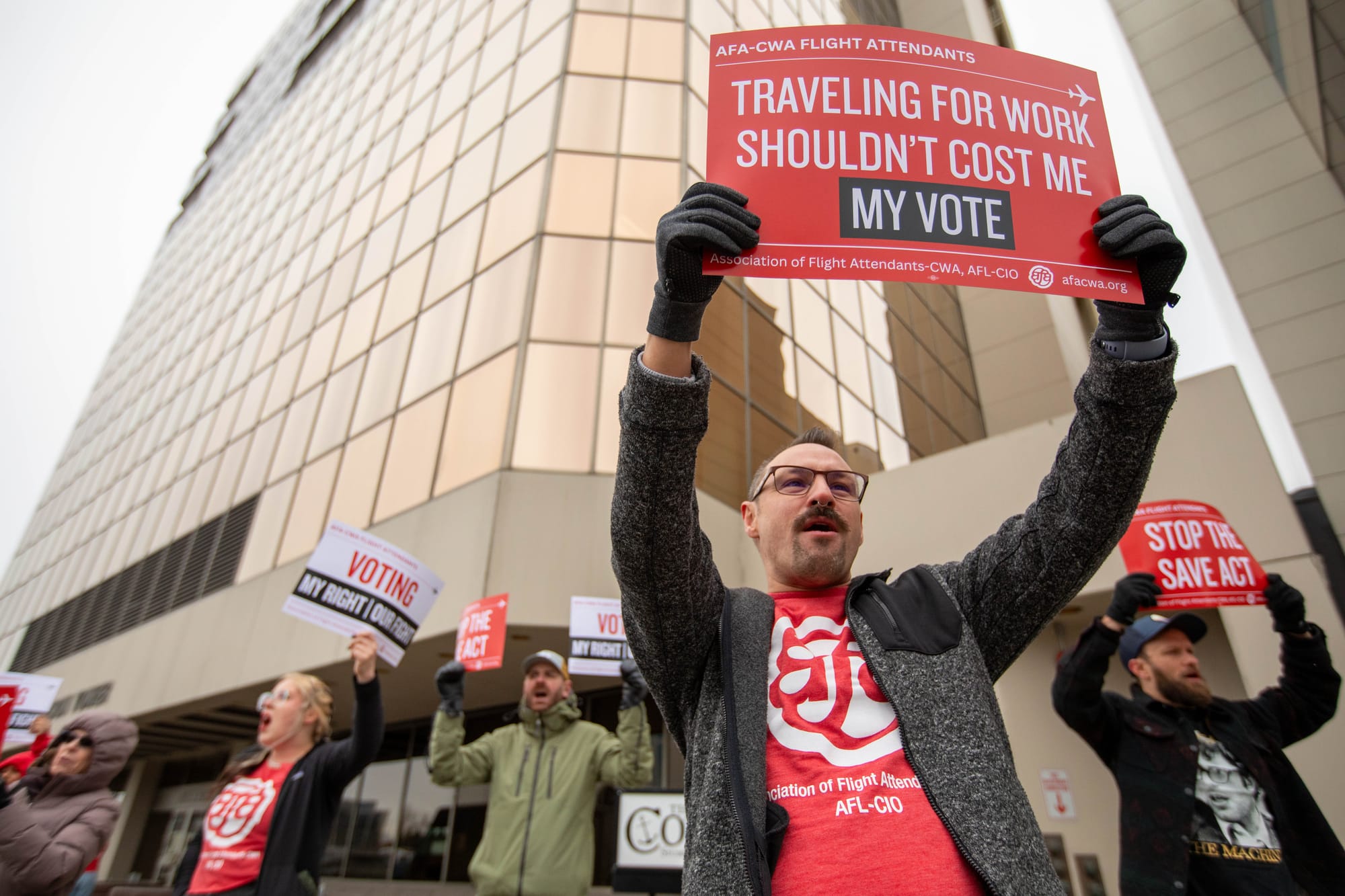

Photos by Matt Acuña Buxton.
Last Friday, instead of writing up my newsletter, I got to go sling a camera for a bit and take pictures of a small crew of Alaska-based flight attendants who are part of the Association of Flight Attendants-CWA. Rebecca Owens told me the SAVE Act — which contains strict ID requirements that would make it hard for people who’ve changed their names, such as married women or trans people, to register — is an attack on the groups the union has long represented.
“This disproportionately affects flight attendants in a litany of ways, one being it’s a heavy, female-dominated work group, and you know that affects women who changed their names,” she said. “We also travel for work, right? So we can’t pop over during lunch break to vote because of our unpredictable schedules. We rely on mail-in voting. There are already so many barriers to voting, we don’t need to be adding more.”
Full story: Airline attendants protest U.S. Sen. Sullivan’s support of SAVE Act
Reading list
Eric Stone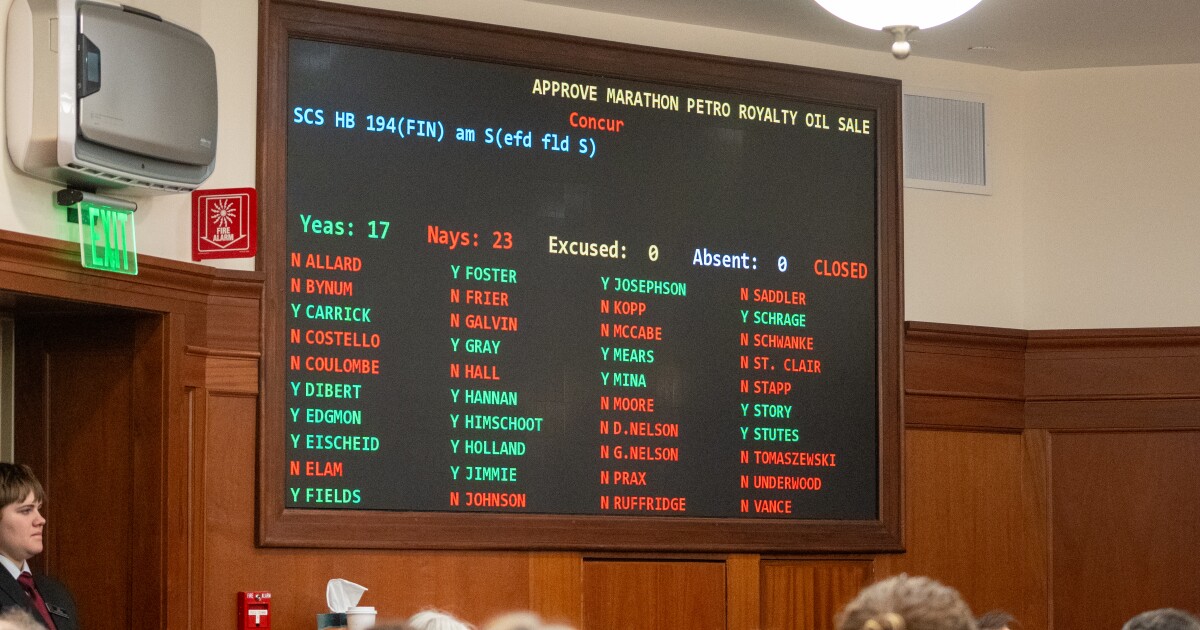 Chris Aadland
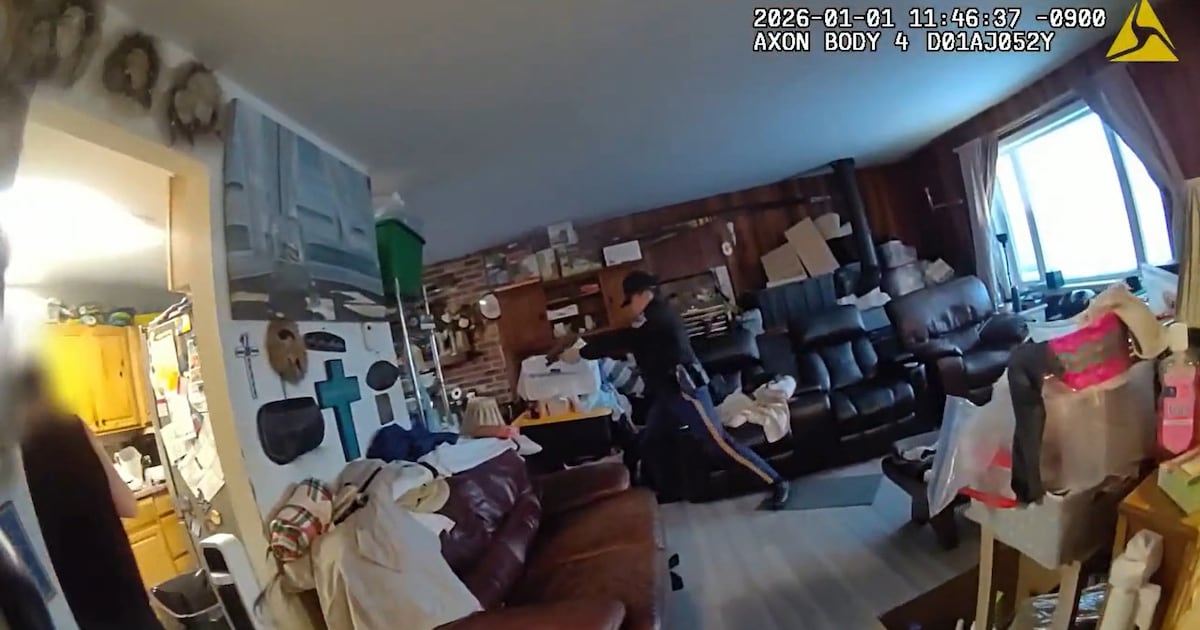 Haley Lehman, Alaska Beacon
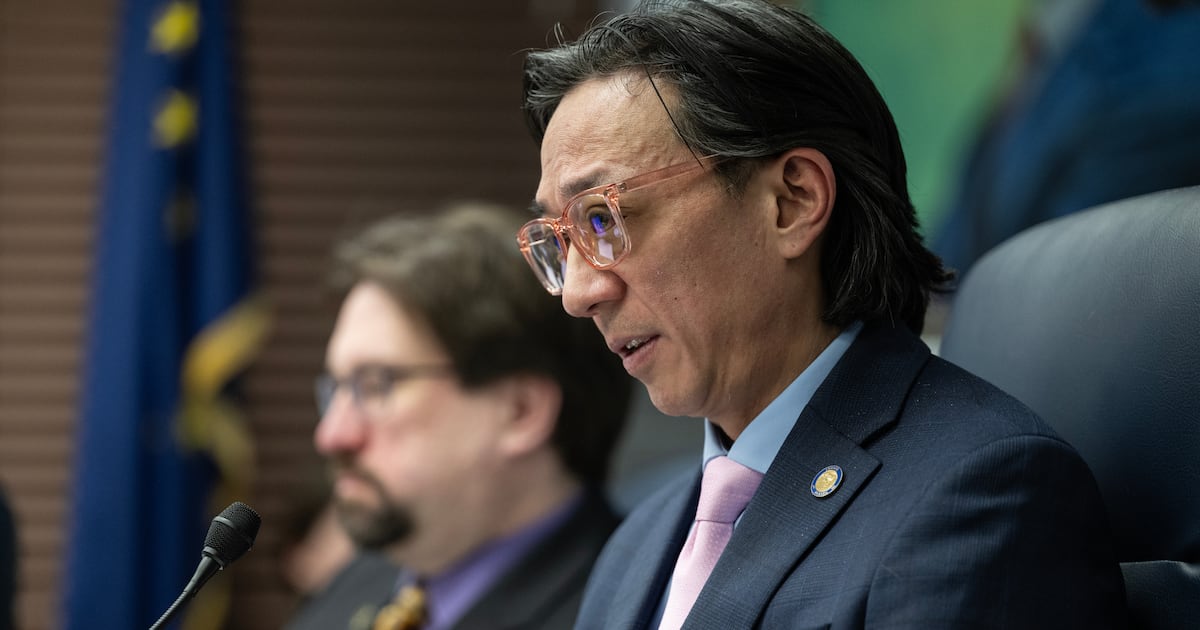 Yereth Rosen
 Kevin Hardy

The Alaska Memo Newsletter
Join the newsletter to receive the latest updates in your inbox.