Special session bound, packed crime bill passes, pension override fails and more
Following Monday's mad dash, the penultimate day of the legislative session was largely subdued as lawmakers turned their attention to everything else.

Hello, Alaska! It's Day 121 of the legislative session.
In this edition: Following Monday's mad dash to try to pass the AKLNG bill, the penultimate day of the legislative session was largely subdued as lawmakers – now facing a certain special session on the subsidy – turned their attention to everything else. That included an attempt to override the governor's veto of the pension bill, passing a packed-to-the-gills crime bill, the styrofoam ban and an interesting battle over how we treat feral cats.
Current mood: 🥱
Tuesday's threads
- The House floor session, part 1 (reader version)
- The joint session on HB 78 (reader version)
- The Senate passes the crime bill (reader version)
- The House floor session, part 2(reader version)
Dunleavy calls a special session on subsidies for the AKLNG pipeline project
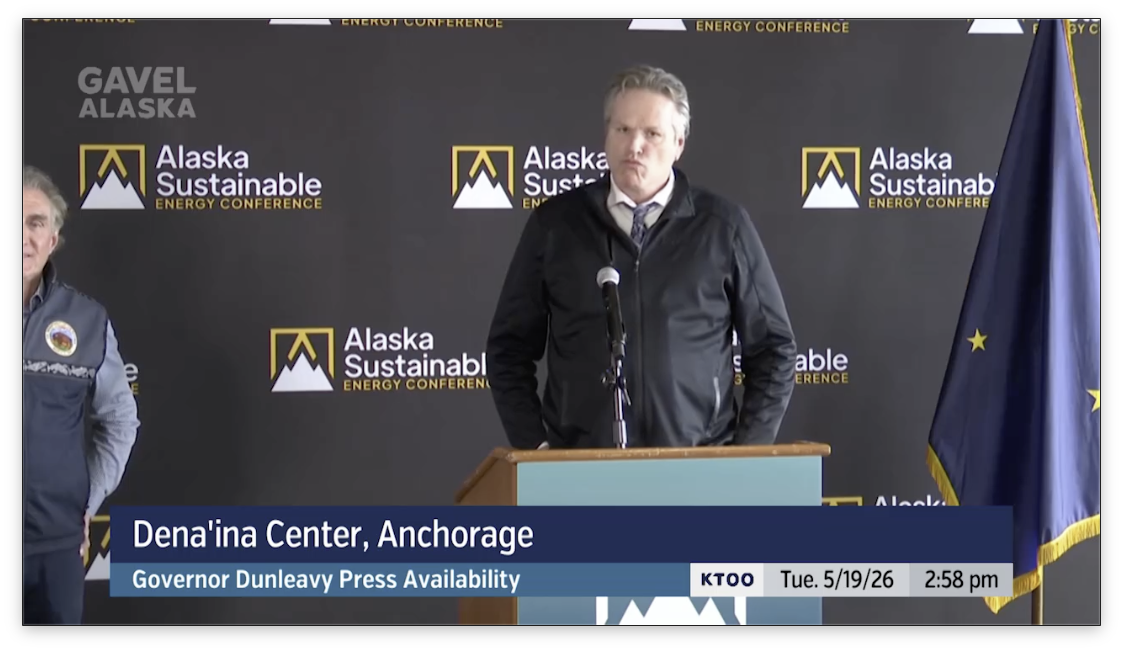
From the safety of an energy conference in Anchorage, Gov. Mike Dunleavy on Tuesday announced he's calling legislators back into a special session on Thursday to continue working on a multibillion-dollar, multi-decade subsidy that he insists is necessary to finally make the long-sought-after natural gas pipeline connecting the North Slope to Southcentral a reality. The AKLNG bill is the only legislation on the call, which means there's no longer the carrot of a pension plan on the table.
"A pension can wait," he said at his news conference.
Given that Dunleavy is leading the charge on the legislation, it's unlikely that lawmakers' litany of concerns about transparency or basic details about project costs and risks will be satisfactorily addressed over the next 30 days. The approach still seems to be to lambast well-founded questions about the many unknowns with a "C'mon, you don't want to be a wet blanket, do you?" or "You can either get what we're offering, or you can get zero when you kill the project." At the news conference, he insisted that Alaskans "need to know" that it's legislative leadership who will be at fault for the project's inevitable failure.
Still, the votes on Monday showed that a majority of lawmakers in the House are keen on giving Dunleavy and the developers pretty much anything they want based on little more than their word, as evidenced by a proposal that included a bottom-dollar tax rate and the rollback of transparency provisions. The cadre of pro-industry representatives also vehemently opposed closing any tax loopholes and rejected price protections for Alaskans.
What's less clear is where the Senate as a whole stands.
There's a vocal coalition of project skeptics who have so far refused to give the developers everything they want – the Senate Resources Committee on Monday advanced its version of the AKLNG bill on Monday, with lawmakers blasting what was happening in the House – but what ultimately matters is whether a deal can reach 11 votes.
By the end of Monday night, it seemed the House's bulldozer approach – which would have left the Senate with no input on the bill beyond an up-or-down concurrence vote – had lost them a couple of votes in the Senate. Now that the process has been reset without the fire-sale pressure of trying to get it done in time to save the pension bill, the course ahead is less clear.
Browbeating legislators into submission hasn't worked for the governor the last seven years, and that's not likely to change now that he's taken the one major piece of leverage off the table. Legislators are acutely aware that this project is being pushed by a governor who already has one foot out the door, and he won't be the one facing the fallout from his decisions.
Crime bill clears Senate with loads and loads of riders, ballooning from four pages to 65

Senate Judiciary Committee chair Sen. Matt Claman, D-Anchorage, infuriated people across the political spectrum when he latched onto House Bill 239 – a bill originally increasing the penalties for hit-and-run drivers who kill someone – as the vehicle for a massive crime omnibus bill. Of particular concern was the future of other provisions that would raise the age of consent in Alaska to 18, the latest in a long-running effort to protect young people against sexual assault and grooming, following up on a prior law that raised the age to marry in the state.
On Tuesday, HB 239 landed on the Senate floor with a frankly impressive number of riders and passed unanimously. If you need a visual representation of what happened to the bill, here's the new title:
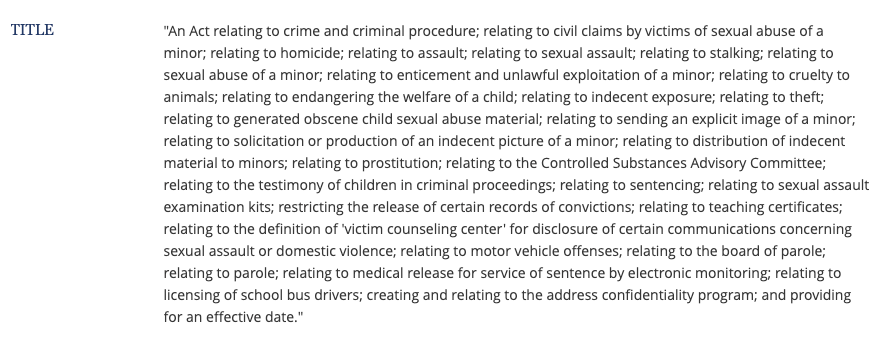
According to Claman's floor speech, here's what was added:
- HB 101, raising the age of consent to 18
- SB 247, creating penalties for computer-generated child sexual abuse material
- HB 242, creating a crime for sexual assault by health care workers (specifically a response to the disgusting case relating to a Juneau chiropractor)
- HB 62, updating the process for the state's handling of rape test kits
- HB 81, limiting access to certain marijuana conviction records
- SB 62, updating the parole board by expanding it by two seats
- SB 100, establishing the crime of mail theft as third-degree theft
- SB 31, a new address confidentiality program
- HB 384, adds tribal organizations as potential victim counseling centers, extending confidentiality protections for victims
- SB 17, creates the crime of airbag fraud
- SB 233, moving the controlled substance advisory panel from the Department of Law to the Department of Commerce, Community and Economic Development
- Updates the state's animal cruelty laws to cover bestiality
- Raises the minimum age for prostitution charges to 18, meaning minors won't be able to be charged for prostitution when they are also victims
The measure returned to the House this morning for concurrence, where legislators largely held their noses and voted for the sprawling package. The lone no vote on the omnibus bill came from Rep. Bill Elam, R-Kenai, who said it was "beyond a Christmas tree."
The bill heads next to the governor.
Long-running fight for public-sector pensions ends, for now, with failed veto override
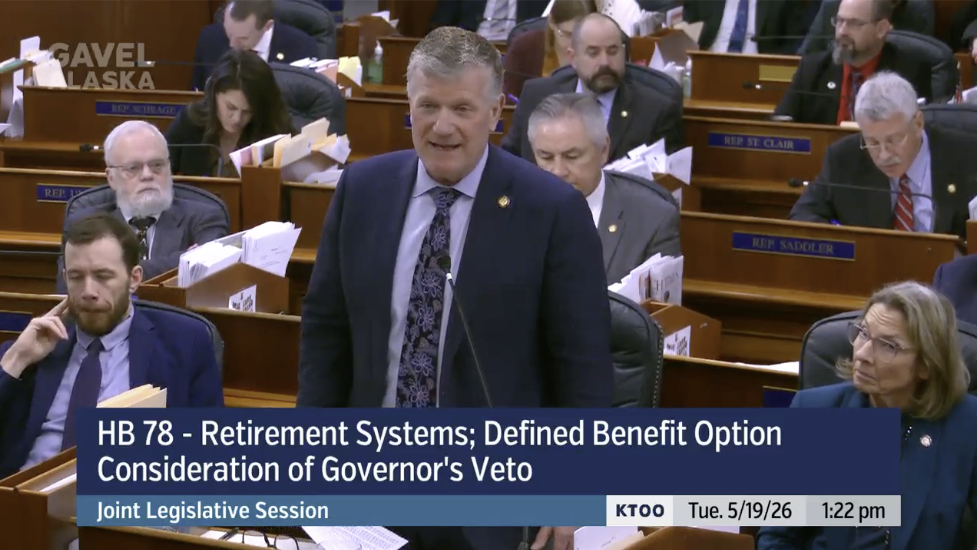
The latest effort in lawmakers’ long-running push to restore a pension retirement for public sector workers in Alaska came to an end on Tuesday as lawmakers failed to override Republican Gov. Mike Dunleavy’s veto of the bill.
The 33-27 vote fell short of the 40 votes needed to enact House Bill 78, which would have given public-sector employees the option to opt into what backers conceded was a bare-bones pension system. Still, it’s the farthest the measure has advanced since lawmakers rolled back the pension system in 2006, teeing up the issue for 2027, when Alaska will have a new, potentially worker-friendly governor.
The veto of the legislation was long expected, given Dunleavy’s animosity against organized labor — the Alaska Supreme Court once found he had acted with “abundant evidence of anti-union animus” — but he seemingly tried to make a deal with lawmakers, offering to let it become law if they passed a massive subsidy for his natural gas pipeline megaproject.
Lawmakers tried and failed to make that happen on Monday, when House Majority Leader Rep. Chuck Kopp, a moderate Anchorage Republican who ran on restoring a pension, spearheaded an effort to ram the bill through as an amendment to a bill nearing the finish line.
Ultimately, that effort was hampered by insurmountable technical issues and failed to advance, and Dunleavy issued his veto of the pension bill just before midnight.
Lawmakers met in a joint session Tuesday afternoon, as required by the Alaska Constitution, to hear one last round of passionate arguments for the pension.
“House Bill 78 is not a retirement bill. It is a workforce bill, and it’s a resource development bill,” Kopp said. “We cannot build a gas line through this state unless we can retain our engineers. We cannot permit a mine when the permitting office turns over every 18 months. We can’t drill on the North Slope when the haul road isn’t being maintained. … Every business in Alaska depends on a functioning public sector underneath it.”
Sen. Bill Wielechowski, D-Anchorage, referenced a 2009 Scranton Times-Tribune article where Dunleavy talked about how great Alaska’s pension system was to him when he started working, where he said “I could retire with an income that many people would envy as a working income.” Wielechowski said if it was good enough for the governor, it should be good enough for younger Alaskans.
“Michael Dunleavy, when he said that, was absolutely right,” Wielechowski said. “He came, and he stayed for the pension, and it was very good to him. We should not be pulling up the ladder. He shouldn’t be pulling up the ladder, because it was good for him, and it was good for a lot of people in this room. We shouldn’t be pulling up the ladder.”
But pull up the ladder they did.
Sitka Sen. Bert Stedman, another longtime Alaska worker who has a state pension, insisted that young people don’t want to pursue a lifelong career anymore, and that chronic employee turnover is a product of people wanting to switch jobs rather than of jobs not being attractive. Then he joked that the most helpful thing he could do for the system is croak.
“I’m not wishing anybody to expire early, maybe a couple of my representatives would wish one guy would expire and help with the pension a little bit,” he said. “Have a heart attack and get it over with, but I’m part of the problem. I’m going to hang around for a while, and hopefully a long time.”
Other lawmakers have been similarly dismissive of younger Alaskans attempts to share in the same systems that benefited them. Tok Republican Sen. Mike Cronk said earlier this year that young people don’t want pensions, even though he admitted that he worked precisely 25 years as a teacher in order to get medical benefits from the state. Glenallen Republican Rep. Rebecca Schwanke said that her family cost the state $30,000 in medical costs last year, and that they couldn’t afford to bring anyone else on.
Stedman pointed out that his retirement benefits are protected under the Alaska Constitution, telling anyone who might be getting ideas about his benefits to think again.
“We can’t do that, and I’m not advocating that we change our constitution and strip retirement, guaranteed retirement benefits away,” he said. “I think that’d be one of the worst things we can do. So, I don’t want anybody to misinterpret what I’m saying.”
What’s next?
The pension, like so many other worker-friendly reforms, will have to wait for another governor.

This story was edited with help from Victoria Petersen and The Alaska Current. Everything else is mine, including the typoes.
Styrofoam food container ban passes

Soon-to-be-retiring Anchorage Democratic Rep. Andy Josephson's House Bill 25 – a ban on polystyrene single-use food containers – cleared the Legislature on Tuesday, first passing out of the Senate and then clearing the House on concurrence. In the Senate, the measure added a provision that'd allow local governments to opt out of the ban, which would otherwise take effect in 2027.
The bill now likely awaits a veto by Dunleavy.
Trap-spay-neuter-and-release program axed
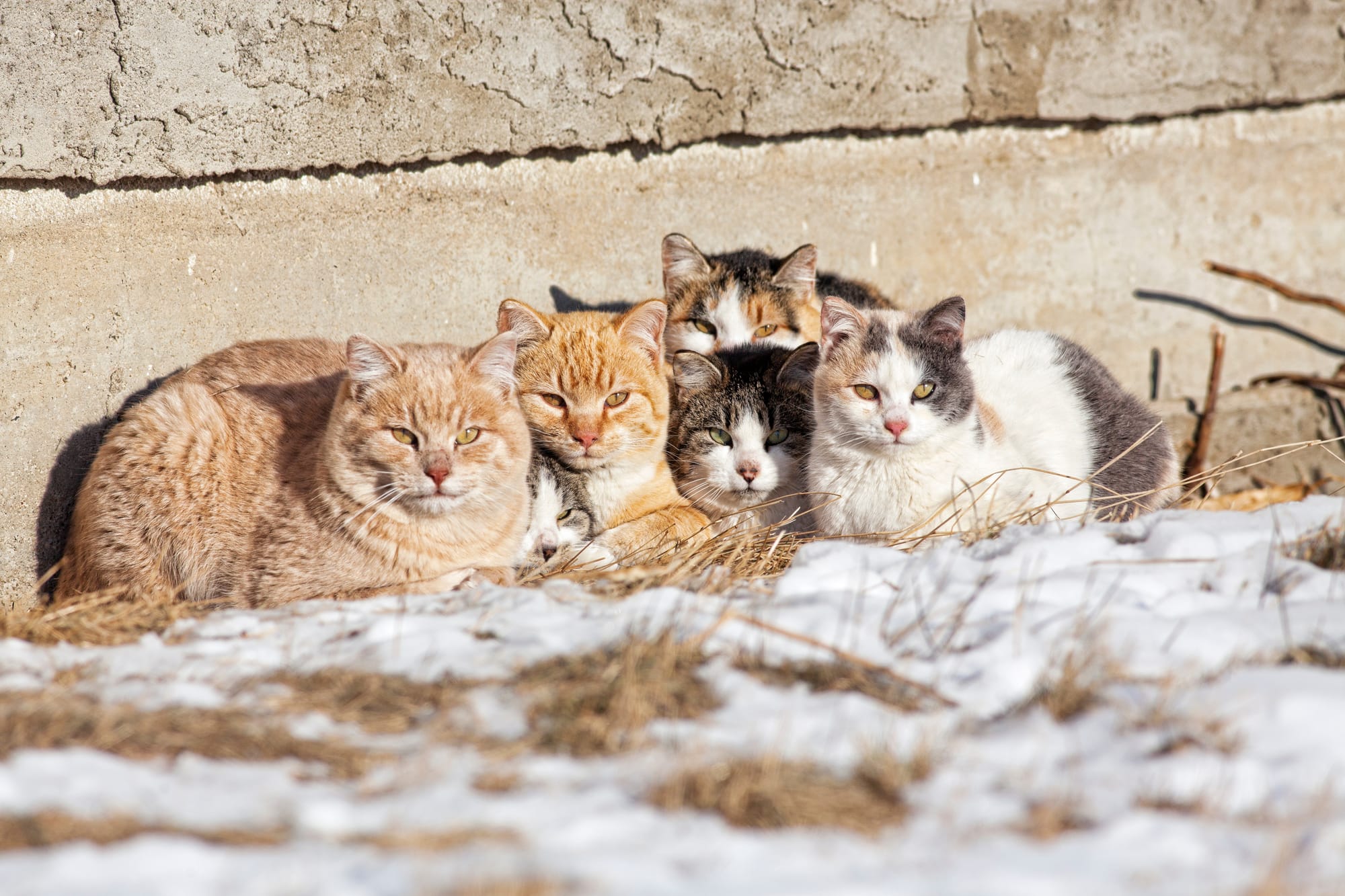
Fairbanks Republican Rep. Will Stapp's bill establishing a state program to help local communities set up trap-spay-neuter-and-release programs for feral cats and dogs seemed relatively non-controversial – sounds like a good plan, right?
Well, that's until it returned to the House as a rider attached to a Senate bill dealing with invasive species, and lawmakers were claws-out.
"This is not something that bodes well for wild birds across our state," said Rep. Rebecca Schwanke, the far-right Glenallen Republican with a soft spot for the outdoors. "Being able to trap, neuter, vaccinate, and release feral cats is the single worst decision that urban areas around the United States have made when it comes to urban bird populations. ... They are a predator. This is a feral animal."
Others chimed in to defend the bird populations.
"A personal observation: in our neighborhood, there is just a significant decline in wild birds, songbirds, little bitty birds, all kinds of birds, and we have lots of cats running around," North Pole Rep. Mike Prax said. "So, there must be some sort of connection to that. ... (Cats) should not be just returned to where they were because of the impact on the bird population and wild animal populations."
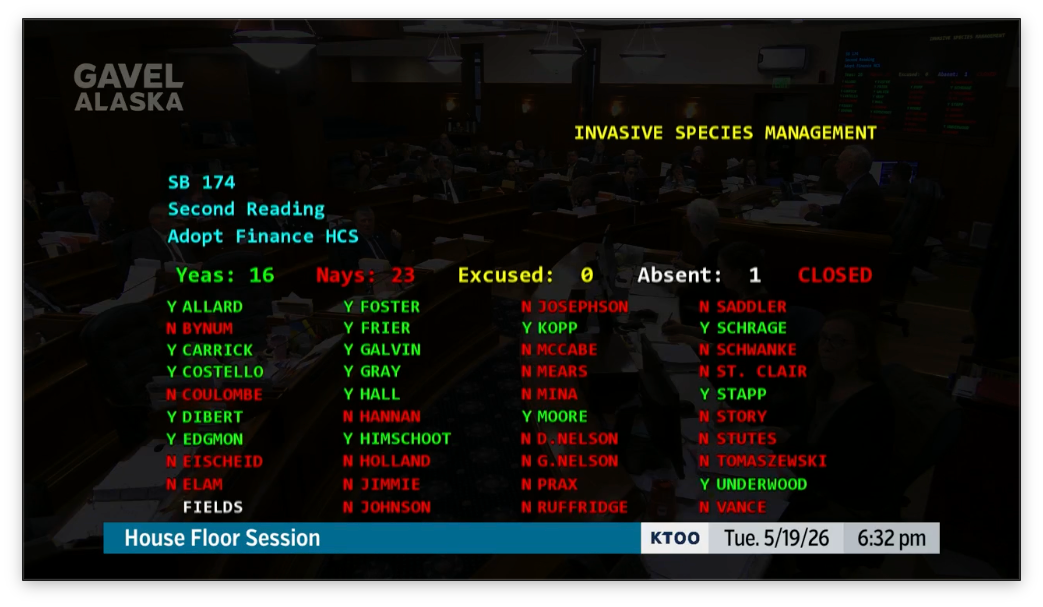
Lawmakers voted 16Y-23N against adopting the House Finance Committee's version of the bill that packed in the program. Instead, they enedup taking a clean version of SB 174 that simply sets up a coordinator position for invasive species management.
Of course, no one mentioned it, but the alternative to the trap, fix and release is trap, fix and adopt, but mostly euthanize.
Anti-smoking bill passes with "super popular, super cool" cigar lounge legalization

Lawmakers passed an updated version of the vape tax and tobacco age bill that Dunleavy vetoed several years ago. Senate Bill 24 would formally raise the state's tobacco possession age to 21, aligning it with federal law. It would also extend cigarette-style taxes to vapes, which currently fall outside the state's tobacco taxes.
Of course, a crew of stogey-lovin' Republicans took it as an opportunity to open the doors to cigar lounges, which Fairbanks Republican Rep. Will Stapp breathlessly called "super popular, super cool," as others brushed away the concerns that it very obviously conflicts with the state's smoke-free workplace law. Several of the GOP bros also complained mightily that there are on-site cannabis consumption sites (which, for the most part, are for edibles or are outside), saying it wasn't fair that cannabis got special treatment compared to "premium cigar culture."
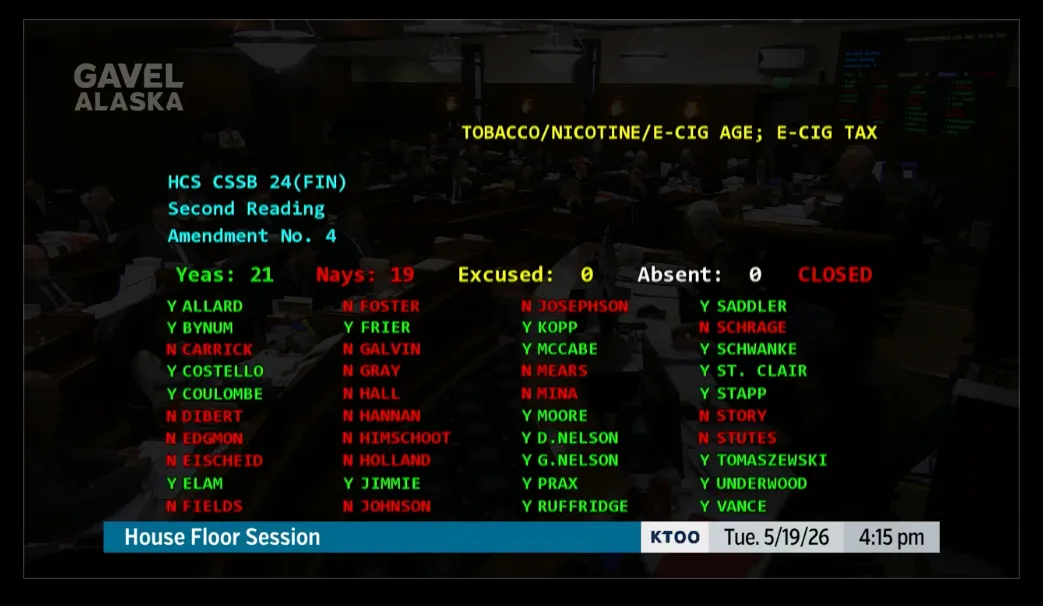
The amendment ultimately passed 21-19.
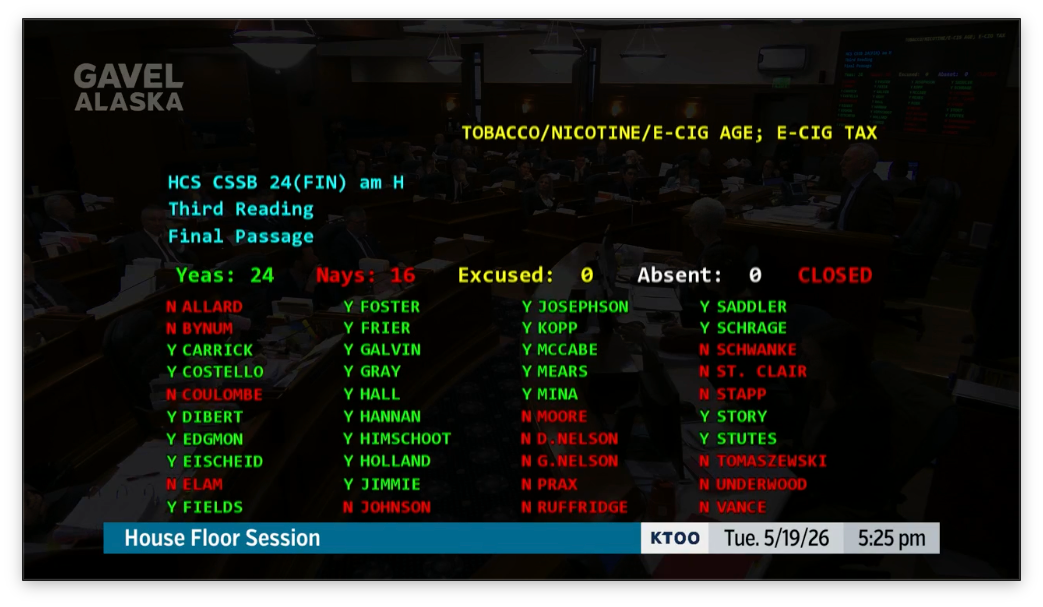
The underlying bill was later passed 24-16.
The measure also cleared the Senate this morning, teeing it up for another veto. But, hey, maybe the cigar lounge thing will change his mind.
Stay tuned!

The Alaska Memo Newsletter
Join the newsletter to receive the latest updates in your inbox.