Legislators dismiss the AKLNG ‘razzle dazzle,' and Dunleavy's vetoes show what's at stake in the race for governor
The big takeaway from the first full week of the special session is that Alaska's fortunate they didn't rush it through.

Hellooooooo, Alaska! It's Friday.
In this edition: In the first full week of hearings on the project, lawmakers are finding more questions than answers as they tease out the risks of the economically questionable megaproject. They don't know where the cost might land, how much Alaskans might have to pay for the gas – or the project itself – while the entire subsidy could be wiped away by overruns. Also, there's a new episode of Hello Alaska with Matt and Pat out breaking down the end-of-session blitz. And we'll also talk about how Dunleavy's latest round of legislating via veto is a good reminder that so much will have to wait until someone else is in that office. Also, weekend watching and the reading list!
Current mood: 🚲 😎
"I just couldn’t stomach the idea of letting that legacy disappear or watching it pass to another outside owner."
The indomitable Amy Bushatz, the editor and founder of the upstart Mat-Su Sentinel, on acquiring the Mat-Su Frontiersman newspaper.
Risk-adverse legislators dismiss the AKLNG ‘razzle dazzle’ to drill down on the details
The biggest takeaway from the first full week of hearings on Gov. Mike Dunleavy’s proposed multi-billion-dollar, multi-decade subsidy for the natural gas pipeline project is that the state sure is lucky that lawmakers’ efforts to rush the bill through didn’t pan out.
With the table cleared of all other legislation, lawmakers on the powerful House and Senate Finance committees have spent the week hearing from consultants, economists, local borough mayors, Dunleavy administration officials, North Slope producers and other experts. They’ve drilled down into details that hadn’t received much scrutiny, like the risks not only if the pipeline doesn’t get built, but if it does.
What they’ve found is far more questions than answers about the 800-mile megaproject aimed at selling the North Slope’s vast gas reserves to international buyers, delivering potentially affordable gas to Alaskans living in Southcentral Alaska and Fairbanks and putting a bit of money into the state treasury. The big fundamental question is whether the project makes sense in the first place, or whether there's a good reason the North Slope producers walked away.
And what's becoming clear is that even with the preferred give-them-everything-they-want approach adopted by Dunleavy, the project remains only marginally competitive in the world market. Tax cuts only go so far when a 100% cost overrun is in the range of outcomes and the actual source of the gas hasn't been identified.
How much will AKLNG cost?
It’s been particularly evident in the Senate Finance Committee – a committee that would have been locked out by the rushed process, which is probably the point – where Sitka Republican Sen. Bert Stedman has been steadily picking apart the project's fundamental claims and assumptions.
“So that number is complete garbage, and it makes it very misleading,” he said at Wednesday’s hearing with the Legislature’s oil and gas consultants about the cost estimates on the project. “We knew it, a lot of us have been around knew that’s not at all that case, but that’s the line of razzle dazzle they gave us.”
The $46 billion estimate is simply a back-of-the-napkin update, adjusting a 10-year-old cost estimate for a prior iteration of the project for inflation.
For Stedman – who frequently raises the issue of rising construction and maintenance costs in Alaska when discussing the ever-growing backlog of aging public infrastructure – and for most anyone else watching, it’s clear that more than just inflation will likely be driving up costs. After all, a lot has changed in a decade.
For their part, Dunleavy and developer Glenfarne have been tight-lipped about where the cost of the latest iteration of the AKLNG project will land, arguing that divulging that information to lawmakers would undercut the project’s chances of competing in an already-competitive investment market.
While that may be debatable, what’s not debatable is that the project's cost overruns will have a far greater impact on its economic viability than even the generous cuts envisioned by Dunleavy. A 20% difference in the final cost could easily wipe out any competitive edge Dunleavy generated. The Legislature's oil and gas consultant, Nick Fulford from GaffneyCline, provided this helpful overlay identifying the "zone of profitability" for the project on the state's modeling of the project's sensitivity to overruns and gas prices.
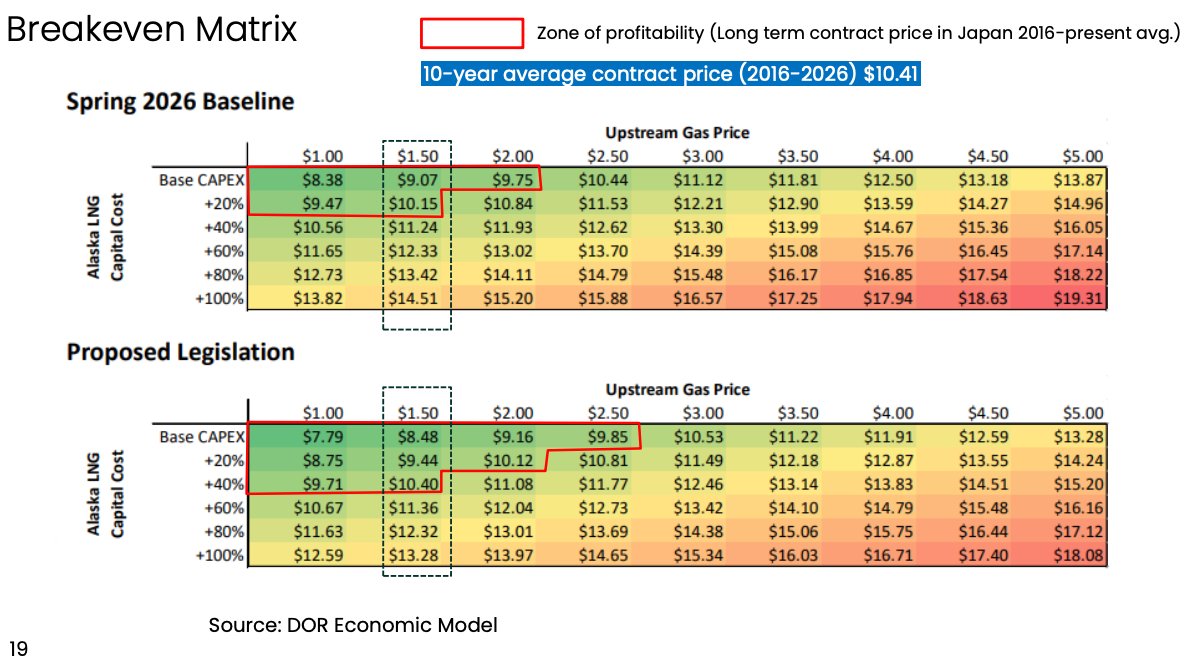
In it, he's highlighted the areas essentially where the project would be a go in the red outline. It's also important to note that this only illustrates the difference between the status quo – a position that almost no one seems committed to actually maintaining at this point – and the governor's maximally generous position. By giving nearly $21 billion in local and state tax cuts, the zone only expands that window's range by a square in each direction, meaning it could probably weather up to a 40% cost overrun as long as gas on the North Slope doesn't go north of $1.50 per MCF, as opposed to a 20% cost overrun under the status quo.
Another 20% overrun, and the project falls out of the profitability zone altogether.
At today's meeting of the Senate Finance Committee, state chief economist Dan Stickel told lawmakers that while he still doesn't have any firm knowledge of the price range, project developers at least say the state's in the ballpark.
"We've been told that while AGDC and Glenfarne are not sharing the updated cost assumptions, we are told that they are within the range of our sensitivity analysis for construction of between $46 billion and 100% cost increase," he said.
So, anywhere between $46 billion and $92 billion. Not exactly helpful, a point that Stedman didn't let slide.
"I'd like to see the lender lend on those numbers and keep his job."
How much will AKLNG cost the state?
Having the project cost as a complete unknown is, of course, a major issue for lawmakers because it has a trickle-down effect on nearly every other aspect of the project. It’ll impact the price of gas for Alaskans — playing a big role in whether it delivers cheap energy, affordable energy or barely competitive energy — as well as future cash calls on lawmakers.
One of the big things that wasn’t discussed much in the final mad dash to the session is what’s next for the AKLNG project if lawmakers approve the subsidy. To hear some boosters of the project, this bill is the one and only thing lawmakers need to do, but listen to the presentations, and it’s clear that if it goes ahead, legislators could be dealing with the project – and its hard sell – for years to come.
That’s because the current agreement includes various stages in which the state could be asked for additional funding to cover the project's construction costs, a move it would need to make if it wants to maintain its 25% equity ownership in the project. If not, the state's stake in the project would soon get diluted to nothing.
That's because the state owns only 25% of a holding company – 8 Star Alaska – that will own subsidiaries that will ultimately build, own and operate the pipeline and treatment facilities. Once investors come in to provide capital to actually build it, their money will go into those subcompanies, and they'll get an ownership stake. It's not a question of if that will happen, but when and when they do, the state's ownership will get diluted, potentially to a near-worthless level.
"In order to raise the funds to build 8 Star Pipeline, they're going to have to issue out the equity to other investors in order to bring in the cash necessary to build the thing," explained AGDC's Matt Kissinger to House Finance on Thursday. "That is called dilution, and that is exactly how it was designed. This should not be an aha moment; this is truly how it works. Is just like in Shark Tank, when they go in and make their trade, they're getting diluted. They walk in owning 100% of their company, they walk out owning 70% 60%. It's the same exact model here."
He said the state will be able to "dilute the diluters" and protect its 25% stake by contributing 25% of the project's latest cash call, including to cover overruns. Lawmakers would have a six-month window to pony up the cash or risk losing out. And that's not to mention the inevitable political pressure to keep the project moving if other investors don't materialize to cover the overruns.
That could be anywhere from a few hundred million to several billion dollars at each stage of the project. It's also important to note that, given those tight turnarounds, Legislators would have few realistic sources of cash to tap beyond the Alaska Permanent Fund's earnings reserve account, which is a can of worms.
This week, many legislators were still wrapping their heads around what the entire process would look like, because it's quickly becoming clear that this subsidy bill is just the start of lawmakers' asks.
And while project officials have framed the buy-in as offering legislators the opportunity to invest in the project, suggesting there will be thorough vetting at each decision point, the current ploy of trying to ram the project through with little opportunity to ask those questions isn’t exactly setting a great precedent. AKLNG backers have bombarded legislators with everything from ad blitzes to a former U.S. senator and angry news conferences, where the governor has tried to preemptively pin blame for the projects' failure on individual lawmakers.
This "Why are you asking so many questions when you could just pass it, what are you a chicken?" approach very nearly worked on legislators, so there's no reason for them to abandon it at the project's next junction.
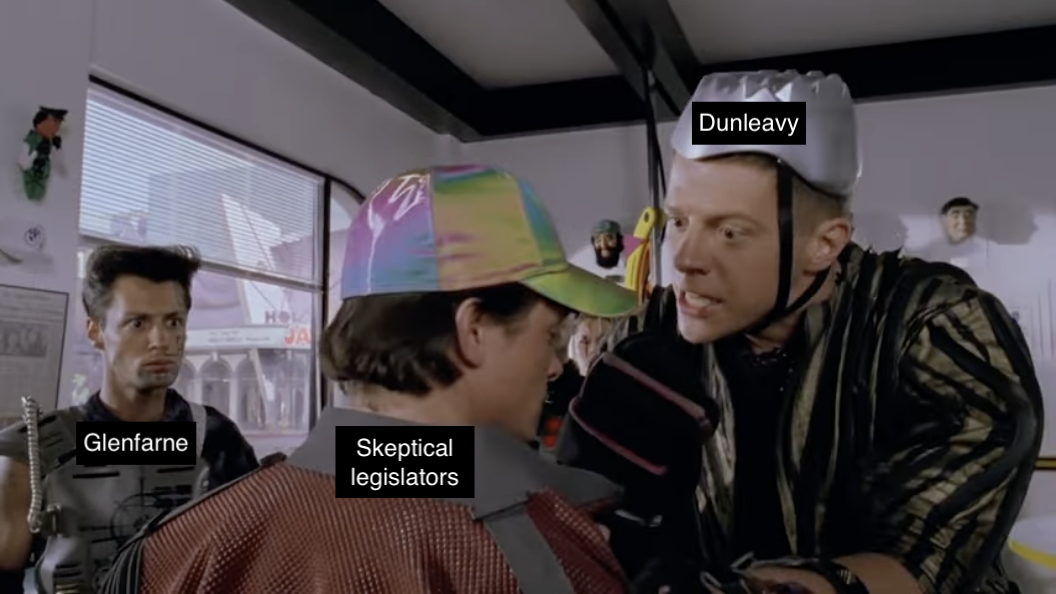
How much will AKLNG cost the state, and what's the state going to get for all its money?
It also doesn't sound like the current issues around transparency will actually be solved if legislators put a bunch of equity into the project.
At the House Finance Committee hearing on Thursday, officials with the Alaska Gasline Development Corporation – who started out the hearing by proclaiming they’re “100% aligned with Glenfarne” – conceded that even if lawmakers choose to invest, they won’t necessarily get the answers they’re looking for on the project economics. That information, they said, will flow to them at the "100%-aligned-with-Glenfarne" AGDC, which will make the pitch to lawmakers.
If and when lawmakers get the insight they want on things like the project schedule, debt levels, cash flow and tariffs will basically be left to the folks at the "100%-aligned-with-Glenfarne" AGDC to decide what they actually need to know and what can be papered over with a "What are ya? Chicken?" sales pitch.
For lawmakers like Sen. Stedman, the situation leaves Alaskans with way too much exposure to risk, whether it's calls on the treasury to keep the project profitable or the risk that the project won't live up to its lofty promises and will leave Alaskans paying for way more pipeline capacity than they could ever use.
"I don't wanna be here like I'm bitching about everything, but I got a couple sniffles," Stedman said. "Who's gonna put down the $3 billion in cash when there's nobody on the other end to put any gas in it. It's ridiculous. ... Some of the real high-level underwriting numbers, I'd like to see those, because I just have a hard time getting comfortable if we're stuck with a 42-inch line at 8 or 10% capacity, and the folks in the Railbelt are stuck with a bill."
There's also the question of whether the state may be giving up too much.
While there's a general agreement that moving away from the property tax structure is needed for cash flow purposes – it's hard to levy a property tax on a gasline that hasn't started – the next question is whether that change should also come with such a deep and near-perpetual cut that Dunleavy and Glenfarne want.
They're asking that their tax cuts last for 36 years, while most other LNG projects get just 10 years. Fulford told lawmakers that the true make-or-break window for an LNG project is in its first 10 years. After that, he said, it's mostly upside.
"In 10, 20, 30 years, this project could be generating billions of dollars in free cash flow, and the way in which it's taxed in that time ... makes little difference," Fulford told House lawmakers on Tuesday. "Because those cash flows are so heavily discounted, they make almost no difference, so in that sense, I would suggest that alleviating the tax burden on the project for that first 10 years or so is of far more importance than what you do after 10 years."
But as Fairbanks North Star Borough Mayor Grier Hopkins told the House Finance Committee on Thursday, the ultimate goal for many along the pipeline corridor is to secure affordable energy. And while we have focused a lot on cost comparisons with Southcentral's import plan – where the worst-case scenario for AKLNG doesn't look favorable – Fairbanks is already grappling with frankly atrocious energy costs. Even the worst-case scenario for AKLNG – where they build a massive pipeline but never get around to exporting the gas, so Alaskans are stuck paying for an overbuilt pipeline – is likely cheaper than what the city's paying.
When asked by Ketchikan GOP Rep. Jeremy Bynum if Fairbanks had to pick between cheap gas and the revenue to cover the anticipated impacts on roads and emergency responder services (a sticking point for AKLNG boosters who worry those payments would cut into profits), Hopkins stressed that while Fairbanks will likely feel the impacts of the pipeline construction more acutely than in any other region, thanks to its existing pipeline manufacturing infrastructure and rail access, the potential for low-cost energy is too big an opportunity to pass up.
"If you're asking me to pick one or the other, we've been waiting 60 years for a gasline," Hopkins said, "We haven't been waiting for 60 years for a gasline's ancillary impacts to the communities, so I think that choice would be easy."
Well, as long as it's affordable.
Stay tuned.
Follow the threads via ThreadSky:
- House Finance on Tuesday
- Senate Finance on Wednesday
- Senate Finance on Thursday
- House Finance on Thursday
- Senate Finance on Friday
Dunleavy’s latest vetoes are a reminder that a lot will have to wait for a new governor
Alaska’s 2026 regular legislative session came to a largely smooth ending last week, with lawmakers wrapping up the final day of passing bills with plenty of time to spare.
Much of that is because high oil prices buoyed the state’s budget — usually one of the largest points of friction in the final days of the session — with extra money for education, school maintenance, child care and healthcare, all while running a slight surplus and paying out a $1,200 PFD. And that’s based on the spring revenue forecast, which was put together in the nascent days of Trump’s Iran war, meaning the surplus could very well be massive by this time next year.
Legislators ultimately resisted the urge to spend based on those assumptions, leaving what could be hundreds of millions in additional oil tax revenue for next year’s Legislature to decide.
And even if oil prices fall back to earth and the time of tight budgeting returns, lawmakers will still have plenty to look forward to.
That’s because this is the final year of far-right Alaska Republican Gov. Mike Dunleavy’s time in office.
His schoolyard-bully approach to legislating never won over lawmakers, who spent much of the last eight years working to curb his worst impulses while struggling for incremental progress — last year’s massive fight over education funding boiled down to a $20 increase in per-student funding over the prior year. When Dunleavy doesn’t get his way, he’s taken to giving performatively angry news conferences that often get combative with reporters, disappearing from Juneau for long stretches of the session and, of course, vetoing the heck out of lawmakers’ bills.
Thanks to Alaska’s strongest-in-the-nation veto power — requiring a ⅔ vote to override non-spending vetoes and a ¾ vote to override spending vetoes – Dunleavy has often resorted to legislating by veto in his second term.
He issued 12 non-budget vetoes during the 2023-2024 legislative session and has already issued another 12 during this one, including his twelfth non-budget veto on the final day of the session: Anchorage Rep. Genevieve Mina’s bill to include the input of local communities and tribes in the formulation of the state’s transit plan. That followed his veto of the pension bill after lawmakers failed to sign off on his AKLNG pipeline subsidy — a move he allegedly made in front of one of the bill’s key sponsors, as if to rub their face in it.
Other vetoes have appeared petty, seemingly targeting legislators who have been critical of him, such as his 2023 veto of Fairbanks Rep. Ashley Carrick’s legislation to update state law on e-bikes. Other lawmakers suggested it was payback for her criticizing his latest K12 funding veto.
“I can say there’s been chatter about the governor being hard on particular legislators,” Fairbanks Democratic Sen. Scott Kawasaki told the Alaska Beacon at the time. “I just think the governor’s been a little petty with some of the obvious politics around good bills.”
Combined with the three non-budget vetoes he issued in his first term, Dunleavy has issued 26 over his two terms in office. That’s more than Govs. Bill Walker, Sean Parnell, Sarah Palin and Frank Murkowski had combined.
Dunleavy still has plenty of opportunity to run up the score this year. There are still dozens more bills that the Legislature has yet to send over to the governor for consideration — including prime targets like campaign contribution limits, a bill honoring the late Vic Fischer (a legendary statesman who spent his final years trying to recall Dunleavy), and a ban on single-use Styrofoam food containers.
That said, he’s not likely to catch up with the last veto-happy governor. That’d be Democratic Gov. Tony Knowles, whose fraught relationship with legislative Republicans led to nearly 70 vetoes over his two terms in office. Legislators ultimately mustered overrides for 20 of them.
In the big picture, Dunleavy’s legislate-by-veto approach means that, in addition to stopping the damage he’s done from the governor’s mansion, lawmakers have faced eight years of roadblocks on everything from school funding and contraceptive care to public pensions and the most modest election reforms.
His veto of the election bill — a measure designed to be inoffensive across the political spectrum — stands out in particular because so many of its policies are ones he had once championed.

That included voter roll maintenance measures that would have made it far easier and faster to deactivate voters suspected of being ineligible to vote, a measure long sought by conservatives. On the flip side, it would have implemented ballot-fixing and ballot-curing, but also aimed to make around-the-edges changes to many of the well-known, long-standing structural barriers to voting in rural communities.
Other issues, like campaign finance limits, struggled to get traction with lawmakers because the governor’s veto seemed like a foregone conclusion. (Interestingly, lawmakers revived the campaign finance in the final hours of the legislative session, setting it up to be his 13th veto.)
For many, it feels like the state’s stuck in neutral.
While his veto message on the election tried to hide behind concerns about implementing the changes in time, the underlying message was that election reforms — like so many things — will simply have to wait for a new governor.

This story was edited with help from Victoria Petersen and The Alaska Current. Everything else is mine, including the typoes.
More from The Alaska Current
 Holly Todd
 Dermot Cole
 Tammalivis Salanoa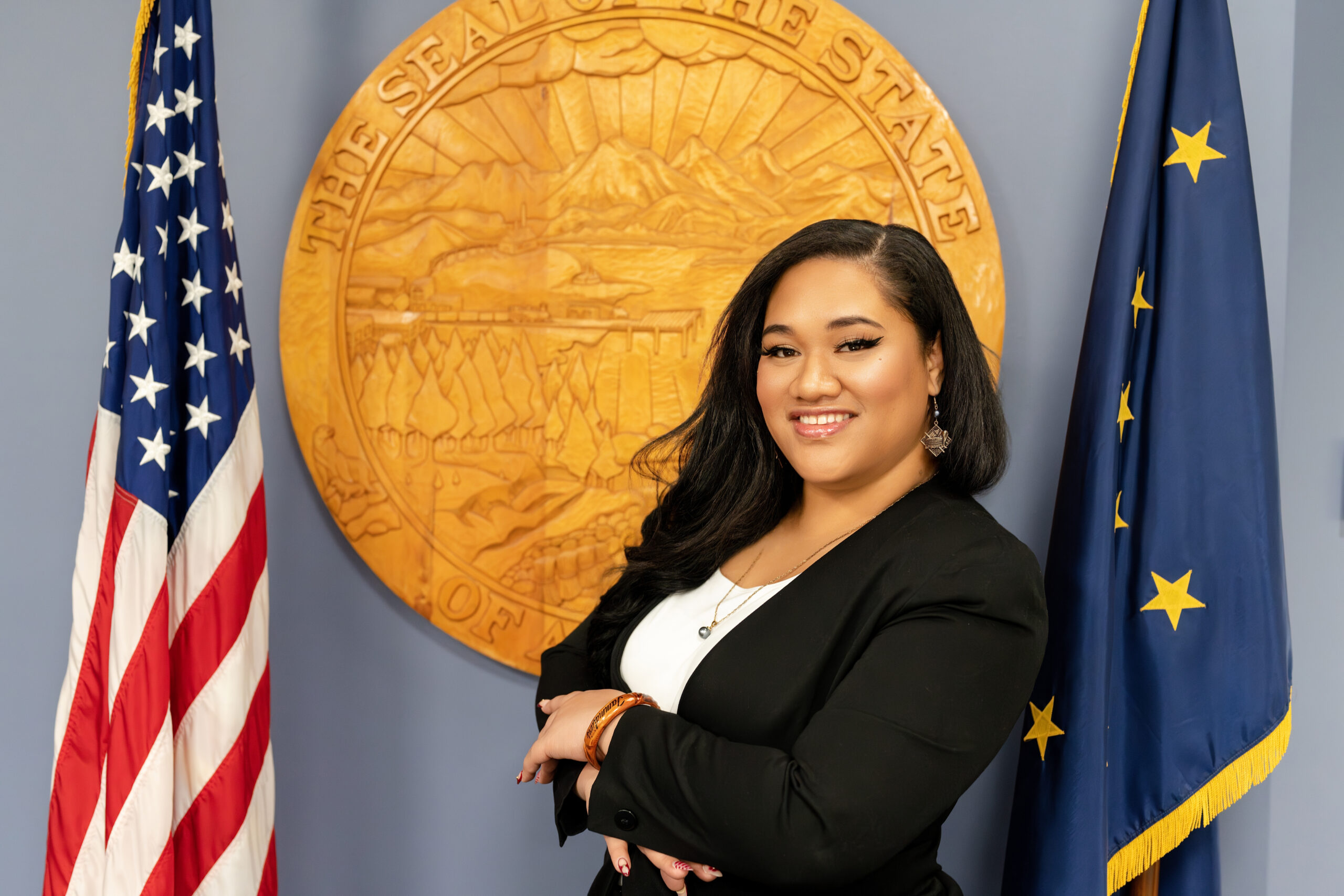
📰 And the rest of the state
 Iris Samuels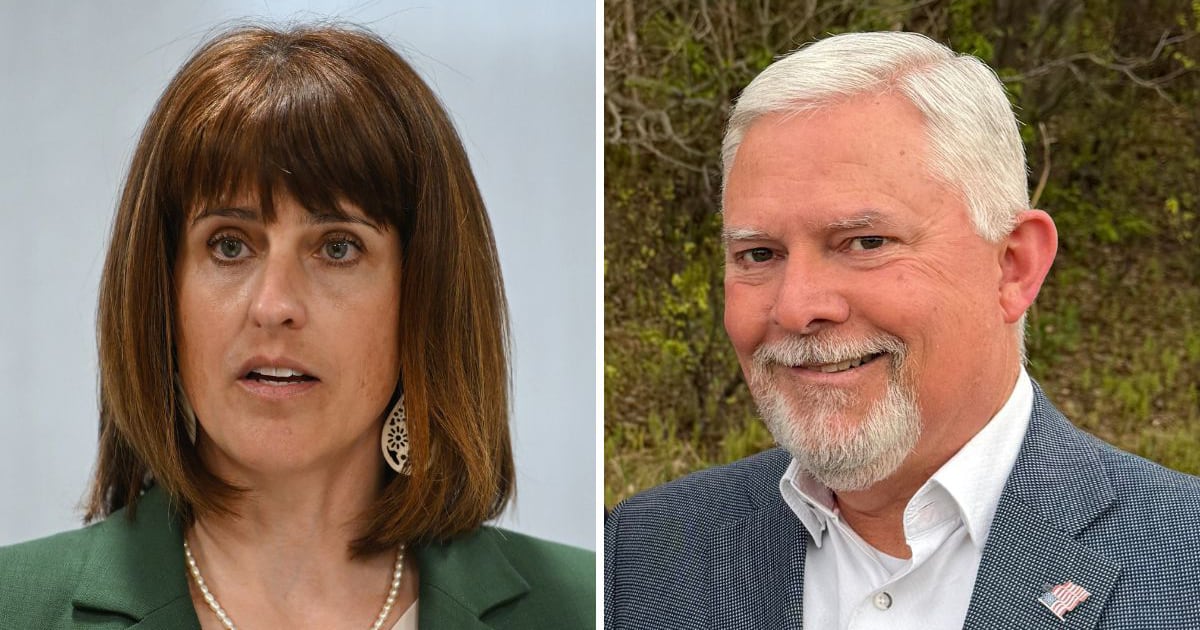
The gubernatorial race is shaping up as candidates scramble to finalize their tickets, with one Republican turning to none other than Jeff Landfield. I'll get to it once the dust settles.
Eric Stone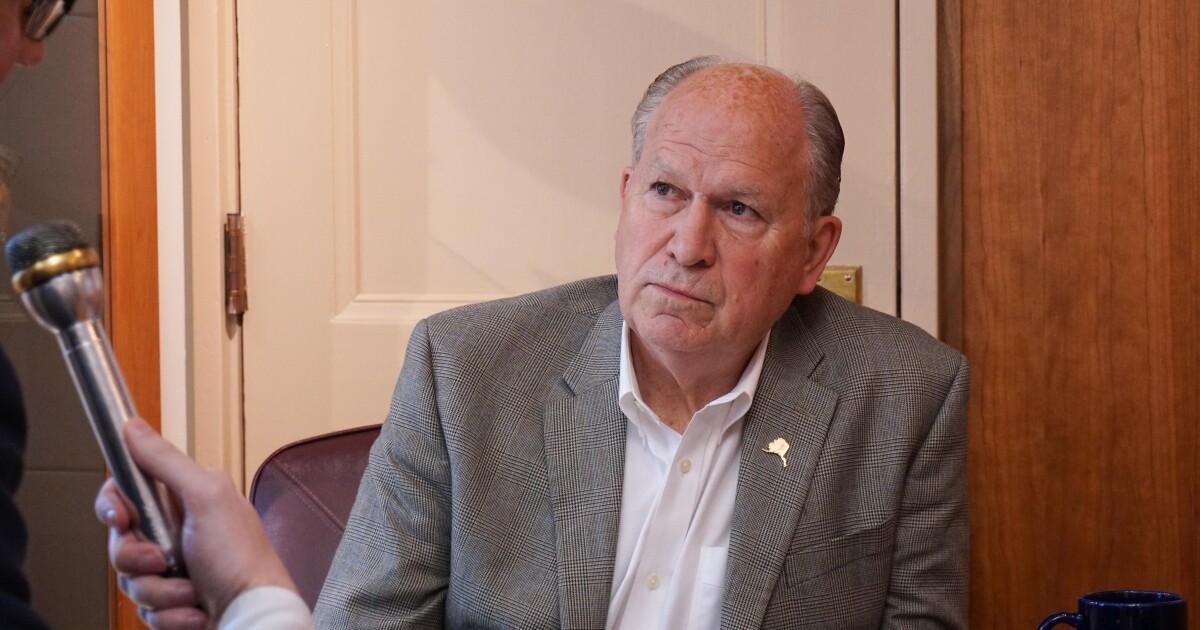
🤔
 Wil Courtney and Matthew Simon
Anyone else remember "So Many Reasons for McGuire"?
 Liz Ruskin
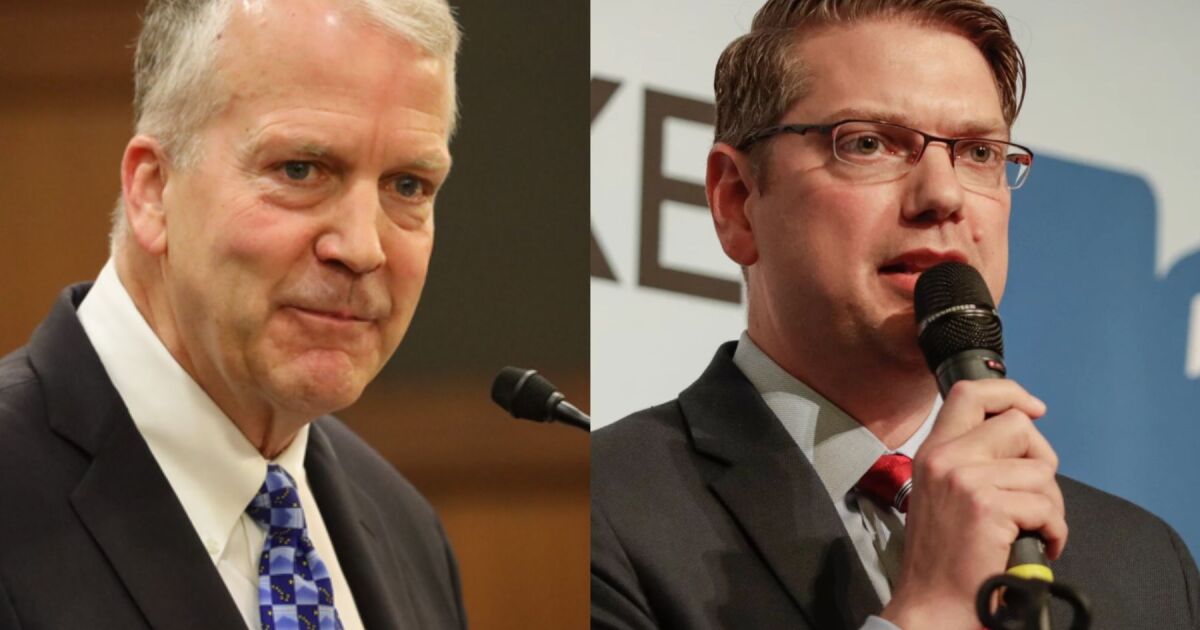 Margaret Sutherland
 Yereth Rosen
📺 Weekend watching
One of my favorite escapes lately has been shows on the Dropout network (previously College Humor), especially Game Changer, where the rules change every game. Most of the great episodes are all behind the paywall, but luckily, their Secret Sober Game Changer – one of my favorites – is public. Check it out!
Have a nice weekend, y'all.

The Alaska Memo Newsletter
Join the newsletter to receive the latest updates in your inbox.