House continues effort to understand Oath Keepers' alternate reality
Researchers warned that the Oath Keepers and other far-right militias pose a serious risk through a combination of conspiracies, militarism and "popular constitutionalism."

Good evening, Alaska!
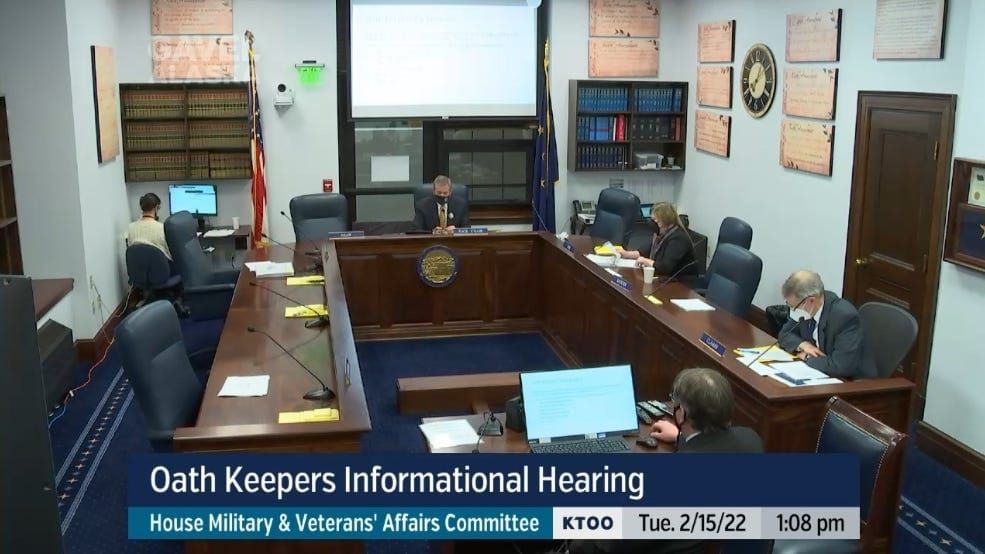
In this edition: The House Military and Veterans’ Affairs Committee continued its hearings on the Oath Keepers—without involvement of any House Republicans—and delved into some key concepts important to understanding just how a group ostensibly in support of upholding the U.S. Constitution seems hellbent on doing anything but upholding the U.S. Constitution; Jessica Cook joins Les Gara’s gubernatorial ticket; Sen. Natasha von Imhof is done with politics “for the foreseeable future”; Dunleavy’s neutrality on the U.S. Senate race didn’t win him any favors in Mar-a-Lago; and some corrections.
Legislative day: 29
Spice level: 🫑
Alaska redistricting lawsuit status: Still waiting for a decision. It’s due by midnight.
The problem with ‘Popular Constitutionalism’
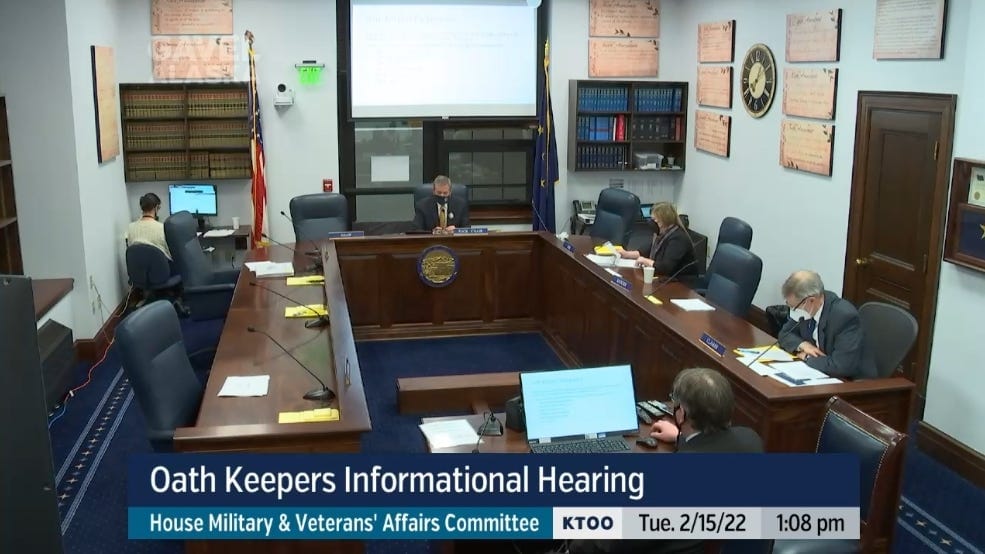
That was one of the key concepts to remember from today’s meeting of the House Military and Veterans’ Affairs Committee, which continued its informational series on the Oath Keepers today. The concept of “Popular Constitutionalism” and “Popular Nullification” are, as was explained by the researchers presenting today, the concept that the individual—not the U.S. Supreme Court—can be the only arbiter of what is constitutional and what laws should be upheld. They argued it’s a particularly nefarious concept when paired with the group’s efforts to target of service members to join its ranks, the group’s embrace of far-right conspiracies theories that create the justification for violence and the group’s clear conservative political leanings.
“(That popular constitutionalism) empowers individuals to interpret the constitution with more authority even than the Supreme court, really has some strong implications that undercut due process and the rule of law,” explained Sam Jackson, the author of "Oath Keepers: Patriotism and the Edge of Violence in a Right-Wing Antigovernment Group." “If individuals get to decide for themselves what the constitution means and they reach some interpretation that differs from long-standing interpretations or interpretations that most of America views as legally binding. That suggests they're going to operate under a different set of understandings of the law than the rest of us. I can’t even put into words how problematic I think that is for people in America to believe they are living in two different legal situations.”
This content is for Paid Members
Unlock full access to The Alaska Memo and see the entire library of members-only content.
SubscribeAlready have an account? Log in