Dan J. Sullivan's disqualification would be illegal — even if he was a decoy, which he says he isn't
"We're a free country, it's America. Run for office for your own personal reasons."


It's Wednesday, Alaska!
In this edition: A court date is set in the lawsuit challenging the Alaska Division of Elections' decision to block a man named Dan Sullivan from running against U.S. Sen. Dan Sullivan, with the suit arguing, among other things, that even if it was a plot to confuse voters — which they say it isn't — the state doesn't have the power to probe the motivations of candidates. Also, there's a new episode of Hello Alaska with a bit of historical perspective on the whole thing, as well as legislative session awards. And then, if you need even more Dans Sullivan drama, let's get into Monday's legislative hearing on the case and what it says about Republicans' shifting legal thinking about the case.
Current mood: 🤔
Coming eventually: What's going on with the special session?
Lawsuit argues Alaska election officials can’t disqualify Dan J. Sullivan — even if he was running as decoy

Even if Petersburg Dan J. Sullivan were running against Republican U.S. Sen. Dan S. Sullivan with the intent to confuse voters — which, to be clear, he says he isn’t — his legal team argues the state lacks the power to disqualify him.
On Monday, Petersburg Sullivan filed a lawsuit seeking to overturn Division of Elections Director Carol Beecher’s decision last week to remove him from the ballot, arguing she violated the U.S. Constitution, Alaska election law and even Alaska election regulations. The case is set for a hearing in the Anchorage Superior Court on Thursday, with an eye toward getting it before the Alaska Supreme Court before the state's ballot-printing deadline early next week.
Amid Republican furor over the evidence-less conspiracy, Beecher disqualified Petersburg Sullivan last week, arguing that the facts of the case — like him going by Dan instead of Daniel — “strongly suggested” he was trying to confuse voters. Never mind that Senator Sullivan is also registered as Daniel. Beecher and other Republicans have cited a regulation on confusing candidates as justification, claiming that the circumstances prove he's running for the wrong reasons.

The lawsuit seeking to put him back on the ballot argues that’s not something Beecher is allowed to consider — even if there was evidence of a scheme, which there isn’t.
The suit rests on the fact that the qualifications for the U.S. Senate are limited by the U.S. Constitution to age, citizenship and the intent to be a resident of the state you’re elected to represent. The courts have previously rejected term limits as an unconstitutional additional barrier in conflict with those rules, so the suit argues that Beecher effectively invented a new qualification for office when she decided to scrutinize Petersburg Sullivan's reasons for running.
“The requirement the Division applied simply does not exist. Nothing in Alaska law regulates in any way the private motivations that draw individuals to declare or campaign for office,” the suit argues. “Members of unpopular political parties, for example, frequently run for election, though there is little chance they will succeed.”
The suit notes that the regulations Beecher relied upon, which deal with confusing names on ballots, are more about the design of the ballot and don’t give her the power to block a candidate from running altogether. It notes that her powers are again limited to reviewing the qualifications laid out by the U.S. Constitution, nothing more. The appropriate solution, it argues, would be to use middle initials or an incumbent and non-incumbent label.
It goes on to say that even if the intent of Petersburg Sullivan was to try to trick voters, nothing in state or federal law would give her the power to disqualify a candidate for that.
“The Division flatly lacks authority to speculate about a candidate’s motivations and utilize such speculation to exceed the scope of its lawful review of a candidate’s qualifications, the filing wrote. “But even if the Division were correct in its presumption, a plan or desire to divert voters away from one candidate — or even to promote a different candidate — does not eliminate Mr. Sullivan’s right to be considered himself.”
As the lawsuit points out, the courts have typically opted for a more lenient, let-the-voters-decide approach to election controversies, and Alaska judges have previously rejected attempts to disqualify candidates.
That includes an effort to block Rep. David Eastman, a member of the anti-government Oath Keepers militia, from running because his membership violated a Red Scare-era law against anti-government people serving in government. As well as another attempt to disqualify an imprisoned felon, Eric Hafner, from running for the U.S. House in Alaska, with the Division of Elections arguing then that it had no reason to question his intent to move to Alaska because he could, potentially, get pardoned for his multiple convictions for, among other things, threatening elected officials, judges and their families.
If that sort of leniency has been allowed in the past, the suit argues, then it should be similarly applied here. It also argues that any apparent confusion over names is properly addressed not just by ballot design but also by campaigns. For example, a pro-Sen. Sullivan campaign recently launched TV ads that refer to Dan S. Sullivan.
“As the Alaska Supreme Court has previously acknowledged,” the filing argues. “Alaska voters are savvy.”
Why it matters
The case is particularly important because control of the U.S. Senate could very well run through Alaska.
Sen. Sullivan — a diehard Trump supporter — is one of the more vulnerable incumbent Republicans, and even a few percentage points could be a difference maker in what's expected to be a competitive race against enduringly popular Democratic former U.S. Rep. Mary Peltola. Several polls already show he’s lagging behind Peltola.
That’s why Sen. Sullivan and the Republican machine are so freaked out about Petersburg Sullivan and have been so quick to throw together a narrative insisting that he must be part of a larger conspiracy by Peltola and her allies to confuse voters. No evidence of that has materialized, but it hasn’t stopped the Division of Elections from cobbling together a case that relies heavily on conditional words like “seems” and “appears.”
More coverage: Alaska Beacon, ADN, KTUU, AP News

This story was originally posted on The Alaska Current on June 23. It has been updated to reflect the latest developments on the court filing and added some additional context.
More from The Alaska Current
 Emily Mesner
 Matt Acuña Buxton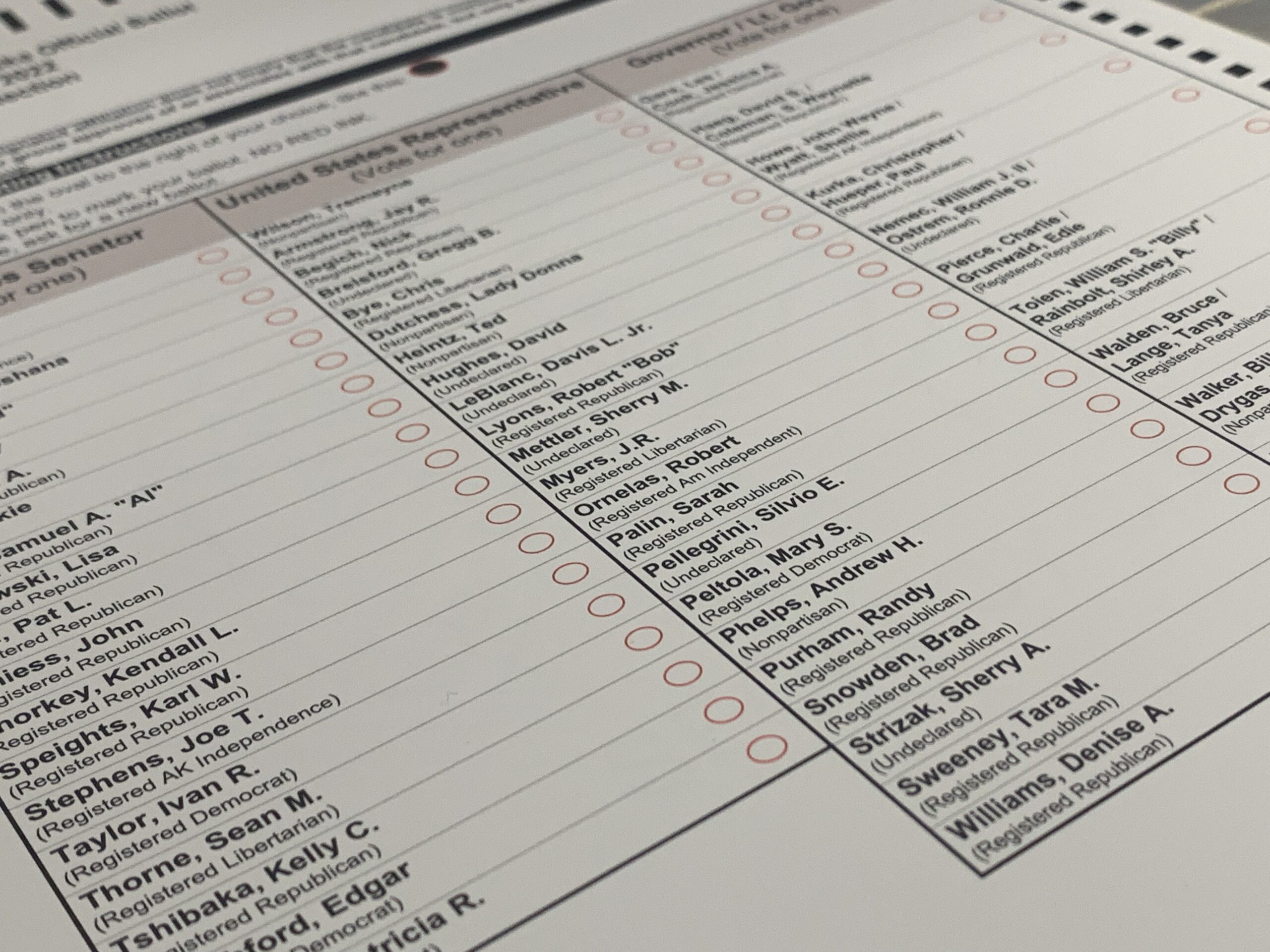
 Rachel Levy
Hello Alaska - Episode 007 - Awards Show

Roll out the red carpet, the 2026 Noble and Not-so-Noble Legislative Session Awards show is here!
Who’s the Best Senator in a Leading Role? The bill Most Likely to Succeed? The legislator Most Likely to Secede? The Biggest Pipeline Pig?
But first, we gotta talk more about this whole fast-evolving Dans Sullivan situation — and bring in a special guest who knows a thing or two about history repeating itself, Alaska historian David Reamer.
'You don't need any special legal training to smell a rat.' Legislators review justification for removing Dan J. Sullivan from the ballot
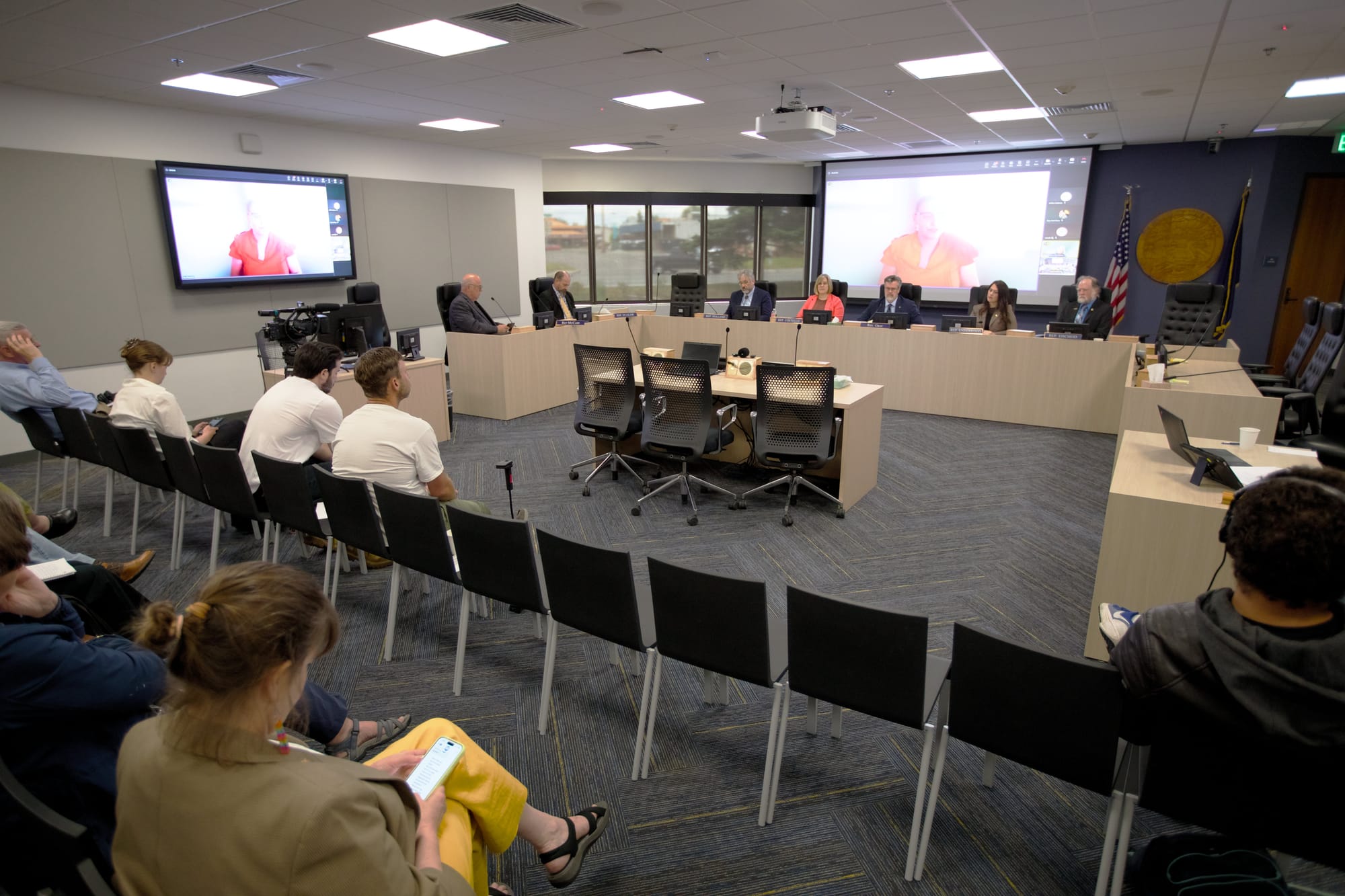
At Monday's joint hearing of the House State Affairs and Judiciary committees on the removal of Petersburg Sullivan, it was pretty clear that many Republicans had already accepted the narrative as true and the response warranted.
"There's evidence there that indicates that, in fact, this candidate, at least as far as the Division is concerned, was trying to mislead the voters," said Anchorage Republican Rep. Mia Costello, rattling off the same points that Beecher has argued prove some kind of fraud — the name, the party affiliation, his personal affiliations and his campaign design. "It's absolutely questionable why they exist that way."
And not only was Elections Director Carol Beecher justified in her removal of the Petersburg Sullivan, but Costello also frequently mused about transferring the case to the Department of Justice or the Federal Election Commission for penalties.
Her zeal for charges, however, was only shared by fellow die-hard Republicans.
As Petersburg Sullivan's lawsuit has laid out, there are no grounds for the Division of Elections to factor a candidate's motivations into determining whether they're qualified. And as several Democrats and legal experts pointed out, the regulations Costello claims are the legal pathway to removal are more about ballot design than candidate qualifications.
"That's direction to the Division of Elections, not to a candidate," Judiciary Committee Chair Rep. Andrew Gray said. "We're a free country, it's America. Run for office for your own personal reasons."
Rep. Ted Eischeid, an Anchorage Democrat, also added that his website is blue and gold, with many of the same motifs used by the Sullivans, because, after all, that's what's on Alaska's state flag.
While the Division of Elections didn't participate in the hearing — they threatened to sue the Legislature after the Legislature tried to compel their attendance with a subpoena — several legal experts with experience in Alaska's election laws questioned the justification for the removal. They all noted that there's no clear legal mechanism for removing someone, leaving the appearance that the Division of Elections acted unfairly.
"I don't think you would need any special legal training to smell a rat here," said former state senator Hollis French, an attorney. "If a prisoner with no ties to the state of Alaska in New York State can be put on the ballot for federal office in the state of Alaska, I think the division of elections is sort of foreclosed from then on, from engaging what they've engaged in this case."
Not about qualifications to hold office, but to run for office
And while Republicans seem to be convinced that there's a conspiracy afoot, their shifting legal justifications for the move seem to suggest they understand they're not exactly on stable legal footing. Big Lake Republican Rep. Kevin McCabe suggested that the case wasn't at all about the qualifications for holding office — which is laid out by the U.S. Constitution — but about the qualifications to run for office — which he argues can be left up to regulations.
"In this case, we aren't trying to determine whether or not Mr. Daniel J. Sullivan is qualified to hold the office or not," McCabe said. "What we're trying to determine is whether or not he is qualified to run for the office, or if the mere fact that he is using pretty much everything as Senator Daniel S. Sullivan — including the same color website, virtually the same name, is what Ms. Beecher relied upon — is the fact that it wasn't the constitutional requirements to hold the office, it was the (regulation) that parses out how he can run for the office."
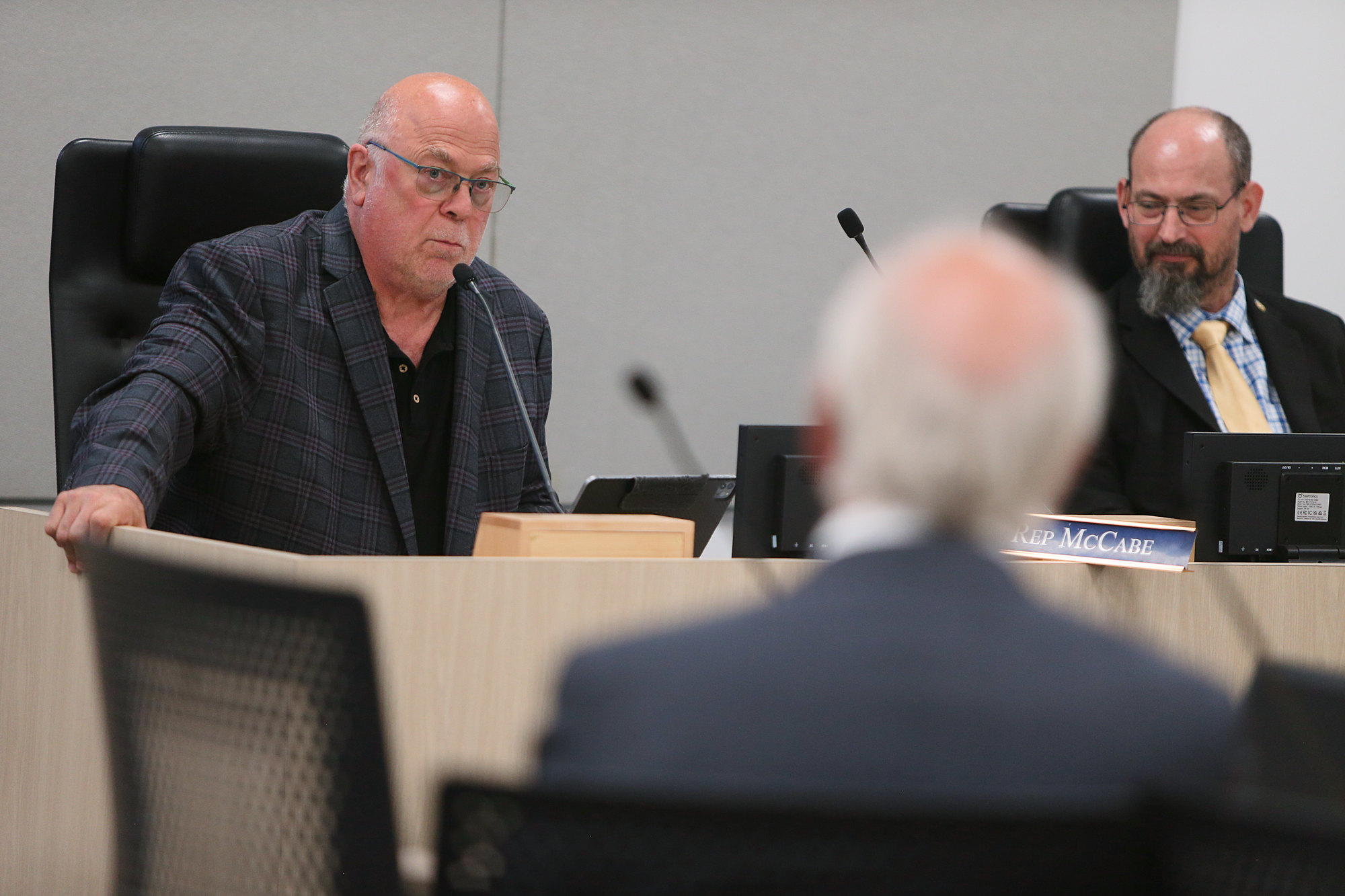
McCabe, it should be noted, often drew barely concealed contempt from the audience, with many of his questions punctuated by laughter or stage-whispered comments.
It's also worth pointing out that McCabe seemed to suggest that a legislative legal attorney who wrote an opinion on the case — Andrew Dunmire — broke some kind of professional code by criticizing the executive branch's work. Dunmire pointed out that there was no legal backing included in Beecher's letters, so he technically wasn't criticizing any lawyer's work.
Costello also echoed McCabe's legal reasoning, arguing that it's not a case about Petersburg Sullivan's qualifications to hold office but about his qualifications to run for office, which is why additional barriers can be imposed.
"I think we've established today the issue is not whether or not this individual is qualified to be on the ballot, and also I don't believe that motive has anything to do with it," she said. "I think it has to do with confusion of the voters, and we have established, by virtue of the fact that we're here, that it is confusing. ... It's not whether it's confusing, it is confusing, it's whether or not it was intentionally designed to be confusing."
And while there might not be any hard evidence that was the intent, Costello said there's enough circumstantial evidence to believe there is.
It's a point that was sharply rebutted by Rep. Gray, who noted that he didn't call the hearing out of any confusion about which Dan is which, but about whether the Division of Elections has the power to block someone from running.
"I do not believe we're here because of confusion that I'm here because I believe there's a case to be made that a qualified candidate was removed from the ballot, and that the division of elections did not have the authority to remove that person from the ballot," he said. "My reasoning is not to figure out the confusion, it's to ask the question: Did the Division of Elections have the authority to remove a qualified candidate from the ballot?"
Stay tuned.
Follow the thread: Monday's hearing

The Alaska Memo Newsletter
Join the newsletter to receive the latest updates in your inbox.