Alaska versus Outside
Outside: Anywhere that is not Alaska.

Hello, Alaska! It’s election day.
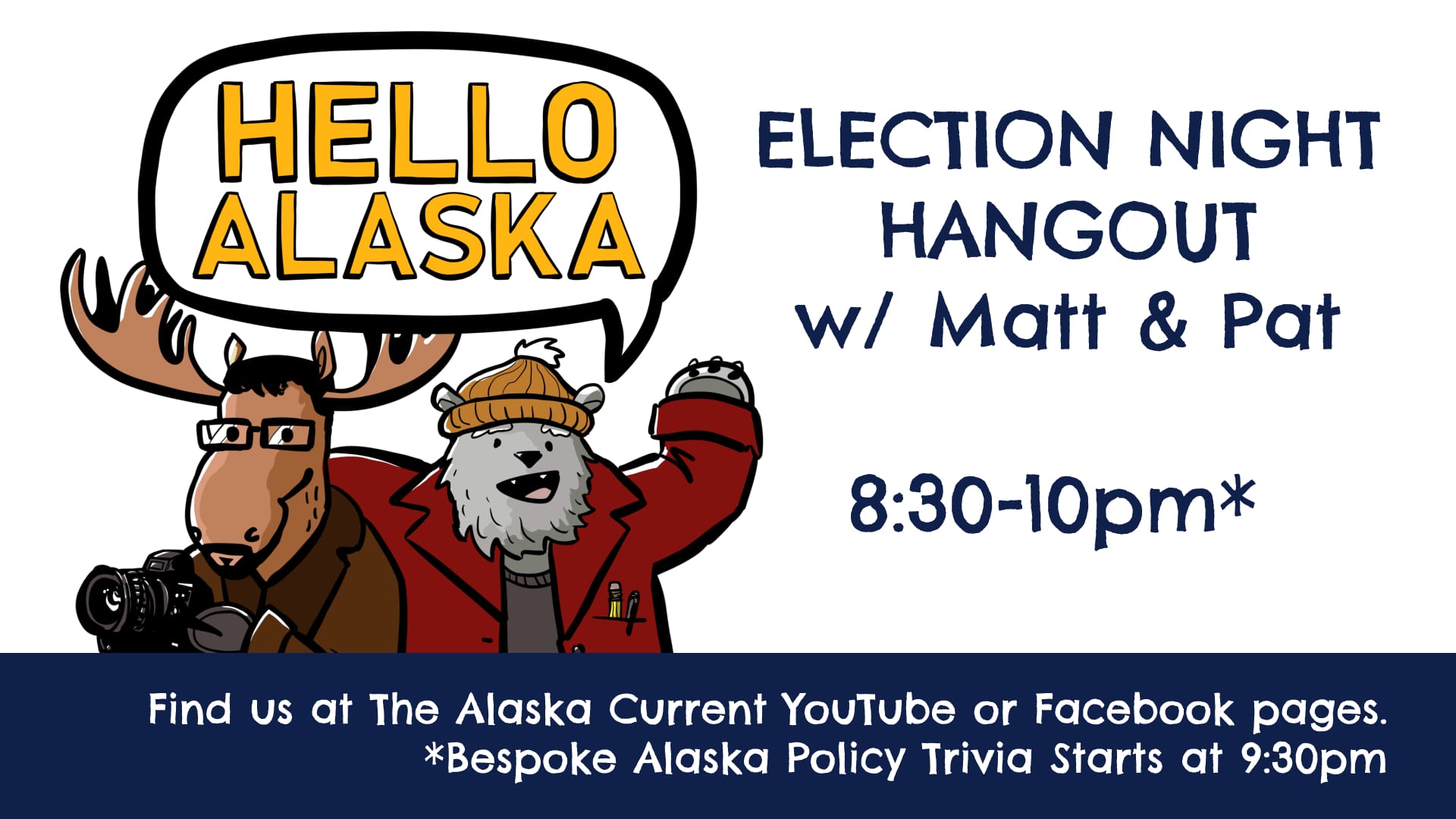
🎙️🎧 Livestream alert
It's been a wild and wacky election year, and it's that time of year when I look around and wonder where all the time went. I've been mad busy with the Alaska Current and recording the revamped Hello Alaska podcast with Pat Race, but I'm hopeful that once everything settles, I can really dig back into what I love the most: The wonkery that is the Alaska Legislature.
But if you want to catch up and see what we've been up to, Pat and I will be co-hosting a shoestring livestream tonight. Find it on YouTube and Facebook.
Alaska versus Outside
It’s been a madhouse of an election year with surprises packed into surprises packed into legally preposterous attempts by the President of the United States of America to challenge Alaska’s election results, followed up with frankly offensive accusations about the average Alaskan’s intelligence. And as we’ve tried to make sense of everything—whether the latest breathlessly reported New York Times hit on Mary Peltola will be the make-or-break issue in what is realistically a very close race—one thing I keep coming back to is this uniquely Alaska notion of Outside.
Outside: Anywhere that is not Alaska. Usually refers to the rest of the United States. No quotation marks. Can be descriptive or pejorative, depending on context. Avoid pejorative uses unless part of a quotation essential to the story.
The above definition comes from the second edition of The Associated Press’ Stylebook for Alaska, and it frankly encapsulates what I have loved so much in 15 years of covering Alaska—a land of leave me the hell alone, but call if you’re in a jam—for Alaskans. At the end of the day, living in Alaska has its challenges, but those of us who wouldn't have it any other way? We're in it together.
And it's one of the many reasons why, in my view, Alaskans have broadly shrugged off the revelations that Peltola—or, more specifically, people in her orbit—is perhaps not quite as squeaky clean as her carefully cultivated image suggests.
But to many Alaskans? The bad words frankly made her more human, and in the course of my reporting this fall, I've had sources condition talking with me by first asking whether I thought the New York Times' reporting was fair.
"Because if you had a problem with her language, then you'll have a problem with mine. I've got a potty mouth!"
And when it comes to the alleged ballot stacking, it's hard for us to muster outrage when we have spent years watching conservatives put their thumb on the scales in far more egregious ways—like how about that Republican who dropped out, clearing the table for Republican US Rep. Nick Begich, and immediately landed a gig with the Trump administration?
But in the big picture, there are simply more important issues to most Alaskans than whether a candidate offends the sensibilities of an Outside newspaper—especially one that plays here more as an institute of the elite than anything else. After all, Peltola replaced a guy who, lest we forget, once held a knife to the throat of the Speaker of the House, an exchange that was largely treated as a funny story.
And this focus on respectability politics—which so often leans into racist and misogynistic territory—misses that one of the biggest themes of this election is not the left versus right of it all, but the up versus down of modern politics.
For most Alaskans, the central issue that this election will ultimately hinge on has been largely unchanged for months: It's all about affordability, the price of gas, the tariffs, and the wars.
Those are boring issues, especially for an institution that seems written by and tailored to serve people who are comfortable enough to be largely unbothered by the price of gas, where the prestige that comes along with blowing up a candidate overrides the immediate, real-world fallout of two more years of Trump unfettered.
And it has been immensely funny to me to see Republicans like US Sen. Dan Sullivan—who is essentially the personification of the ownership class—gesticulate at the New York Times’ reporting, essentially going, “Don’t you stupid libs love the New York Times? Isn't this supposed to be a kiss of death?”
For all the ink spilled, not once in my work in the field have I heard a single voter mention the Sullivans or Peltola using bad words or anything about the husbandry of Meatball, the lizard whose care seemed oddly central to the New York Times' thesis that she's a bad boss with a questionable moral compass.
Instead, people like Alyssa Young, who works in a Head Start program and voted at an elementary school in East Anchorage this morning, said she's seen firsthand what a lack of compassion in the federal government means.
"The thing that's most important to me is just getting people in office that really care about people," she told me. "With our current administration, that doesn't seem to be the case, and I really just want change, positive change, but change especially for our young people and our Alaska Native communities."
Stay tuned, and don't get swept away.

The Alaska Memo Newsletter
Join the newsletter to receive the latest updates in your inbox.