Dan Sullivan disqualified for going by Dan, AKLNG bill clears the House
The state concedes no single thing is disqualifying about Petersburg Sullivan, just the narrative around him.


Hello, Alaska! It's Monday.
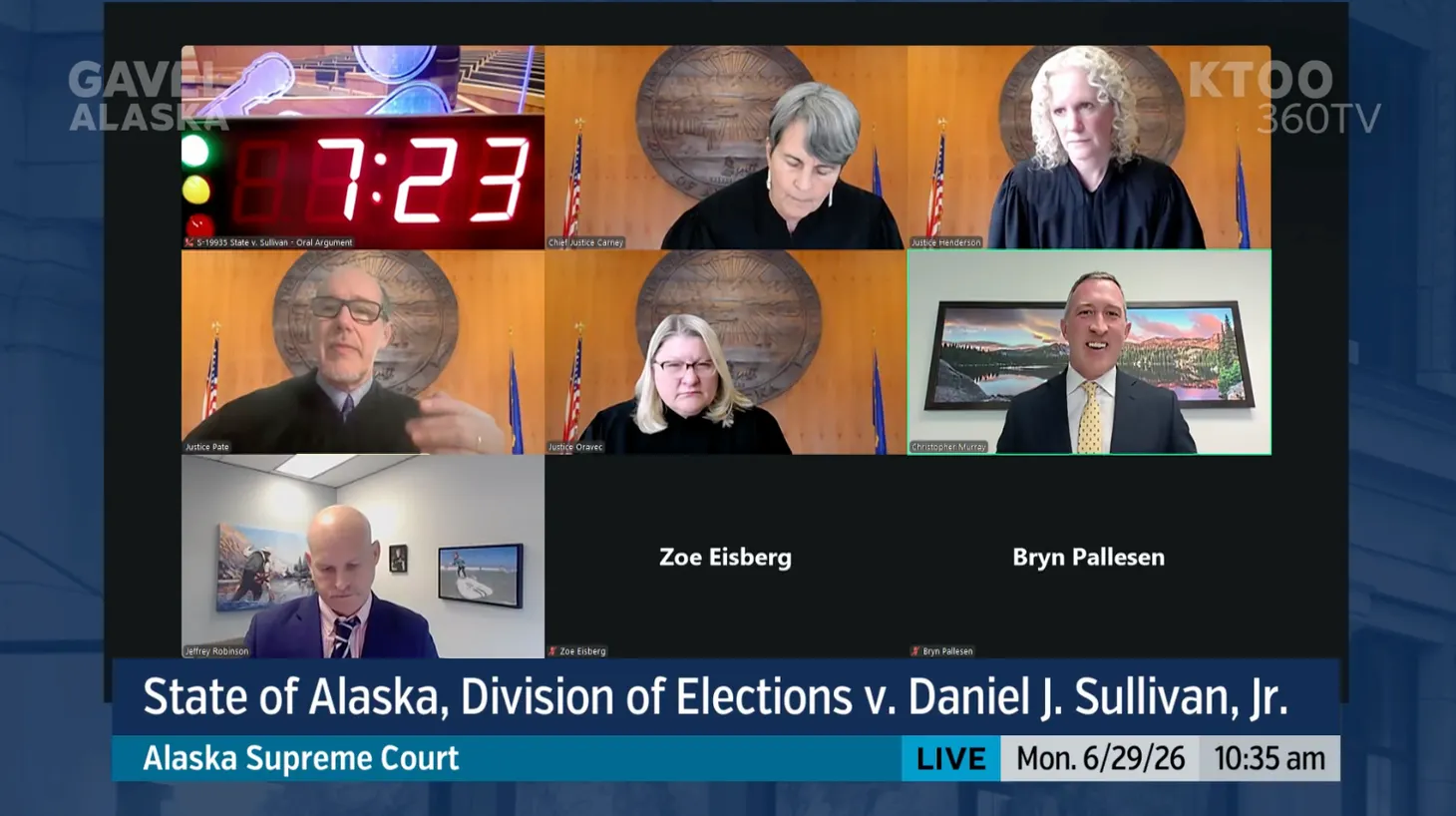
In this edition: Alaska Republicans are absolutely losing their minds over the Other Dan Sullivan, levying allegations of criminal wrongdoing that escalated last week when the Alaska Division of Elections launched an investigation to make sure Dan J. Sullivan is running for the right reasons. And, shocker, the Republicans in charge of the investigations decided he was not, in fact, running for the right reasons and have disqualified him, pointing to scandalous points like the fact that he never used the name "Dan" on his official voter registration. Meanwhile, there's a new episode of Hello Alaska out examining the governor's race and an update on the AKLNG special session after the bill cleared the House last week.
Current mood: 🤔
Something fun: Voting in The Hello Alaska 2026 Noble and Not-so-Noble Legislative Session Awards is now open!
Dan Sullivan going by 'Dan' is just the proof the Division of Elections needed to disqualify him

The Alaska Division of Elections, under the purview of Director Carol Beecher and Lt. Gov. Nancy Dahlstrom, has officially disqualified a Petersburg man named Dan Sullivan from running for office against Republican U.S. Sen. Dan Sullivan.
It'd be a shocking turn of events if it was just about anybody else involved in the race or the decision making — you have to wonder if there'd be such a mad dash to disqualify a Mary B. Peltola — but this outcome was pretty obvious the moment that Dahlstrom announced the launch of her investigation last week. From the outset, Sen. Sullivan, the Alaska Republican Party and the National Republican Senatorial Committee have screamed bloody murder over Petersburg Sullivan's entrance into the race, insisting that it must be the product of a vast criminal conspiracy by the allies of Democratic candidate Mary Peltola — who happens to be polling quite well against the increasingly unpopular Sen. Sullivan.
And it's a narrative that many seem to buy as self-evident. Petersburg Sullivan couldn't be motivated by, say, his own dissatisfaction with Sen. Sullivan.
“Everybody in Alaska knows I’m Dan Sullivan-R. So he’s trying to do that. Why?” the senator — who has been derisively called Ohio Dan long before Petersburg Sullivan got involved in the race —told reporters. "He’s not an R. He’s purposely trying to trick my constituents to rig the election for Peltola."
Of course, those are claims that Petersburg Sullivan and Peltola’s campaign flatly deny, and we haven't been presented with anything close to a smoking gun that actually proves a connection between the two campaigns. In an actual case of a ghost candidate designed to deceive voters, a Florida Republican was indicted because, among other things, he paid for the tuition of the ghost candidate's child.
Nothing near as that has surfaced in this case.
Instead, the evidence that Beecher cobbles together in her disqualification letter are pretty milquetoast and relies on several leaps in logic:
- Petersburg Sullivan has never used the name "Dan" on his voter filings with the state, which Beecher suggests is proof that he's trying to trick voters by going by Dan Sullivan now. (I also typically use my legal name on legal filings.)
- He requested to run as a Republican, which combined with use of the shortened version of Daniel "strongly suggests an intent to confuse yourself with the incumbent Senator." (On this point, Petersburg Sullivan noted he was a member of the now-defunct Alaskan Independence Party, and picked Republican because it most closely aligned with his political beliefs.)
- His campaign website and logos that use the Alaska flag's blue and gold with stars is too similar to Sen. Sullivan's website. Apparently, Sen. Sullivan has a monopoly on using the Alaska State Flag as a motif for campaigns.
- A political consultant worked with also sometimes works with Democrats (but mostly on progressive causes around healthcare and isn't a Democrat herself). While Beecher said that connection "is, in isolation innocuous," the combination of him not using his full legal name, running as a Republican and using the Alaska State Flag as inspiration for his campaign materials "suggests a determined effort" to deceive voters.
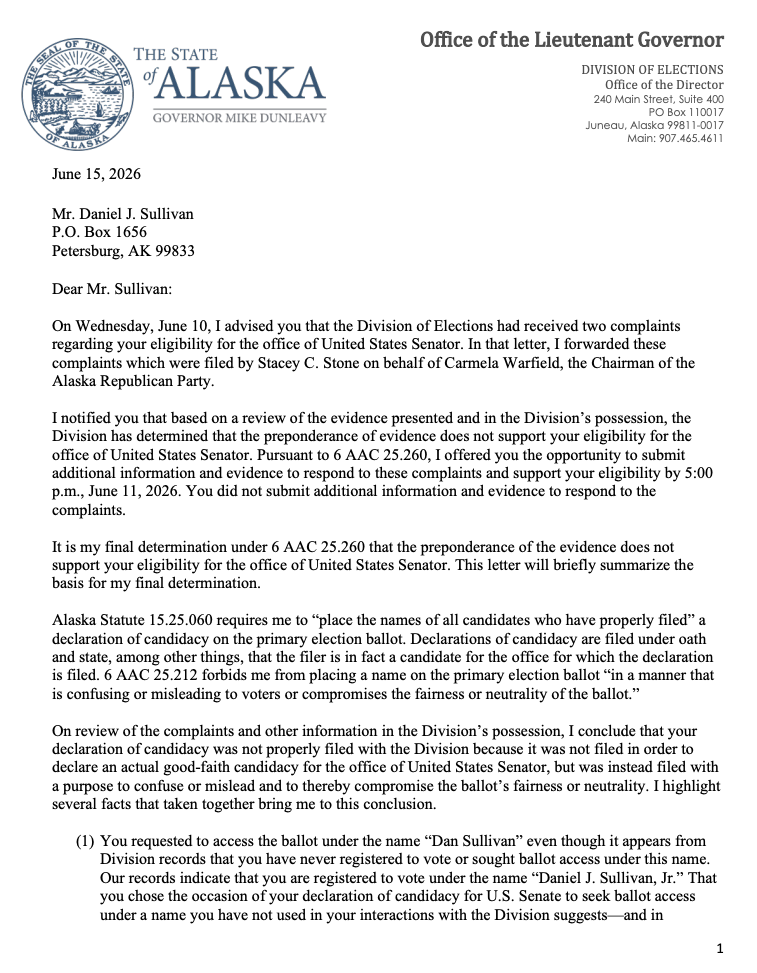
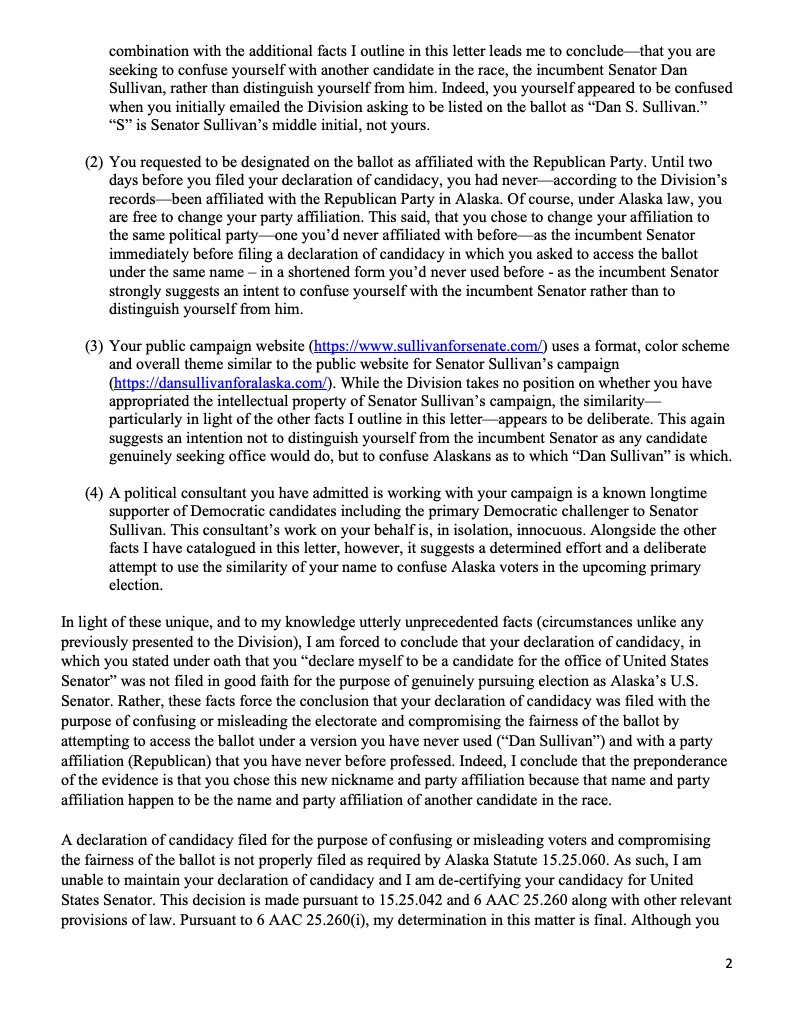
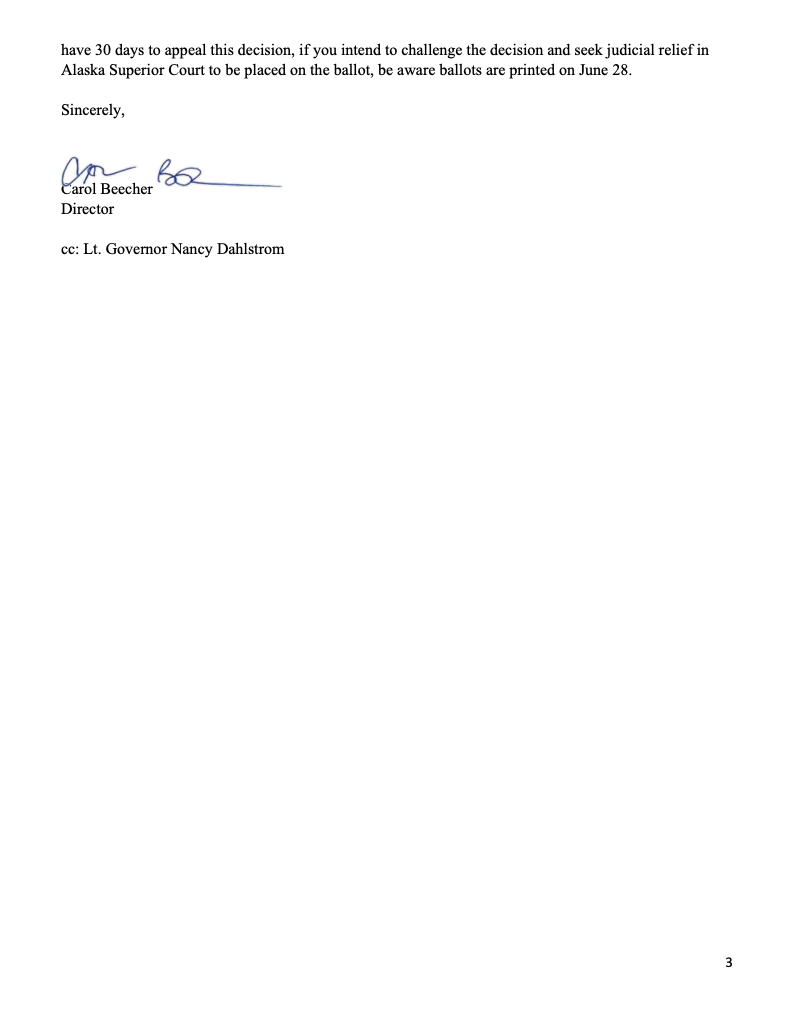
Beecher's letter disqualifying Petersburg Sullivan.
So, to be clear, the state's case is that none of the individual issues are, on their own, disqualifying. Instead, it's all the red yarn that Sen. Sullivan and his allies have supplied tying them all together that proves something untoward is afoot.
"These facts force the conclusion that your declaration of candidacy was filed with the purpose of confusing or misleading the electorate and compromising the fairness of the ballot by attempting to access the ballot under a version you have never used (“Dan Sullivan”) and with a party affiliation (Republican) that you have never before professed," Beecher wrote. "Indeed, I conclude that the preponderance of the evidence is that you chose this new nickname and party affiliation because that name and party affiliation happen to be the name and party affiliation of another candidate in the race."
Whether the string of circumstances actually "force the conclusion" Petersburg Sullivan must be disqualified is likely something that the courts will ultimately decide. It's a lot of inferences but without an explicit connection, it's hard to see how the courts would approve of such a drastic move of denying someone the ability to run for elected office.
It's also worth noting that the Division of Elections has the power to change the ballot design to help dispel any confusion. In one letter, the Division of Elections suggests listing Petersburg Sullivan as Daniel James Sullivan Jr, non-incumbent. Though not explicitly laid out in that communication, it suggests they might be planning on giving Sen. Sullivan an "incumbent" label, which may very well draw its own legal challenge.
Still, as for the apparent confusion, it should be noted that Alaska voters successfully wrote in “Murkowski” in 2010.
Thumbs on the scale

When I said this outcome wasn't particularly surprising it's because it wouldn’t be the first time that the Division of Elections under Lt. Gov. Nancy Dahlstrom has given a right-wing cause a boost.
In 2024, the Division of Elections gave the voter initiative seeking to repeal Alaska’s open primary and ranked choice voting system an opportunity to fix otherwise fatal errors, ensuring it reached the ballot. At the end of 2025, the Division also transferred the state’s confidential voter file to the Department of Justice. It was a move that incensed legislators, who ultimately rejected the attorney general who signed off on the decision, because it ran contrary to the state’s strong constitutional privacy protections. Advocates worry the information and corresponding agreement, which Alaska was one of the few states to fully agree to, could be used to suppress voting and fuel violent ICE activity.
In this year's elections, there's already brewing battles over whether the initiative language for the ballot is actually fair.
In the 2024 election, Dahlstrom also dropped out of the race for the U.S. House, allowing an imprisoned Democrat who had never visited Alaska to advance to the general election, where Republican Nick Begich ultimately defeated then-U.S. Rep. Mary Peltola.
At the time, Democrats sued over the elevation of the fifth-place candidate to the race, which some Dahlstrom apologists have used to argue the latest investigation is justified. But to be clear, while the Democrats were worried about Peltola being undercut, the core legal argument concerned the rules governing the filling of a general-election opening after a candidate withdraws from a primary.
Here, this is Dahlstrom and the Division of Elections — not a political party — attempting to divine whether Petersburg Sullivan is running for the right reasons. Is he even a Real Republican? Does he even go by Dan? Their concern doesn't appear to be so much about whether the letter of the law is being followed — because, by all accounts, he meets the standards to run — as about whether Sen. Sullivan is disadvantaged in this race.
And is that the job for the Division of Elections?
It's also worth pointing out that Republicans are also no strangers to the conduct they’re alleging. In 2021, a Florida Republican was charged after he was caught setting up a fake candidate with the same last name as a Democratic incumbent. Even in Alaska, the Anchorage Assembly races were marred by allegations that conservatives were behind a progressive candidate to siphon votes from a moderate in hopes of boosting the conservative. In that case, the evidence was even clearer with a well-known conservative operative serving as the progressive candidate’s campaign manager while also running an independent expenditure campaign boosting both the progressive and the conservative candidates.
But judging by the state of the race, Sen. Sullivan may need any boost he can get.
Sen. Sullivan’s popularity has tanked in Trump’s second term, with the Republican siding with the president on a litany of decisions that have harmed Alaskans, whether it be on healthcare, infrastructure development or general affordability. Sullivan has been a cheerleader of Trump’s costly and interminable war with Iran, which has driven energy prices soaring, and his refusal to immediately condemn Trump's legal payout fund, only waiting until it was dead to speak out against it, hasn't sat well with Alaskans, either. Polling consistently has suggested he could be in trouble in a head-to-head race with Peltola, so even a few percentage points could be the votes that matter.
In the latest Alaska Survey Research poll, Peltola had 49.4%, and Sullivan had 44.2%. Interestingly enough, longtime perennial candidate Dustin Darden — a guy who has run under the Republican, Democratic and now-defunct Alaskan Independence parties over just the last three election cycles, but has not drawn similar accusations of running for underhanded reasons — is polling at 2.7%.
For his part, Petersburg Sullivan said he wanted to bring attention to Sen. Sullivan's notorious aversion to meeting with potentially critical groups and the impacts his decisions have had on the state.
“I am running because I am tired of sitting back and watching our current Senator routinely fail to represent the interests of ordinary Alaskans like me,” Petersburg said in one response to the state's questions. “The fact that Senator Sullivan shares my first and last names adds insult to injury, motivating me to raise my hand as an alternative choice for Alaskans. Senator Sullivan and NRSC have no right to exclude me from the ballot simply because we happen to share a name."
Stay tuned.
Hello Alaska - Episode 006 - Gov Race VIBES

Episode 006 - Gov Race VIBES.
The filing deadline for governor has passed, and a sprawling slate of 17 candidates is off in the race to be Alaska's next governor. Never one to do things by the book, Matt shares a very video game-y primer on the field based on his very scientific system of the Votable Index Based Entirely on Science (AKA VIBES). Pat has thoughts, but luckily the VIBES tiers list is a living document. The guys also talk about the Dan Sullivan dust-up and set up a proper way to cap off the legislative session.
AKLNG bill advances out of the House, highlighting state's geographic divide
The AKLNG subsidy bill — cutting taxes on the long sought-after megaproject by about 85% for the next three decades — advanced out of the House on Friday on a 35 to 4 vote. While the finer points of the project are still out in the ether, the special session has brought some clarity to the project as well as a few concessions that helped win over many of the skeptical lawmakers. In-state gas prices are capped, the state's exposure to cost overruns is limited and the tax breaks are contingent on project labor agreements, direct payments to local communities to cover the impacts during construction and an agreement to build a spur line that would deliver natural gas into the Fairbanks area. For many of the chamber's progressive members, the bill still isn't perfect but it was a vast improvement over what the governor initially introduced.
"I wish that we had more of the information that we requested," said Rep. Andrew Gray, D-Anchorage. "I wish that we weren't kind of flying blind and just assuming good intentions from industry, but I do believe that the bill in front of us has important safeguards and is better than the previous bills that we have looked at."
As it's proposed, the cost of gas from the pipeline would be capped at $16 per MCF to in-state customers. That's higher than what folks in the Anchorage area are paying, but cheaper than what utilities expect the imported natural gas they'll need to replace flagging supplies of Cook Inlet will cost. The prices come down if and when facilities necessary to sell natural gas to potentially lucrative international markets come online, a decision that's separate from the pipeline itself. If those facilities are never built and the pipeline only ever serves in-state customers, it would require the state to triple its current natural gas demand to begin to see prices fall from the $16 figure to today's prices.
In the big picture, the project's economics are still on shaky ground. That's because the tax break – which replaces a 2% property tax with a tax based on the amount of gas that goes through the system — makes a far smaller impact on the project's underlying economics than, say, the cost of the project itself or the price of natural gas from North Slope producers. As several presentations over the three weeks of the special session show small changes to either of those factors could quickly erase any tax benefits, leaving the project struggling to be profitable.
 Matt Acuña Buxton
"To be sure, this bill does not guarantee a natural gas pipeline will be built, and I think the public and Alaskans need to understand this is not a guarantee, but this removes an important obstacle to that," said Eagle River Republican Rep. Dan Saddler. "A high tax on no pipeline gets you no money, a lower tax on a real pipeline gets you money as well as all the benefits."
Opposition to the bill was limited, with just a handful of lawmakers voicing concerns about the state giving up too much for too long. North Slope Rep. Robyn Frier said she still supported the project, but complained the tax break gave too much away on behalf of her community. Frier had pushed to give the North Slope Borough – which will be home to the costly carbon capture and removal facilities needed to treat North Slope gas before it's put into the pipeline — a stronger position in negotiating its alternative to property taxes.
"We are going cold in rural Alaska. And Just feel like we don't want to be on the table, we want to be at the table. We want the ability to negotiate," she said, when offering an amendment to restore that power, which was voted down.
It's a good reminder that attitudes about the 800-mile pipeline project connecting the North Slope to Southcentral Alaska vary greatly by each community.
Fairbanks, for example, is intent on securing a source of natural gas to replace far costlier trucked LNG and diesel. In an interview with me, Fairbanks North Star Borough Mayor Grier Hopkins stressed that any shot at securing a source of affordable natural gas for the Interior was critical, pointing to fast-escalating costs for heating oil and diesel-powered electrical generation. At one hearing, he said even $19 per MCF would be a big relief to Fairbanks, where gas rates are currently reaching toward $25 per MCF delivered to customers.
"For us in the borough, the revenue from the line is secondary," he told me. "I think there's legitimate questions for what the state should look at giving away in these taxes, in terms of transparency, in terms of jobs, in terms of being an equity stakeholder, and what that looks like, and what the language is becoming clearer in the House and Senate Finance Committees, but we need to be able to afford to live here. ... Making sure you know we're seeing the benefits of affordable gas is important, and what affordable means for Fairbanks is different than what affordable means for other parts of the state"
Anchorage, where gas has historically been more plentiful and affordable than Fairbanks, is anxious about flagging local gas supplies and is looking down the barrel of expensive imported LNG. For many of the Anchorage folks, the cap intended to keep gas cheaper than imported gas is a big win. The North Slope, meanwhile, has long benefited from collecting vast sums of taxes from some of the state’s most valuable oil and gas infrastructure and hasn't been particularly keen on watching the state sign away that money.
While the energy concerns and promises of economic growth ultimately won out in the House, the big hurdle for the legislation and the project has and remains to be the Senate Finance Committee, which has more lawmakers from rural and coastal communities that won’t see the direct benefits of piped natural gas anytime soon. Lawmakers have tried to thread that needle by designating some of the AKLNG revenue for affordable energy fund that'd ostensibly be aimed at helping rural communities grapple with their energy bills.
Whether that actually smooths things over will be seen this week as the Senate gets underway with the House version of the bill, but as Fairbanks Rep. Ashley Carrick said during the debate, the House bill was ultimately what was achievable under the current layout of the Legislature.
"As we've talked about this project as a generational investment and a generational historic opportunity, we always have to remember that we are, per constitution, meant to develop our resources for the maximum benefit of Alaskans," she said. "I believe that this legislation comes as close as we can, given all the political, the economic, and the social circumstances of our state and our various communities, to accomplishing that by providing the spur line and providing funding for the Affordable Energy Fund."
Stay tuned.

The Alaska Memo Newsletter
Join the newsletter to receive the latest updates in your inbox.