With no limits, deep-pocketed donors play an outsized role in shaping Alaska's elections
Just 2% of all contributions made to non-congressional candidates account for 52% of all the money they've raised.


Happy Friday, Alaska.
In this edition: More than $10 million is bouncing around in Alaska's non-congressional races. Let's unpack two big threads from the latest round of campaign contribution reports: The outsized role that wealthy donors are playing in Alaska's elections since contribution limits were struck down, and just what those reports can — or cannot — tell us about how candidates are spending those massive wads of cash. Also the reading list and weekend watching!
Current mood: 🤑
Something fun: A women's pro wrestling troupe in Fairbanks rings in 10 years of bodyslams and bruises
With no limits, deep-pocketed donors play an outsized role in shaping Alaska's elections

Candidates for Alaska's state offices have collectively raised more than $9.2 million from sources other than themselves, according to some rough crunching of the fundraising numbers released last week as part of the 30-day reports due to the Alaska Public Offices Commission. The reports, which cover fundraising from the start of the year through mid-July, are not only one of the best and first looks at how gubernatorial candidates are stacking up against each other with a month until a consequential primary election, but also a stark reminder of the impact that uncapped campaign contributions have had on Alaska's political races.
The 2026 election marks the third cycle that Alaska will be without any limits on what deep-pocketed donors can give directly to candidates. It's the end result of a 2021 ruling that struck down the old limits as too narrow, a decision that Gov. Mike Dunleavy — who had benefited greatly from well-endowed backers — was totally happy to let play out unchecked in the final years of his governorship.
Not only did Dunleavy decline to appeal the ruling, effectively abandoning the voters who approved the limits back in 2006, but he's opposed lawmakers' efforts to restore updated limits, culminating with this year's veto of HB16. That bill would have instated a $2,000-per-candidate, per-election-cycle limit, adjusted for inflation every ten years to satisfy the judge's concerns in the 2021 ruling.
Of course, voters will have the opportunity to enact those limits for future elections with Ballot Measure 1, which HB 16 was based on, on the Aug. 18 primary ballot. (Last time voters had the chance to vote on campaign finance limits, 73% said yes.)
But until then, wealthy donors haven't been shy to step up with five- or six-figure checks, far eclipsing the $500-per-candidate limit the courts struck down.
By my count, more than half of all the cash raised by candidates for the Alaska state Legislature and the governor's office came through contributions that wouldn't be legal if the limits in HB 16 had been law. And, just to be clear, I'm also ignoring any contributions that candidates gave to themselves, like the $1.25 million that Republican gubernatorial candidate Matt Heilala put into his run.
About $4.8 million of the $9.2 million candidates have raised has been given through a total of just under 600 contributions. Meaning that just 2% of the total contributions made to all non-congressional candidates account for 52% of all the money given to them this election cycle.
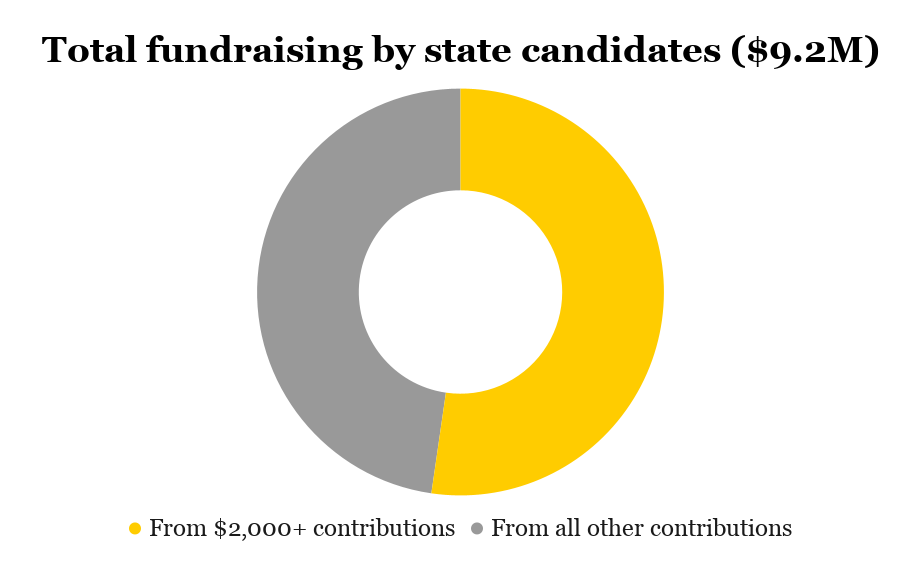
Meanwhile, the remaining 98% of the contributions fall under that proposed $2,000 limit. At an average of about $150, those 28,500 contributions come about $400,000 short of the total raised by big-ticket contributions.
So, to be clear, the big-ticket contributions — ones beyond the limit voters will almost assuredly approve on Aug. 18 — account for one out of every fifty contributions, but are responsible for pumping in more than half of all of the cash going to candidates for the Alaska Legislature and governor.
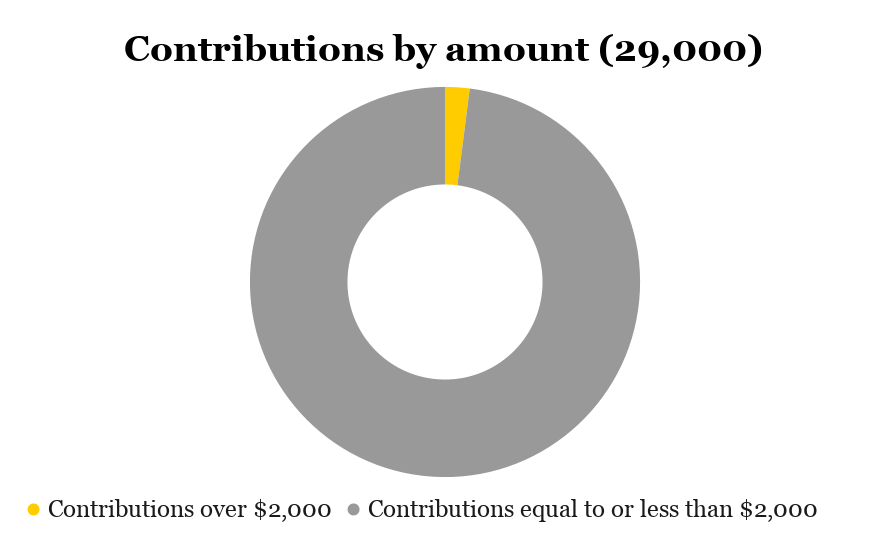
But, as my HS math teacher said, good enough for government work.
Why it matters
While money doesn't mean everything, it certainly makes a difference, especially for the candidates vying for one of the four spots on the November ballot for the governor's race, where a crowded 17-member field has made it difficult for any of the candidates to break away from the pack. No candidate has really gotten within reach of 20% in any of the recent polling, with most sitting in the low teens, meaning that a well-timed ad blitz could make the difference.
And at this stage of the race, where candidates are trying their best to make the case that they can win in November, cash can be a critical benchmark to determine whether it's worth continuing.
On the congressional side of things, money was one of the biggest reasons for Rev. Matt Schultz to drop out of the race. With the big players lining up behind independent candidate Bill Hill, Schultz told the Alaska Beacon it just didn't make sense for him to continue if the goal was to unseat Rep. Nick Begich III.
“One of the most disturbing things about the election process is how much … is determined by money, and I did not have a viable financial path forward,” he said. “If I had made it through the primary, which — I think there’s a real good chance I would have been the frontrunner — but I would not have had the financial war chest required to take on Nick Begich.”
Stay tuned.

Hello Alaska with Matt and Pat!

It's the most wonderful time of the year! Matt and Pat dive into the first good look at how the fundraising battle for Alaska's sprawling gubernatorial race is shaping up. Who raised the most? Who's gaining steam and who's petering out? And, most important, who bought the most candy for Parades?

Candy to consultants. Alaska’s campaign finance reports drill down to sweets, but can obscure the big ad buys.

Candidates running for Alaska’s state offices — the Alaska Legislature and governor — have spent more than $7.1 million ahead of the state’s primary election, including more than $10,000 alone on candy.
That’s according to the latest fundraising reports filed last week with the Alaska Public Offices Commission, covering each campaign’s income, expenses and debts from the start of the year through July 17. And while the reports give voters their first good look at the money behind the candidates running for state office — letting us figure out frontrunners and who’s funding them — the amount of detail each campaign actually shares about how it’s spending that money varies wildly.
On one end of the spectrum, reports drill down into the minutiae of campaign expenses, like spending on candy ($10,503.12), food ($82,346.07), signs ($318,999.75), wood for signs ($1,236.84) and stickers ($24,485.81). You can see that candidates spent $39 on a nametag from Bovey Trophies in Anchorage, $70.95 on buttons from an online retailer or $3,628.80 for production of an ad that ran during the Super Bowl.
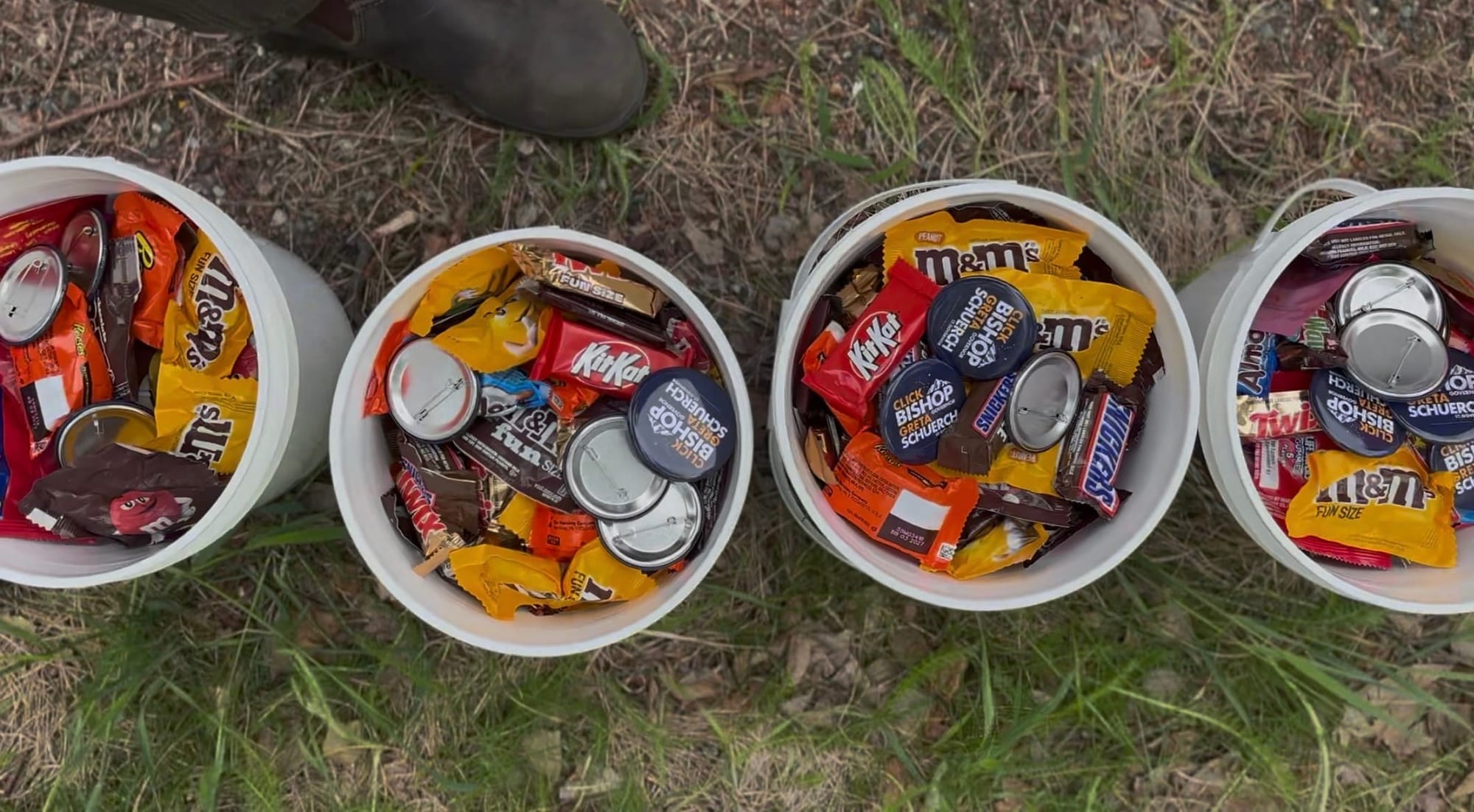
Dig through the reports enough, and you’ll see Alaska’s top spender on candy is moderate, labor-friendly Republican Click Bishop, a former state legislator among the 17 candidates running for governor. He’s spent $3,220.74 on candy purchases for parades, mostly from Costco, according to reports filed with the Alaska Public Offices Commission last week, which is nearly a third of all candy bought for campaign purposes this cycle.
Unfortunately, far more money is spent to influence Alaska’s elections that isn’t captured with that kind of detail.
Instead, several campaigns effectively masked much of their spending by listing their big expenses, especially media buys and campaign management. According to our analysis, campaigns have spent $2.6 million on television, radio and other advertising, a little more than $1 million on consultants and somewhere in the neighborhood of $450,000 on printing and mailing.
Details on each of those vary from campaign to campaign, with many breaking down where ads were actually placed.
Others, however, boiled it down to a few, vague sentences.
That was the case for the single largest expenditure of the campaign cycle, $400,000 that Republican gubernatorial candidate Matt Heilala — a doctor who has largely self-funded his campaign — spent with Alaska-based Brilliant Media for “Media Consulting, Production, and Placement.” It doesn’t include any mention of what kind of media was produced, where it was placed and who, along the way, made a profit from Heilala’s spending.
He’s far from alone on that front.
Several candidates reported their media buys as a single, large lump sum.
Some seem to be placeholders. For example, Jonathan Kreiss-Tomkins, who leads in overall fundraising, has a $239,296.00 expense listed to C+K with the purpose listed as “Media Buy – need details.” And former Alaska Attorney General Treg Taylor — who previously asked to hide details about his rental properties from disclosure — has a $39,907.00 spend at Anchorage-based Blayde Communications listed with a purpose of “TBA.”
Others offer middling detail, like Taylor’s $9,800 he spent with Ohio-based FlexPoint Campaigns for the placement of a TV ad during the World Cup on July 1 and July 3.
And it’s not just this year. In fact, specificity has been a growing issue before Alaska campaign finance regulators, who’ve been fielding more and more complaints that candidates’ reports lack the details needed to keep up with the state’s disclosure laws.
“There has actually been quite a bit of scrutiny over this particular question in response to a host of complaints that were filed over the past two years,” said APOC Executive Director Heather Hebdon via email. “Essentially, there is a heightened disclosure requirement for expenditures related to advertising and consulting.”
A 2025 complaint against Rep. Kevin McCabe stands as one of the first times the APOC commissioners dealt with the issue head-on, dinging the Big Lake Republican for reporting his ad buys without enough detail, landing him with a $3,200 civil penalty for four violations. In that case, it was less than $21,000 spent with descriptions like “graphics, digital advertising,” “digital ad” or “digital ads.”
“‘Digital ad’ or ‘’digital ads,” without more, provides insufficient detail on ‘all services rendered’ by an advertising or consulting agency,” the APOC order explained. “This description does not indicate whether (the vendor) created the ads, directly distributed them, arranged placement on another entity’s website or app, or provided some combination of these services.”
Hebdon said that for most expenditures like printing, signs, staff time and candy, a stated purpose is sufficient detail to meet the disclosure rules, but more details are needed with more complicated and multi-faceted expenditures to advertising agencies and consultants, especially when they may be subcontracting out for significant sums of money.
“Ideally this would give the public an idea of how the expenditure relates to campaign activities. For your general expenditures, the regulations simply require a purpose for the expenditure,” she explained, “But for expenditures to advertising agencies or vendors that provide consulting and management services, the expenditure requires a more comprehensive explanation to detail all services rendered, including media placement and subcontractors.”
For Heilala’s part, he’s filed an amendment to his initial report.
According to that amendment, of his $400,000 media spend that was originally reported as "Media Consulting, Production, and Placement," $220,000 was spent with ad-placing company Simplifi Holdings, another $160,000 was spent on digital media between Meta, YouTube and Google, and $20,000 at Facebook. His $100,000 spend at Hackney Communications that was originally reported as "Communications Consulting, Production, and Placement" gives a far better breakdown, with an itemized report of the consulting cost, media production placement on various radio stations, podcasts and advertising on two news blogs at $1,750 apiece.
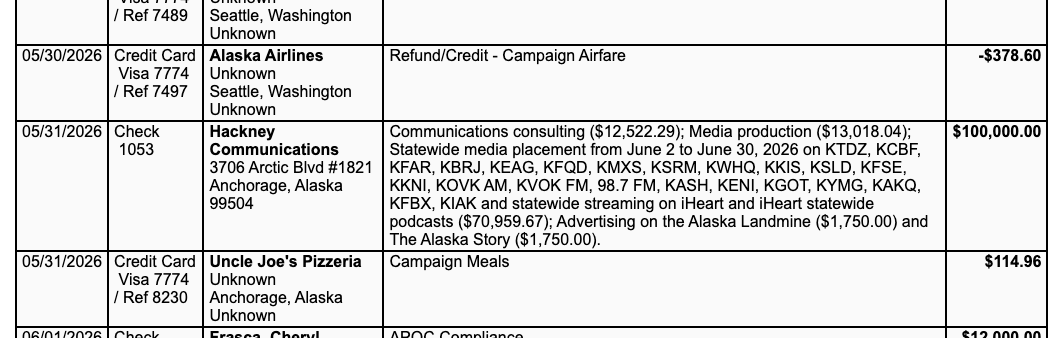
Whether that’s sufficient detail will likely depend on whether someone has the time and know-how to make it an issue by filing a complaint.
While APOC offers compliance training and has staff to answer questions as they come up, fines and penalties are typically driven by complaints. That’s in large part because the agency has been infamously underfunded, and the lawmakers responsible for overseeing its budget are often on the receiving end of the fines.
But want to know what kind of candy a campaign handed out?
You’ll have to ask a campaign manager.
“We always buy variety packs because you never know what someone’s favorite candy is,” said Bishop campaign manager Shannon Mason in an email accompanied by pictures of mini chocolates in buckets to be handed out at parades. “In a way, that’s a lot like our campaign—we’re focused on bringing people together and working with everyone, no matter their preferences. There’s something for everyone.”

This story was edited with help from Victoria Petersen and The Alaska Current. Everything else is mine, including the typoes.
More from The Current
 Emily Mesner
 Matt Acuña Buxton
 Holly Todd

The Reading List
 Colleen Mondor
 James Brooks
 Bella Biondini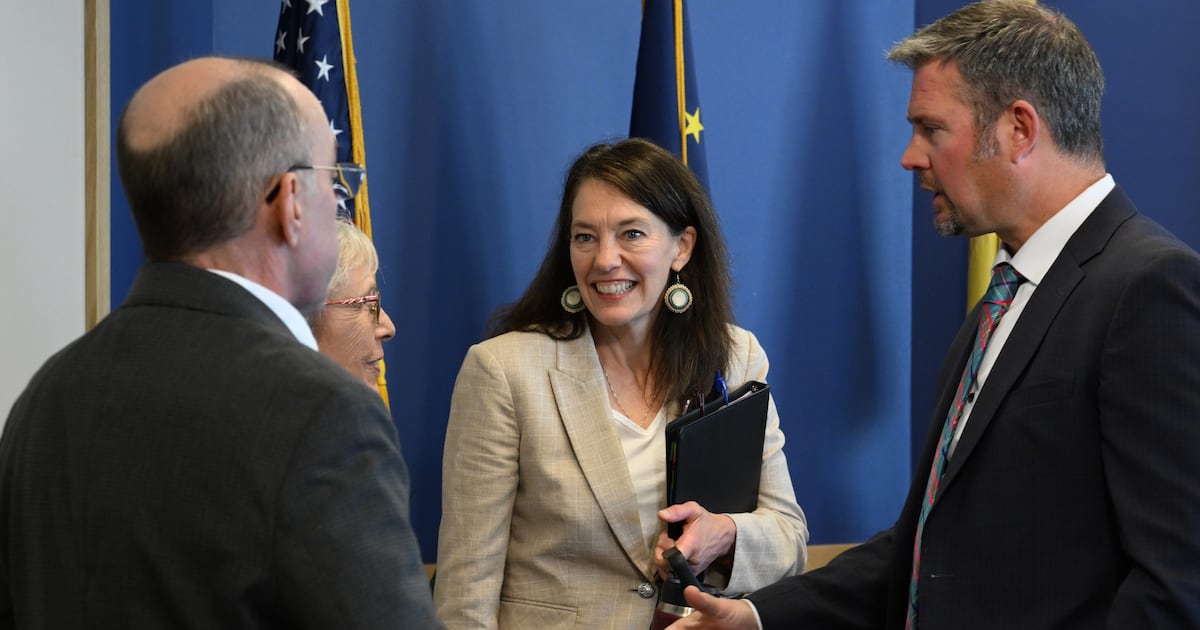
 Corinne Smith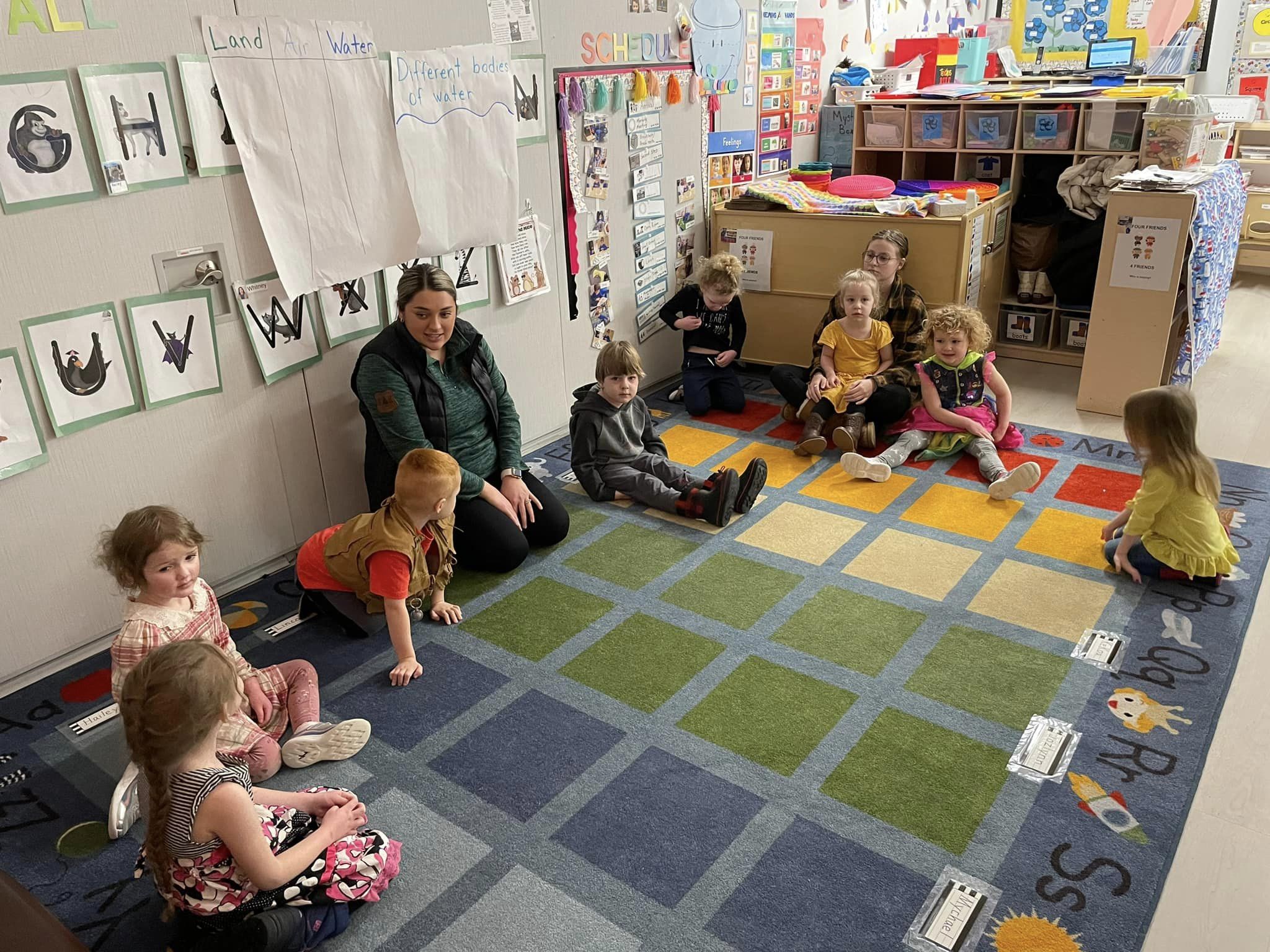
 Katherine Irving, KMXT
 James Brooks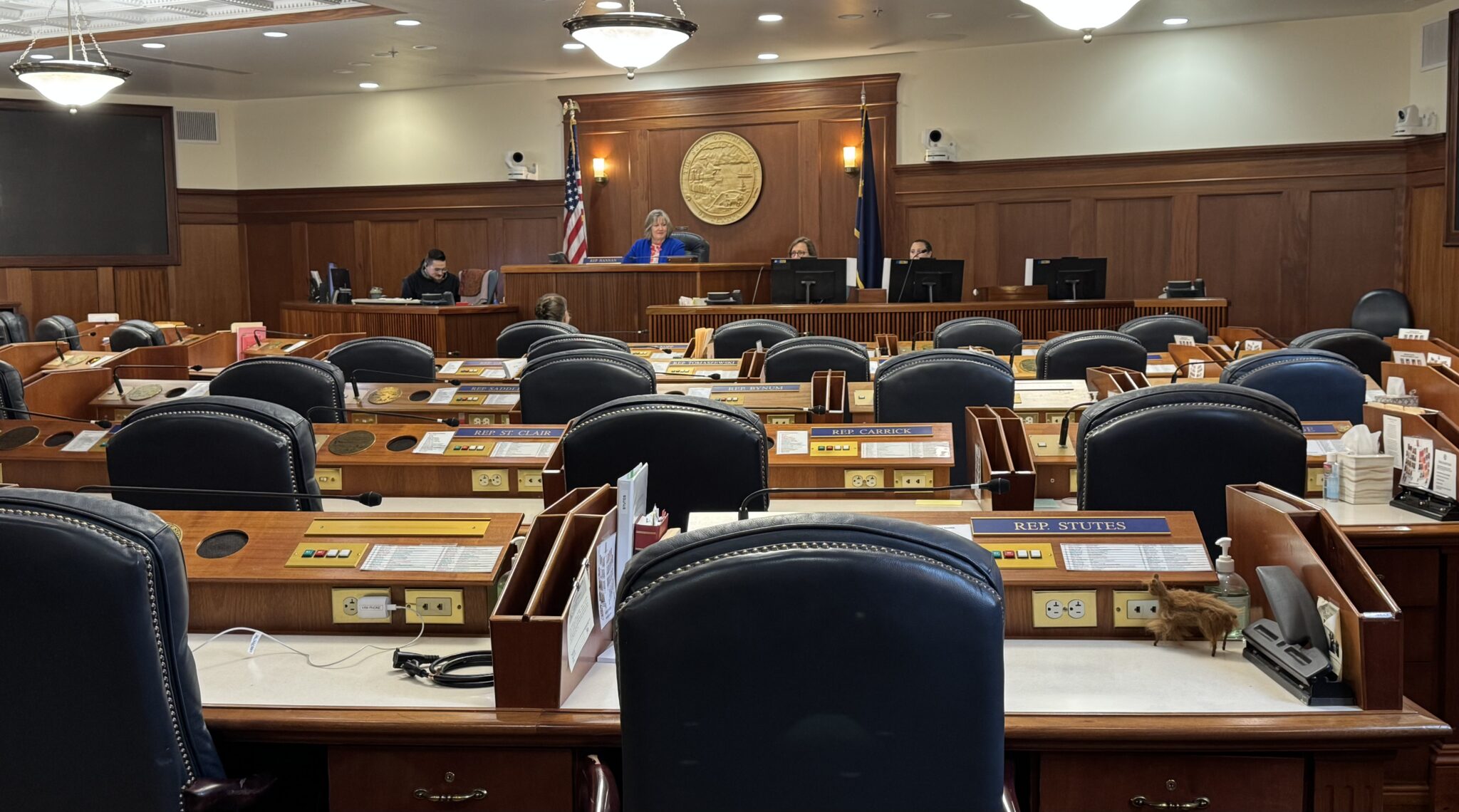
Weekend watching
While the weather is gorgeous once again, I have been thoroughly enjoying Anchorage's damp July playing through video games with pals. And now, more than ever, is it a great time to play games with pals. Here's a surprisingly interesting and informative look at the emerging genre of "friendslop" games.
Have a nice weekend, y'all.

The Alaska Memo Newsletter
Join the newsletter to receive the latest updates in your inbox.